In this course, students will learn about plasmas, the fourth state of …
In this course, students will learn about plasmas, the fourth state of matter. The plasma state dominates the visible universe, and is of increasing economic importance. Plasmas behave in lots of interesting and sometimes unexpected ways. The course is intended only as a first plasma physics course, but includes critical concepts needed for a foundation for further study. A solid undergraduate background in classical physics, electromagnetic theory including Maxwell's equations, and mathematical familiarity with partial differential equations and complex analysis are prerequisites. The course introduces plasma phenomena relevant to energy generation by controlled thermonuclear fusion and to astrophysics, coulomb collisions and transport processes, motion of charged particles in magnetic fields, plasma confinement schemes, MHD models, simple equilibrium and stability analysis. It also covers two-fluid hydrodynamic plasma models, wave propagation in a magnetic field, kinetic theory, Vlasov plasma model, electron plasma waves and Landau damping, ion-acoustic waves, and streaming instabilities. A subject description tailored to fit the background and interests of the attending students is distributed shortly before and at the beginning of the subject.
The plasma state dominates the visible universe, and is important in fields …
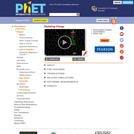
The plasma state dominates the visible universe, and is important in fields as diverse as Astrophysics and Controlled Fusion. Plasma is often referred to as "the fourth state of matter." This course introduces the study of the nature and behavior of plasma. A variety of models to describe plasma behavior are presented.
This is a quiz designed to accompany the online simulation "Wave on …
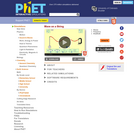
This is a quiz designed to accompany the online simulation "Wave on a String," which is part of the PhET Interactive Simulations of the University of Colorado Boulder.The quiz was designed for Canvas. Each question includes instructions for an action the student is to complete in the online simulation, followed by a multiple choice question.
The electric field lines from a point charge evolve in time as …
The electric field lines from a point charge evolve in time as the charge moves. Watch radiation propagate outward at the speed of light as you wiggle the charge. Stop a moving charge to see bremsstrahlung (braking) radiation. Explore the radiation patterns as the charge moves with sinusoidal, circular, or linear motion. You can move the charge any way you like, as long as you don���������t exceed the speed of light.
Broadcast radio waves from KPhET. Wiggle the transmitter electron manually or have …
Broadcast radio waves from KPhET. Wiggle the transmitter electron manually or have it oscillate automatically. Display the field as a curve or vectors. The strip chart shows the electron positions at the transmitter and at the receiver.
Broadcast radio waves from KPhET. Wiggle the transmitter electron manually or have …
Broadcast radio waves from KPhET. Wiggle the transmitter electron manually or have it oscillate automatically. Display the field as a curve or vectors. The strip chart shows the electron positions at the transmitter and at the receiver.
Watch a string vibrate in slow motion. Wiggle the end of the …
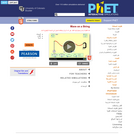
Watch a string vibrate in slow motion. Wiggle the end of the string and make waves, or adjust the frequency and amplitude of an oscillator. Adjust the damping and tension. The end can be fixed, loose, or open.
Watch a string vibrate in slow motion. Wiggle the end of the …
Watch a string vibrate in slow motion. Wiggle the end of the string and make waves, or adjust the frequency and amplitude of an oscillator. Adjust the damping and tension. The end can be fixed, loose, or open.
No restrictions on your remixing, redistributing, or making derivative works. Give credit to the author, as required.
Your remixing, redistributing, or making derivatives works comes with some restrictions, including how it is shared.
Your redistributing comes with some restrictions. Do not remix or make derivative works.
Most restrictive license type. Prohibits most uses, sharing, and any changes.
Copyrighted materials, available under Fair Use and the TEACH Act for US-based educators, or other custom arrangements. Go to the resource provider to see their individual restrictions.