The Open Science movement is rapidly changing the scientific landscape. Because exact …
The Open Science movement is rapidly changing the scientific landscape. Because exact definitions are often lacking and reforms are constantly evolving, accessible guides to open science are needed. This paper provides an introduction to open science and related reforms in the form of an annotated reading list of seven peer-reviewed articles, following the format of Etz et al. (2018). Written for researchers and students - particularly in psychological science - it highlights and introduces seven topics: understanding open science; open access; open data, materials, and code; reproducible analyses; preregistration and registered reports; replication research; and teaching open science. For each topic, we provide a detailed summary of one particularly informative and actionable article and suggest several further resources. Supporting a broader understanding of open science issues, this overview should enable researchers to engage with, improve, and implement current open, transparent, reproducible, replicable, and cumulative scientific practices.
The National Center on Accessible Instructional Materials and PACER Center are pleased …
The National Center on Accessible Instructional Materials and PACER Center are pleased to announce the release of our new video explaining Accessible Instruc...
This course is about the electronic properties of materials and contains lectures …
This course is about the electronic properties of materials and contains lectures about scattering, transport in metals, phonons and superconductivity.
Students experiment with a new materialâaerogel. Aerogel is a synthetic (human-made) porous …
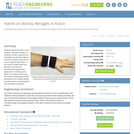
Students experiment with a new materialâaerogel. Aerogel is a synthetic (human-made) porous ultra-light (low-density) material, in which the liquid component of a gel is replaced with a gas. In this activity, student pairs use aerogel to simulate the environmental engineering application of cleaning up oil spills. In a simple and fun way, this activity incorporates density calculations, the material effects of surface area, and hydrophobic and hydrophilic properties.
Do you need proof that driving is a dangerous activity? More Americans …
Do you need proof that driving is a dangerous activity? More Americans have died in car crashes over the past 100 years than in all the wars the U.S. has ever fought combined. More than 40,000 Americans die each year on the nation's highways, most as the result of high-speed collisions. In this video segment adapted from NOVA, learn how engineers developed the air bag, an important automobile-safety device now found in most cars. Recommended for: Grades 3-12
Students define and classify alloys as mixtures, while comparing and contrasting the …
Students define and classify alloys as mixtures, while comparing and contrasting the properties of alloys to those of pure substances. Students learn that engineers investigate the structures and properties of alloys for biomedical and transportation applications. Pre- and post-assessment handouts are provided.
Acting as engineering teams, students take measurements and make calculations to determine …
Acting as engineering teams, students take measurements and make calculations to determine the specific strength of various alloys and then report their data to the rest of the class. Using this class data, students write data-based recommendations to NASA regarding the best alloy to use in the construction of the engine and engine turbines for the Space Launch System that will eventually be used to transport astronauts to Mars.
Aerogel, commonly called "frozen smoke," is a super-material with some amazing properties. …
Aerogel, commonly called "frozen smoke," is a super-material with some amazing properties. In this lesson and its associated activity, students learn about this silicon-based solid with a sponge-like structure. Students also learn about density and how aerogel is 99.8% air by volume, making it the lightest solid known to humans! Further, students learn about basic heat transfer and how aerogel is a great thermal insulator, having 39 times more insulation than the best fiberglass insulation. Students also learn about the wide array of aerogel applications.
An analysis of historical structures is presented themed sections based around construction …
An analysis of historical structures is presented themed sections based around construction materials. Structures from all periods of history are analyzed. The goal of the class is to provide an understanding of the preservation of historic structures for all students.
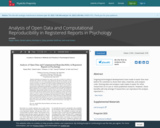
Ongoing technological developments have made it easier than ever before for scientists …
Ongoing technological developments have made it easier than ever before for scientists to share their data, materials, and analysis code. Sharing data and analysis code makes it easier for other researchers to re-use or check published research. These benefits will only emerge if researchers can reproduce the analysis reported in published articles, and if data is annotated well enough so that it is clear what all variables mean. Because most researchers have not been trained in computational reproducibility, it is important to evaluate current practices to identify practices that can be improved. We examined data and code sharing, as well as computational reproducibility of the main results, without contacting the original authors, for Registered Reports published in the psychological literature between 2014 and 2018. Of the 62 articles that met our inclusion criteria, data was available for 40 articles, and analysis scripts for 37 articles. For the 35 articles that shared both data and code and performed analyses in SPSS, R, Python, MATLAB, or JASP, we could run the scripts for 31 articles, and reproduce the main results for 20 articles. Although the articles that shared both data and code (35 out of 62, or 56%) and articles that could be computationally reproduced (20 out of 35, or 57%) was relatively high compared to other studies, there is clear room for improvement. We provide practical recommendations based on our observations, and link to examples of good research practices in the papers we reproduced.
This studio will investigate the social, programmatic, tectonic and phenomenological performance and …
This studio will investigate the social, programmatic, tectonic and phenomenological performance and character of a student gathering place on the MIT campus. Whether it is simply for socializing or for more specific events, the student gathering place will serve as a refuge from the vigorous educational environment of the Institute, and it will reinforce a critical sense of "place" through the almost logical organization of its program. The place will foster a casual discovery of "being": a reflection upon the student's own existence based upon participation in group events and an intellectual attitude toward acting. To create a space that inspires, rather than imposes: such a discovery is the foremost challenge of this studio.
The theme that unites the Level II studios in the fall semester …
The theme that unites the Level II studios in the fall semester is a focus upon the 'making of architecture and built form' as a tectonic, technical and materially driven endeavor. It is a design investigation that is rooted in a larger culture of materiality and the associated phenomena, but a study of the language and production of built form as an integrated response to the conceptual proposition of the project. The studio will look to works of architecture where the material tectonic and its resultant technology or fabrication become instrumental to the realization of the ideas, in whatever form they may take. This becomes the 'art of technology' -- suggesting a level of innovation and creative manipulation as part of the design process to transform material into a composition of beauty and poetry as well as environmental control. In this regard the studio will look to the works and design processes of a number of architects including Shigeru Ban, Peter Zumthor, Herzog and deMeuron, Kazuyo Sejima, Richard Horden, Rick Joy and Glenn Murcutt among others.
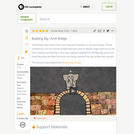
This semester students are asked to transform the Hereshoff Museum in Bristol, …
This semester students are asked to transform the Hereshoff Museum in Bristol, Rhode Island, through processes of erasure and addition. Hereshoff Manufacturing was recognized as one of the premier builders of America's Cup racing boats between 1890's and 1930's. The studio, however, is about more than the program. It is about land, water, and wind and the search for expressing materially and tectonically the relationships between these principle conditions. That is, where the land is primarily about stasis (docking, anchoring and referencing our locus), water's fluidity holds the latent promise of movement and freedom. Movement is activated by wind, allowing for negotiating the relationship between water and land.
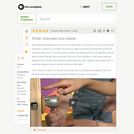
The engineering design process involves many steps. Not only must an engineer …
The engineering design process involves many steps. Not only must an engineer be able to devise a solution to a problem, he or she must also be ready to test and evaluate that solution to reach the best result. To successfully complete the design process, an engineer must be able to identify design flaws and learn from his or her mistakes. In this video segment adapted from ZOOM, learn about the design process as cast members create automatic door openers that enable them to open their bedroom doors while lying on their beds. For grades 3-8.
Scientific data and tools should, as much as possible, be free as …
Scientific data and tools should, as much as possible, be free as in beer and free as in freedom. The vast majority of science today is paid for by taxpayer-funded grants; at the same time, the incredible successes of science are strong evidence for the benefit of collaboration in knowledgable pursuits. Within the scientific academy, sharing of expertise, data, tools, etc. is prolific, but only recently with the rise of the Open Access movement has this sharing come to embrace the public. Even though most research data is never shared, both the public and even scientists in their own fields are often unaware of just much data, tools, and other resources are made freely available for analysis! This list is a small attempt at bringing light to data repositories and computational science tools that are often siloed according to each scientific discipline, in the hopes of spurring along both public and professional contributions to science.
Students explore the properties of composites using inexpensive materials and processing techniques. …
Students explore the properties of composites using inexpensive materials and processing techniques. They create beams using Laffy Taffy and water, and a choice of various reinforcements (pasta, rice, candies) and fabricating temperatures. Student groups compete for the highest strength beam. They measure flexure strength with three-point bend tests and calculations. Results are compared and discussed to learn how different materials and reinforcement shapes affect material properties and performance.
Lighting is responsible for nearly one-third of the electricity use in buildings. …
Lighting is responsible for nearly one-third of the electricity use in buildings. One of the best ways to conserve energy is to make sure the lights are turned off when no one is in a room. This process can be automated using motion sensors. In this activity, students explore material properties as they relate to motion detection, and use that knowledge to make design judgments about what types of motion detectors to use in specific applications.
Experienced Registered Reports editors and reviewers come together to discuss the format …
Experienced Registered Reports editors and reviewers come together to discuss the format and best practices for handling submissions. The panelists also share insights into what editors are looking for from reviewers as well as practical guidelines for writing a Registered Report. ABOUT THE PANELISTS: Chris Chambers | Chris is a professor of cognitive neuroscience at Cardiff University, Chair of the Registered Reports Committee supported by the Center for Open Science, and one of the founders of Registered Reports. He has helped establish the Registered Reports format for over a dozen journals. Anastasia Kiyonaga | Anastasia is a cognitive neuroscientist who uses converging behavioral, brain stimulation, and neuroimaging methods to probe memory and attention processes. She is currently a postdoctoral researcher with Mark D'Esposito in the Helen Wills Neuroscience Institute at the University of California, Berkeley. Before coming to Berkeley, she received her Ph.D. with Tobias Egner in the Duke Center for Cognitive Neuroscience. She will be an Assistant Professor in the Department of Cognitive Science at UC San Diego starting January, 2020. Jason Scimeca | Jason is a cognitive neuroscientist at UC Berkeley. His research investigates the neural systems that support high-level cognitive processes such as executive function, working memory, and the flexible control of behavior. He completed his Ph.D. at Brown University with David Badre and is currently a postdoctoral researcher in Mark D'Esposito's Cognitive Neuroscience Lab. Moderated by David Mellor, Director of Policy Initiatives for the Center for Open Science.
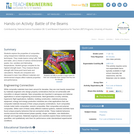
Students learn about material properties, and that engineers must consider many different …
Students learn about material properties, and that engineers must consider many different materials properties when designing. This activity focuses on strength-to-weight ratios and how sometimes the strongest material is not always the best material.
No restrictions on your remixing, redistributing, or making derivative works. Give credit to the author, as required.
Your remixing, redistributing, or making derivatives works comes with some restrictions, including how it is shared.
Your redistributing comes with some restrictions. Do not remix or make derivative works.
Most restrictive license type. Prohibits most uses, sharing, and any changes.
Copyrighted materials, available under Fair Use and the TEACH Act for US-based educators, or other custom arrangements. Go to the resource provider to see their individual restrictions.