
Unrestricted Use
CC BY
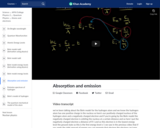
Using shell model diagram to relate absorption to emission. Derives relationship between emitted photon and energy levels, the Balmer-Rydberg equation. Created by Jay.

This brief video shows the relationship and movement of particles inside an atom.

In this video, David explains how an atom can absorb and emit photons with particular values of energy and how to determine the allowed values.

Explore the origin of energy bands in crystals of atoms. The structure of these bands determines how materials conduct electricity.

Explore the origin of energy bands in crystals of atoms. The structure of these bands determines how materials conduct electricity.

Look inside a resistor to see how it works. Increase the battery voltage to make more electrons flow though the resistor. Increase the resistance to block the flow of electrons. Watch the current and resistor temperature change.

Look inside a battery to see how it works. Select the battery voltage and little stick figures move charges from one end of the battery to the other. A voltmeter tells you the resulting battery voltage.

Look inside a battery to see how it works. Select the battery voltage and little stick figures move charges from one end of the battery to the other. A voltmeter tells you the resulting battery voltage.
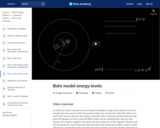
Calculating electron energy for levels n=1 to 3. Drawing a shell model diagram and an energy diagram for hydrogen, and then using the diagrams to calculate the energy required to excite an electron between different energy levels. Created by Jay.
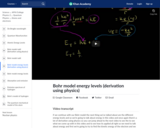
Using classical physics to calculate the energy of electrons in Bohr model. Solving for energy of ground state and more generally for level n. Created by Jay
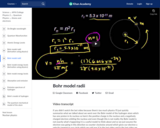
Using equation for Bohr model radii to draw shell model for n=1 to 3, and calculating the velocity of a ground state electron. Created by Jay
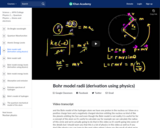
Using classical physics and vectors, plus assumption that angular momentum of electron is quantized, to derive the equation for Bohr model radii. Created by Jay.

In this hands-on activity, students explore the electrical force that takes place between two objects. Each student builds an electroscope and uses the device to draw conclusions about objects' charge intensity. Students also determine what factors influence electric force.

Build an atom out of protons, neutrons, and electrons, and see how the element, charge, and mass change. Then play a game to test your ideas!

Students use balloons to perform several simple experiments to explore static electricity and charge polarization.
A work in progress, CK-12 Chemistry Teacher's Edition supports its Chemistry book covering: Matter; Atomic Structure; The Elements; Stoichiometry; Chemical Kinetics; Physical States of Matter; Thermodynamics; Nuclear and Organic Chemistry.

This series of instructional videos was created by Camosun College for a Canadian edition of the OpenStax "Concepts of Biology" open textbook as part of the BC Open Textbook Project. The lectures are taught by Charles Molnar, a Biology instructor at Camosun College. The videos are accompanied by transcripts.

Students make a simple conductivity tester using a battery and light bulb. They learn the difference between conductors and insulators of electrical energy as they test a variety of materials for their ability to conduct electricity.

Simulate the original experiment that proved that electrons can behave as waves. Watch electrons diffract off a crystal of atoms, interfering with themselves to create peaks and troughs of probability.