Calculus Revisited is a series of videos and related resources that covers …
Calculus Revisited is a series of videos and related resources that covers the materials normally found in freshman- and sophomore-level introductory mathematics courses. Complex Variables, Differential Equations, and Linear Algebra is the third course in the series, consisting of 20 Videos, 3 Study Guides, and a set of Supplementary Notes. Students should have mastered the first two courses in the series (Single Variable Calculus and Multivariable Calculus) before taking this course. The series was first released in 1972, but equally valuable today for students who are learning these topics for the first time. About the Instructor Herb Gross has taught math as senior lecturer at MIT and was the founding math department chair at Bunker Hill Community College. He is the developer of the Mathematics As A Second Language website, providing arithmetic and algebra materials to elementary and middle school teachers. Acknowledgements Funding for this resource was provided by the Gabriella and Paul Rosenbaum Foundation. Other Resources by Herb Gross Calculus Revisited: Single Variable Calculus Calculus Revisited: Multivariable Calculus
Tijdens de cursus Caleidoscoop worden verschillende aspecten belicht waarmee de eerstejaarsstudenten worden …
Tijdens de cursus Caleidoscoop worden verschillende aspecten belicht waarmee de eerstejaarsstudenten worden voorzien van basisvaardigheden en basiskennis die noodzakelijk zijn voor het succesvol volgen van een studie in de wiskunde.
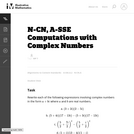
This problem is intended to reinforce the geometric interpretation of distance between …
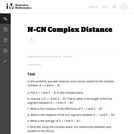
This problem is intended to reinforce the geometric interpretation of distance between complex numbers and midpoints as modulus of the difference and average respectively.
Conçu pour un cours de première année universitaire, ce manuel en algèbre …
Conçu pour un cours de première année universitaire, ce manuel en algèbre linéaire adopte une approche peu commune : il présente les espaces vectoriels dès le début et traite des systèmes linéaires qu’après une introduction approfondie aux espaces vectoriels. Cette approche est fondée sur l’expérience des auteurs ayant observé au cours des 25 dernières années que les étudiantes et étudiants ont souvent besoin davantage de temps pour maîtriser les espaces vectoriels alors que les manuels traditionnels relèguent plutôt le sujet à la fin du cours. De cette façon, ces nouvelles notions au coeur de l’algèbre linéaire qui sont souvent considérées comme abstraites et difficiles dans un cours d’introduction peuvent ensuite être utilisées dans le reste du cours ainsi que différents contextes.
(Nota: Esta es una traducción de un recurso educativo abierto creado por …
(Nota: Esta es una traducción de un recurso educativo abierto creado por el Departamento de Educación del Estado de Nueva York (NYSED) como parte del proyecto "EngageNY" en 2013. Aunque el recurso real fue traducido por personas, la siguiente descripción se tradujo del inglés original usando Google Translate para ayudar a los usuarios potenciales a decidir si se adapta a sus necesidades y puede contener errores gramaticales o lingüísticos. La descripción original en inglés también se proporciona a continuación.)
El módulo 1 prepara el escenario para ampliar la comprensión de los estudiantes de las transformaciones explorando la noción de linealidad. Esto conduce al estudio de números complejos y transformaciones lineales en el plano complejo. Los materiales del maestro consisten en las páginas del maestro que incluyen boletos de salida, soluciones de boletos de salida y todos los materiales del alumno con soluciones para cada lección en el módulo 1.
English Description: Module 1 sets the stage for expanding students' understanding of transformations by exploring the notion of linearity. This leads to the study of complex numbers and linear transformations in the complex plane. The teacher materials consist of the teacher pages including exit tickets, exit ticket solutions, and all student materials with solutions for each lesson in Module 1.
Module 1 sets the stage for expanding students' understanding of transformations by …
Module 1 sets the stage for expanding students' understanding of transformations by exploring the notion of linearity. This leads to the study of complex numbers and linear transformations in the complex plane. The teacher materials consist of the teacher pages including exit tickets, exit ticket solutions, and all student materials with solutions for each lesson in Module 1.
CK-12 Foundation's Trigonometry FlexBook is an introduction to trigonometry for the high …
CK-12 Foundation's Trigonometry FlexBook is an introduction to trigonometry for the high school student. Topics include: Trigonometric Identities & Equations, Circular Functions, and Polar Equations & Complex Numbers.
CK-12's Texas Instruments Trigonometry Student Edition Flexbook is a helpful companion to …
CK-12's Texas Instruments Trigonometry Student Edition Flexbook is a helpful companion to a trigonometry course, providing students with more ways to understand basic trigonometric concepts through supplementary exercises and explanations.
CK-12's Texas Instruments Trigonometry Teacher's Edition Flexbook is a helpful companion to …
CK-12's Texas Instruments Trigonometry Teacher's Edition Flexbook is a helpful companion to a trigonometry course, providing students with more ways to understand basic trigonometric concepts through supplementary exercises and explanations.
No restrictions on your remixing, redistributing, or making derivative works. Give credit to the author, as required.
Your remixing, redistributing, or making derivatives works comes with some restrictions, including how it is shared.
Your redistributing comes with some restrictions. Do not remix or make derivative works.
Most restrictive license type. Prohibits most uses, sharing, and any changes.
Copyrighted materials, available under Fair Use and the TEACH Act for US-based educators, or other custom arrangements. Go to the resource provider to see their individual restrictions.