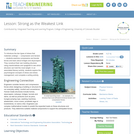
This course provides students with a basic knowledge of structural analysis and …
This course provides students with a basic knowledge of structural analysis and design for buildings, bridges and other structures. The course emphasizes the historical development of structural form and the evolution of structural design knowledge, from Gothic cathedrals to long span suspension bridges. Students will investigate the behavior of structural systems and elements through design exercises, case studies, and load testing of models. Students will design structures using timber, masonry, steel, and concrete and will gain an appreciation of the importance of structural design today, with an emphasis on environmental impact of large scale construction.
Students explore the properties of composites using inexpensive materials and processing techniques. …
Students explore the properties of composites using inexpensive materials and processing techniques. They create beams using Laffy Taffy and water, and a choice of various reinforcements (pasta, rice, candies) and fabricating temperatures. Student groups compete for the highest strength beam. They measure flexure strength with three-point bend tests and calculations. Results are compared and discussed to learn how different materials and reinforcement shapes affect material properties and performance.
Student teams design their own booms (bridges) and engage in a friendly …
Student teams design their own booms (bridges) and engage in a friendly competition with other teams to test their designs. Each team strives to design a boom that is light, can hold a certain amount of weight, and is affordable to build. Teams are also assessed on how close their design estimations are to the final weight and cost of their boom "construction." This activity teaches students how to simplify the math behind the risk and estimation process that takes place at every engineering firm prior to the bidding phase when an engineering firm calculates how much money it will take to build the project and then "bids" against other competitors.
Students learn about stress and strain by designing and building beams using …
Students learn about stress and strain by designing and building beams using polymer clay. They compete to find the best beam strength to beam weight ratio, and learn about the trade-offs engineers make when designing a structure.
Students explore how tension and compression forces act on three different bridge …
Students explore how tension and compression forces act on three different bridge types. Using sponges, cardboard and string, they create models of beam, arch and suspension bridges and apply forces to understand how they disperse or transfer these loads.
Students are presented with a brief history of bridges as they learn …
Students are presented with a brief history of bridges as they learn about the three main bridge types: beam, arch and suspension. They are introduced to two natural forces tension and compression common to all bridges and structures. Throughout history, and today, bridges are important for connecting people to resources, places and other people. Students become more aware of the variety and value of bridges around us in our everyday lives.
Students learn about the many types of expenses associated with building a …
Students learn about the many types of expenses associated with building a bridge. Working like engineers, they estimate the cost for materials for a bridge member of varying sizes. After making calculations, they graph their results to compare how costs change depending on the use of different materials (steel vs. concrete). They conclude by creating a proposal for a city bridge design based on their findings.
Students pretend they are agricultural engineers during the colonial period and design …
Students pretend they are agricultural engineers during the colonial period and design a miniature plow that cuts through a "field" of soil. They are introduced to the engineering design process and learn of several famous historical figures who contributed to plow design.
Students learn about the types of possible loads, how to calculate ultimate …
Students learn about the types of possible loads, how to calculate ultimate load combinations, and investigate the different sizes for the beams (girders) and columns (piers) of simple bridge design. Students learn the steps that engineers use to design bridges: understanding the problem, determining the potential bridge loads, calculating the highest possible load, and calculating the amount of material needed to resist the loads.
Working individually or in groups, students explore the concept of stress (compression) …
Working individually or in groups, students explore the concept of stress (compression) through physical experience and math. They discover why it hurts more to poke themselves with mechanical pencil lead than with an eraser. Then they prove why this is so by using the basic equation for stress and applying the concepts to real engineering problems.
Students take a hands-on look at the design of bridge piers (columns). …
Students take a hands-on look at the design of bridge piers (columns). First they brainstorm types of loads that might affect a Colorado bridge. Then they determine the maximum possible load for that scenario, and calculate the cross-sectional area of a column designed to support that load. Choosing from clay, foam or marshmallows, they create model columns and test their calculations.
This course provides an introduction to the mechanics of solids with applications …
This course provides an introduction to the mechanics of solids with applications to science and engineering. We emphasize the three essential features of all mechanics analyses, namely: (a) the geometry of the motion and/or deformation of the structure, and conditions of geometric fit, (b) the forces on and within structures and assemblages; and (c) the physical aspects of the structural system (including material properties) which quantify relations between the forces and motions/deformation.
Working as engineering teams, students design and create model beam bridges using …
Working as engineering teams, students design and create model beam bridges using plastic drinking straws and tape as their construction materials. Their goal is to build the strongest bridge with a truss pattern of their own design, while meeting the design criteria and constraints. They experiment with different geometric shapes and determine how shapes affect the strength of materials. Let the competition begin!
To introduce the two types of stress that materials undergo compression and …
To introduce the two types of stress that materials undergo compression and tension students examine compressive and tensile forces and learn about bridges and skyscrapers. They construct their own building structure using marshmallows and spaghetti to see which structure can hold the most weight. In an associated literacy activity, students explore the psychological concepts of stress and stress management, and complete a writing activity.
This course covers the fundamental concepts of structural mechanics with applications to …
This course covers the fundamental concepts of structural mechanics with applications to marine, civil, and mechanical structures. Topics include analysis of small deflections of beams, moderately large deflections of beams, columns, cables, and shafts; elastic and plastic buckling of columns, thin walled sections and plates; exact and approximate methods; energy methods; principle of virtual work; introduction to failure analysis of structures. We will include examples from civil, mechanical, offshore, and ship structures such as the collision and grounding of ships.
Students measure different types of small-sized beams and calculate their respective moments …
Students measure different types of small-sized beams and calculate their respective moments of inertia. They compare the calculations to how much the beams bend when loads are placed on them, gaining insight into the ideal geometry and material for load-bearing beams.
No restrictions on your remixing, redistributing, or making derivative works. Give credit to the author, as required.
Your remixing, redistributing, or making derivatives works comes with some restrictions, including how it is shared.
Your redistributing comes with some restrictions. Do not remix or make derivative works.
Most restrictive license type. Prohibits most uses, sharing, and any changes.
Copyrighted materials, available under Fair Use and the TEACH Act for US-based educators, or other custom arrangements. Go to the resource provider to see their individual restrictions.