Artists are often particularly keen observers and precise recorders of the physical …
Artists are often particularly keen observers and precise recorders of the physical conditions of the natural world. As a result, paintings can be good resources for learning about ecology. Teachers can use this lesson to examine with students the interrelationship of geography, natural resources, and climate and their effects on daily life. It also addresses the roles students can take in caring for the environment. Students will look at paintings that represent cool temperate, warm temperate, and tropical climates. In this lesson students will: Identify natural resources found in particular geographic areas; Discuss ways in which climate, natural resources, and geography affect daily life; Apply critical-thinking skills to consider the various choices artists have made in their representations of the natural world; Make personal connections to the theme by discussing ways they can be environmental stewards; Identify natural resources found in particular geographic areas; Discuss ways in which climate, natural resources, and geography affect daily life; Apply critical-thinking skills to consider the various choices artists have made in their representations of the natural world; Make personal connections to the theme by discussing ways they can be environmental stewards.
In these lessons students will explore the paintings of Horace Pippin and …
In these lessons students will explore the paintings of Horace Pippin and Wayne Thiebaud and the mobiles of Alexander Calder to discover and practice math and visual art concepts. Background and biographical information about the work of art and artist, guided looking with class discussion, and activities with worksheets using mathematical formulas and studio art provide the framework for each lesson.
In 1931, a severe drought hit the Southern and Midwestern plains. As …
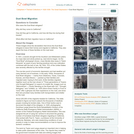
In 1931, a severe drought hit the Southern and Midwestern plains. As crops died and winds picked up, dust storms began. As the "Dust Bowl" photograph shows, crops literally blew away in "black blizzards" as years of poor farming practices and over-cultivation combined with the lack of rain. By 1934, 75% of the United States was severely affected by this terrible drought.The one-two punch of economic depression and bad weather put many farmers out of business. In the early 1930s, thousands of Dust Bowl refugees ? mainly from Oklahoma, Texas, Colorado, Kansas, and New Mexico ? packed up their families and migrated west, hoping to find work. Entire families migrated together (such as the men shown in "Three generations of Texans now Drought Refugees") in search of a better life. Images such as "Midcontinent ? Family Standing on the Road with Car," "Drought Refugees," and "Untitled, ca. 1935 (Worn-Down Family in Front of Tent)" offer a glimpse into their experience on the road, and show that cars provided many families both transportation and shelter on the road. About 200,000 of the migrants headed for California. The state needed to figure out how to absorb the thousands of destitute people crossing its borders daily. One of their tactics was to document the plight of the refugees. In 1935, photographer Dorothea Lange joined the Rural Rehabilitation Division of the California State Emergency Relief Administration (SERA), a section of the Federal Emergency Relief Administration. She was assigned the job of using her camera to document the growing number of homeless Dust Bowl refugees migrating to California. She worked with Paul S. Taylor, a professor at the University of California, Berkeley, who was researching conditions of rural poverty in order to make recommendations on how to improve the workers' conditions. The work by Taylor and Lange played an important role in helping to raise public awareness of the crisis. The reports they made for the government included both data and striking images that revealed the desperate conditions in which the migrants lived and confirmed the need for government intervention. Stark images such as "Home of Oklahoma Drought Refugees" resonated with the public, and portraits of drought refugees like "Ruby from Arkansas" and others shown in this topic humanized the migrants for more fortunate citizens. In March 1936, Lange took what became one of her most famous images, "Migrant Mother." This image of a 32-year-old woman became an icon for the suffering of ordinary people during Great Depression.
This site offers a sampling of traditional Omaha Indian music. The sound …
This site offers a sampling of traditional Omaha Indian music. The sound recordings include wax cylinder recordings made in the 1890s, as well as songs and spoken-word segments from the 1983 Omaha harvest celebration pow-wow, segments from an interview with an Omaha elder in 1983, songs and speeches from a performance by members of the Hethu'shka Society in 1985, and portions of an interview with an Omaha musician in 1999. Photos, fieldnotes, and more from the 1983 pow-wow are included.
Designed to help middle school students begin to answer the important question: …
Designed to help middle school students begin to answer the important question: "Who Am I?", these lessons use self-portraits from the National Gallery of Art's collection to inspire students to create their own self-portraits, poems, speeches, and letters. Artists studied in these lesson plans include Vincent Van Gogh, Paul Gauguin, Judith Leyster, David Alfaro Siqueiros, and Andy Warhol.
No restrictions on your remixing, redistributing, or making derivative works. Give credit to the author, as required.
Your remixing, redistributing, or making derivatives works comes with some restrictions, including how it is shared.
Your redistributing comes with some restrictions. Do not remix or make derivative works.
Most restrictive license type. Prohibits most uses, sharing, and any changes.
Copyrighted materials, available under Fair Use and the TEACH Act for US-based educators, or other custom arrangements. Go to the resource provider to see their individual restrictions.