
Unrestricted Use
Public Domain
Free PowerPoint Click and Reveal Interactions
- Subject:
- Educational Technology
- Material Type:
- Interactive
- Author:
- Tony Vinckx
- Date Added:
- 03/02/2024
Free PowerPoint Click and Reveal Interactions
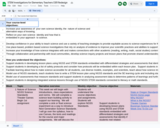
This 10-Week Course Map provides a narrative overview, weekly objective, and course objective as well as related materials and assessments. The map helps educators develop confidence in their ability to teach science and explains ways to use teaching strategies that provide equitable access to science experiences for K-6 students.
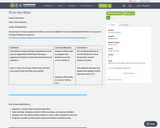
Title: 10 for the Win!Grade: Kindergarten Overall Goal: To have students be able to count by multiples of 10 and comprehend the idea of a sequence of steps involved in a process. StandardsLearning ObjectiveAssessment5d Students understand how automation works and use algorithmic thinking to develop a sequence of steps to create and test automated solutions. K.NS.1: Count to at least 100 by ones and tens and count on by one from any number.Students will be able to program the beebots to go the correct distance. Students will be able to count to 100 by tens.The students will have to use the beebots to move forward the correct amount of steps. The students will have the squares the beebot travels represent sets of 10. Key Terms & Definitions: Sequence- certain order in which steps flowSkip counting- skipping numbers while counting, counting by multiples Number line- line which shows number in order, often marked at intervalsProgram- provide machine with coded instructions to perform task Lesson Introduction (Hook, Grabber): 10 Students will paint hands and stamp them on paper! Each set of hands will represent a set of 10. We will do this all the way up to 100. This paper will be hung in the front of the classroom as a reminder of multiples of 10. Lesson Main:After hanging up our poster with the hands displaying multiples of 10, the teacher would count with the class by 10’s all the way up to 100, while referring to the poster so they can follow along.We will also pass out a number line to the students that highlights 10’s so they have a reference if they struggle.We will make a number line and write multiples of 10 along the side. We will measure out the space between numbers so that it is equal to the length the Beebot travels for each time the button is pushed. For example, if the student wanted to get to 30, they would have to know that you count up by saying “10, 20,30” and they would need to press the forward button on the Beebot 3 times. Each press of the button is a multiple of 10. For this activity, the teacher will break up the students into small groups and they will work together. They will draw a card which will have a multiple of 10 on it ranging from 10-100. The students will have to decide how many 10’s it takes to count up to that number, as well as how many times they will need to program the Beebot to reach the answer on the number line. Lesson Ending:For the lesson ending, we will regroup as a class and talk about how we felt the Beebot activity went. Then we will count together by 10’s up to 100 again to reiterate what we have been learning. Lastly, we will pass out a worksheet to the students which we have included a link to under our resources, and have them complete it individually. This will give us an idea of the students understanding of this concept and can be used for our assessment. Assessment Rubric: GreatAveragePoorIndicatorDescriptionDescriptionDescriptionHand Cut-outsStudent participated in the tracing and cutting out of hands.Student partially participated in the tracing and cutting out of hands.Student failed to participate in the tracing and cutting out of hands.Beebot activityStudent was able to successfully move the Beebot to correct answer.Student was able to move the Beebot, but not to the correct answer.Student was unable to move the Beebot and was unable to correctly answer.WorksheetStudent was able to correctly fill out the entire worksheet.Student was able to fill out 70% of the worksheet.Student was unable to fill out at least 70% of the worksheet. Resources / Artifacts: Number line for students https://www.helpingwithmath.com/printables/others/lin0301number11.htmWebsite which has handprint idea on it https://www.theclassroomkey.com/2016/02/big-list-skip-counting-activities.htmlLesson assessment used in the lesson ending https://www.pinterest.com/pin/287597126178910688 Differentiation: Differentiation for ability levelsIf a student really struggled with math skills, we could place them in a group with stronger math students. We could also offer an alternative activity for the Beebot timeline where we made the timeline go up by smaller multiples. For the worksheet, they could receive a longer amount of time to work on it and have directions read to them/receive help as needed. Differentiation for access & resourcesIf the school had limited resources and did not have access to these robots, they could use other tools like toy cars or something they could use to roll to the spots on the timeline. The game could be altered to fit a large variety of resources. The worksheet we used was found online but a similar version could be created by the teacher. Anticipated Difficulties: Some students might struggle with the concept of skip counting. It may be hard at first for them to remember the multiples of 10. Hopefully by making a poster and providing them with their own number line for reference, this will eliminate some potential difficulties the students may have.
Rubric Element 1.10 Teachers implement routines and procedures for efficiently guiding students through digital and non-digital work time.

Short Histories of Major Art Movements and Select Artists from ART 305
Short Description:
Part textbook, part shared knowledge, this book is the co-creation of the instructor and students of Red Deer Polytechnic's ART 305, 19th Century European Art History class.
Long Description:
What happens when a class shares their collective knowledge about their subject, rather than hiding it away and stuffing it down in individual memory? A textbook that is formed by the meeting of the minds!
As part of the ART 305 19th Century European Art History move to online during the pandemic, a collective project was born: creating a digital open-education resource, free to any who choose to access it, and a way for the individuals in class to be part of a greater community in an online learning environment.
With some chapters authored by the instructor of the class and others created by the students as a result of their term’s research, this text is a growing document that will encompass past, present, and future learners as their collective body of knowledge grows.
Within the parameters of 19th Century European Art History this text begins with the influence and beginnings of change during the Rococo era in France and progresses through time until the beginning of the 20th century. Each chapter marks a specific era or a specific artist and chapters are individually authored.
Word Count: 136177
(Note: This resource's metadata has been created automatically by reformatting and/or combining the information that the author initially provided as part of a bulk import process.)
Learning objectives:
-Leverage the benefits of openly licensed materials to create more culturally responsive and relevant learning environments and resources for students
-Develop a set of inclusive teaching practices to implement in your course that center students as authoritative voices
-Revise or create a renewable assignment that invites students as knowledge creators
-Leverage Open Pedagogy to center social justice in your course learning outcomes
Short Description:
The aim of this compendium is to provide nurse educators with an easily accessible collection of 25 resources designed to support student learning, particularly within nursing programs.
Long Description:
The aim of this compendium is to provide nurse educators with an easily accessible collection of OER designed to support student learning, particularly within nursing programs.
A search of the Pressbooks directory was undertaken to identify resources for potential inclusion in this compendium. These resources were filtered according to the following inclusion criteria: nursing authorship; North American; published after 2015; and intended for nursing students. Materials were excluded if they were identified as self-published books or were not openly licensed.
This resulted in a total of 25 resources that address areas inclusive of, but not limited to, health assessment, nursing leadership and management, foundational nursing practice skills, and the care of special populations.
The compendium is presented as a tabulation of key elements for each of the 25 resources, adapted from the Faculty Guide for Evaluating Open Education Resources. Five key elements are described relative to the criteria of credibility (i.e., authorship, publisher, year of most recent update), relevance (i.e., title of the open textbook, aim, intended audience, topical foci), accessibility/interactivity (i.e., figure and tables, videos, review questions, total interactive H5P activities), and licensing (i.e., availability for use with attribution).
Users of this compendium are encouraged to consider each of the tabulated elements (e.g. credibility, relevance, accessibility/interactivity, and licensing) to determine the merit of directly accessing a resource for potential inclusion as a supplement in a nursing course.
Word Count: 4284
(Note: This resource's metadata has been created automatically by reformatting and/or combining the information that the author initially provided as part of a bulk import process.)
In part, because many planned organizational improvements fall short of their intended goals, higher education administrators have not been able to promote sustained improvements. Most university leaders have been promoted into leadership roles without experience and training to enable them to foresee and address unintended outcomes of their decision making; often, the culture in higher education institutions promotes continuation of the status quo. However, in times of crisis, such as those related to reductions in budgets, many unintended consequences develop as leaders attempt to address change. Unintended consequences have implications related to the success or failure of planned change and higher education administrators must address such outcomes appropriately. This article discusses issues related to unintended consequences of policy changes in higher education.
Most of the learners here in our area don't have much access to the internet because there is no signal reception. They can sometimes access but only for those who can afford. So, teachers preferred modular learning. 21st Century Literature from the Philippines and the World is a senior high school subject which aims to engage students in appreciation and critical study of 21st Century Literature from the Philippines and the World, encompassing their various dimensions, genres, elements, structure, contexts, and traditions. In order to attain this, different activities are implemented. Other activities also have the need to apply multimedia and ICT skills. This resource is a way in applying multimedia and ICT skills of the students in spite of the fact that not all of them have the accessibility on the internet. This is just a step to mold students' skill in using multimedia.
The focus of this lesson is to provide an opportunity for children to develop oral language skills and to record their oral language to share with others.
This workbook is used for library instruction for first year English courses. The model blends online tutorials, learning activies, and drop-in workshops. The learning objectives are detailed in the workbook.
Students are reading to learn new information all the time. They should know different strategies to help them along the way. This is a great little lesson to do at the beginning of the school year and then after semester break again. Students should know the tools to help them be successful readers. This can be used for a teacher inservice or for parents who are new to helping thier own kids out during elearning / homework. 20 minutes
This is a handout I have used to help faculty identify and use Open Educational Resources.

The goals of OpenSciEd are to ensure any science teacher, anywhere, can access and download freely available, high quality, locally adaptable full-course materials. REMOTE LEARNING GUIDE FOR THIS UNIT NOW AVAILABLE!
This unit on weather, climate, and water cycling is broken into four separate lesson sets. In the first two lesson sets, students explain small-scale storms. In the third and fourth lesson sets, students explain mesoscale weather systems and climate-level patterns of precipitation. Each of these two parts of the unit is grounded in a different anchoring phenomenon.
The Open Science movement is rapidly changing the scientific landscape. Because exact definitions are often lacking and reforms are constantly evolving, accessible guides to open science are needed. This paper provides an introduction to open science and related reforms in the form of an annotated reading list of seven peer-reviewed articles, following the format of Etz et al. (2018). Written for researchers and students - particularly in psychological science - it highlights and introduces seven topics: understanding open science; open access; open data, materials, and code; reproducible analyses; preregistration and registered reports; replication research; and teaching open science. For each topic, we provide a detailed summary of one particularly informative and actionable article and suggest several further resources. Supporting a broader understanding of open science issues, this overview should enable researchers to engage with, improve, and implement current open, transparent, reproducible, replicable, and cumulative scientific practices.

This is an online module created for the 3rd Grade of the Junior High School. The topic of the lesson is the "7 Wonders of the World", and its main emphasis is placed on the Listening comprehension skills practice.The lesson is constructed on the basis of the ADDIE Model (Kurt,2017), and it is inspired by the UDL Principles approach (CAST,2011), and the Gagne's Nine Events of Instruction.During the lesson, various online platforms and webtools are used, something that makes learning procedure more interesting and accessible for all learners to attend and follow.
PLEASE NOTE: Some K-12 sites block access to Google Docs where this file resides. If you are unable to access it, it is also available at https://human.libretexts.org/Bookshelves/Literature_and_Literacy/Book%3A_88_Open_Essays_-_A_Reader_for_Students_of_Composition_and_Rhetoric_(Wangler_and_Ulrich)
This book is a free and open resource for composition instructors and students, full of essays that could supplement OER rhetoric and writing texts that lack readings. All of the essays in this reader are versatile rhetorically and thematically. It is arranged alphabetically by author name. Each essay has a series of hashtags that apply to the essay in some way. You can search for essays thematically for topics like education, the environment, politics, or health. You can also search for essays based on composition concepts like analysis, synthesis, and research. You can search for essays that are based on shared values, essays that rely heavily on ethos, logos, or pathos, essays that are very kairos-dependent, and essays that are scholarly.
This collection was created in Google Docs so that it is easily adapted and edited.

Student Success Pathways at Lansing Community College developed from the desire to help our students at Lansing Community College cope with the increasing costs of college textbooks and the difficulty of finding appropriate and affordable materials. Through this project, we are giving students the opportunity for open accessibility to the textbook and a more reasonable college experience. It is our hope that text is not only a cheaper alternative, it will better address the needs of our Lansing Community College students.

Principles of Accounting II is a course from a competency-based business degree pilot. You must be logged into your institutional Canvas account to access this shell.

Principles of Accounting III is a course from a competency-based business degree pilot. You must be logged into your institutional Canvas account to access this shell.