This site consists of letters, journals, books, newspapers, maps, and images documenting …
This site consists of letters, journals, books, newspapers, maps, and images documenting the land, peoples, and exploration of the trans-Appalachian West. The first European travelers, their relations with Native Americans, new settlers' migration and acquisition of land, navigation down the Ohio River, planting of crops, trade in tobacco and horses, and the roles of African Americans, women, churches, and schools are documented.
This lesson recounts efforts to improve homesteading laws and make land ownership …
This lesson recounts efforts to improve homesteading laws and make land ownership possible for more settlers. The distribution of government lands had been an issue since the Revolutionary War. Preemption -- settling the land first and paying for it later -- became national policy; however, supporting legislation was stymied until the secession of Southern states. See one of the first applications for land under this law. Teaching activities are included.
This collection uses primary sources to explore the Homestead Acts. Digital Public …
This collection uses primary sources to explore the Homestead Acts. Digital Public Library of America Primary Source Sets are designed to help students develop their critical thinking skills and draw diverse material from libraries, archives, and museums across the United States. Each set includes an overview, ten to fifteen primary sources, links to related resources, and a teaching guide. These sets were created and reviewed by the teachers on the DPLA's Education Advisory Committee.
This collection uses primary sources to explore the Hudson River School. Digital …
This collection uses primary sources to explore the Hudson River School. Digital Public Library of America Primary Source Sets are designed to help students develop their critical thinking skills and draw diverse material from libraries, archives, and museums across the United States. Each set includes an overview, ten to fifteen primary sources, links to related resources, and a teaching guide. These sets were created and reviewed by the teachers on the DPLA's Education Advisory Committee.
This collection uses primary sources to explore the Lewis and Clark Expedition. …
This collection uses primary sources to explore the Lewis and Clark Expedition. Digital Public Library of America Primary Source Sets are designed to help students develop their critical thinking skills and draw diverse material from libraries, archives, and museums across the United States. Each set includes an overview, ten to fifteen primary sources, links to related resources, and a teaching guide. These sets were created and reviewed by the teachers on the DPLA's Education Advisory Committee.
The unit is focused on the examination of geography in terms of …
The unit is focused on the examination of geography in terms of “place.” Students dive into inquiry to answer the compelling question, What is unique about living in Washington? Through this question students will understand where and why people live in Washington State. Students will dive into the regions of Washington State and define it through many characteristics. Students will ultimately choose a region to become an expert on and communicate what makes that region unique. Each student’s performance task product will reflect choice and build upon student strengths according to their skill set.
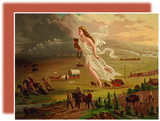
This collection uses primary sources to explore the idea of Manifest Destiny …
This collection uses primary sources to explore the idea of Manifest Destiny and its influence. Digital Public Library of America Primary Source Sets are designed to help students develop their critical thinking skills and draw diverse material from libraries, archives, and museums across the United States. Each set includes an overview, ten to fifteen primary sources, links to related resources, and a teaching guide. These sets were created and reviewed by the teachers on the DPLA's Education Advisory Committee.
This lesson encourages students to study a variety of documents to understand …
This lesson encourages students to study a variety of documents to understand the impact of a particular piece of legislation and relates to the powers granted to Congress in Article I, Section 8 , of the Constitution, related to making laws. It correlates to the National History Standards and the National Standards for Civics and Social Sciences. It also has cross-curricular connections with with history, government, global studies, and music.
This online lesson provides Native perspectives, images, documents, and other sources to …
This online lesson provides Native perspectives, images, documents, and other sources to help students and teachers understand the remarkable nature of the Navajo Treaty of 1868 and why the Navajo maintained an unflinching resolve to return home. Examine the Navajo Treaty of 1868 and the nation's journey home to understand how a people's agency and strength reaffirms and rebuilds Navajo (Diné) nationhood, culture, and sovereignty.
This site illustrates the story of settlement on the Great Plains. Family …
This site illustrates the story of settlement on the Great Plains. Family letters of one homesteader express personal insight into the joy, despair, and determination in his struggle to establish a home on the prairie.
In this activity, students are guided through a close reading of The …
In this activity, students are guided through a close reading of The Journal of Sean Sullivan: A Transcontinental Railroad Worker, a fictional book for young readers based on historical sources. Students will read a short excerpt from the beginning of the book and determine the meaning of key words. Working in groups, students will then read excerpts related to one of the following themes: working conditions of railroad builders; tension between immigrant groups; corruption of the railroad companies; conflict with Great Plains Indian tribes; and boomtowns. They will also complete an individual writing task on their theme. Finally, students will consider the positive and negative effects of the railroad on the country as a whole, as well as on specific groups of Americans.
Unit 4 primarily cover topics dealing with westward expansion during the nineteenth …
Unit 4 primarily cover topics dealing with westward expansion during the nineteenth century. The exceptions are the lessons on Nat Turner and Irish immigration. These are included for chronological reasons, and to show students how historical trends can occur simultaneously. Both themes (slavery and immigration) are revisited in Units 5 and 6. This unit features several elaborate lesson structures: a Structured Academic Controversy (SAC) and and Inquiry. In the SAC on Lewis and Clark, students debate whether or not Lewis and Clark were respectful to the Native Americans they encountered on their journey, while the Inquiry asks students to investigate what motivated Texans to declare their independence. Several lessons, especially on Manifest Destiny and Indian Removal, ask students to consider the perspectives of historical actors whose world views may seem foreign or even incomprehensible.
This unit is focused on the examination of a single topic, in …
This unit is focused on the examination of a single topic, in this case, the Native Americans of the inland Northwest and conflict that arose when other non-native people started to settle in the northwest, and to specifically address the native populations that lived in the inland northwest. The materials were created to be one coherent arc of instruction focused on one topic. The module was designed to include teaching notes that signal the kind of planning and thinking such instruction requires: close reading with complex text, and specific instructional strategies or protocols are described that support students’ reading and writing with evidence are described in enough detail to make it very clear what is required of students and how to support students in doing this rigorous work. Materials include summative assessment of content and process, central texts, key resources, and protocols that support and facilitate student learning.
U.S. History is designed to meet the scope and sequence requirements of …
U.S. History is designed to meet the scope and sequence requirements of most introductory courses. The text provides a balanced approach to U.S. history, considering the people, events, and ideas that have shaped the United States from both the top down (politics, economics, diplomacy) and bottom up (eyewitness accounts, lived experience). U.S. History covers key forces that form the American experience, with particular attention to issues of race, class, and gender.Senior Contributing AuthorsP. Scott Corbett, Ventura CollegeVolker Janssen, California State University, FullertonJohn M. Lund, Keene State CollegeTodd Pfannestiel, Clarion UniversityPaul Vickery, Oral Roberts UniversitySylvie Waskiewicz
U.S. History is designed for a two-semester American history sequence. It is …
U.S. History is designed for a two-semester American history sequence. It is traditional in coverage, following a roughly chronological outline, and using a balanced approach that includes political, economic, social, and cultural developments. At the same time, the book includes a number of innovative and interactive features designed to enhance student learning. Instructors can also customize the book, adapting it to the approach that works best in their classroom.
The unit has two parts. In each, students dive into inquiry to …
The unit has two parts. In each, students dive into inquiry to answer the compelling questions:
1. Who are some of our closest tribal neighbors, and what have they been their lifeways since time immemorial? 2. Why do people explore, and how does this lead to expansion?
Part 1 is focused on the examination of the northwest and some of the original inhabitants. Through these questions students will learn about the culture of some of their closest tribal neighbors, the Spokane Indians. The final project for Part 1 is a cultural investigation display, in which students will show what they know about the culture of the Spokane Tribe.
In Part 2, Students will also learn about forces that brought change to the northwest: fur trade era and exploration. Students will ultimately learn about the Corps of Discovery and the Oregon Trail and know the impact each had on the west. Students will finish Part 2 with a timeline activity that will reflect choice and build upon student strengths according to their skill set.
Finally, a lesson on a Tribe of the Columbia Plateau is offered as an extension, but it is strongly recommended that students get to experience this lesson.
Note that the emphasis here is on the Spokane Tribe as one of our closest tribal neighbors. In no way is this an exhaustive study nor should the tribal cultures be generalized to other tribes of the region. We understand that each tribe in our region and North America was and continues to be unique in its culture, practices, lifeways, and traditions.
No restrictions on your remixing, redistributing, or making derivative works. Give credit to the author, as required.
Your remixing, redistributing, or making derivatives works comes with some restrictions, including how it is shared.
Your redistributing comes with some restrictions. Do not remix or make derivative works.
Most restrictive license type. Prohibits most uses, sharing, and any changes.
Copyrighted materials, available under Fair Use and the TEACH Act for US-based educators, or other custom arrangements. Go to the resource provider to see their individual restrictions.