These worksheets were developed by Bryanne McDonough (PhD Candidate, Boston University) for …
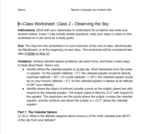
These worksheets were developed by Bryanne McDonough (PhD Candidate, Boston University) for a 6 week summer AS101 course taught at Boston University using the Openstax Astronomy 2e textbook. Each lesson was two hours long, so modification may be necessary for using these worksheets in a shorter class format, although many are already split into two parts. I'm open to feedback and would love to hear if you decide to use this resource in anyway: please contact Bryanne McDonough (bnmcd@bu.edu).
These activities cover topics in Solar System Astronomy, aligned with the OpenStax …
These activities cover topics in Solar System Astronomy, aligned with the OpenStax Astronomy textbook. Topics cover chapters 1-5, 6-13, and sections of 14 and 21 covering exoplanets. All activities are designed to be done in small groups in the classroom, but most can be adapted for use as homework or projects. Quantitative and Hands-on activities may be used as labs.
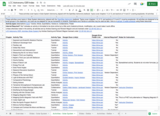
This is one part of an astronomy resource collection by Lane Community College. This collection was built by Andrea Goering (goeringa@lanecc.edu) and Richard Wagner (wagnerr@lanecc.edu), instructors of physics and astronomy at Lane Community College in Eugene, Oregon, USA. Development of these resources was funded through LCC's OER Initiative (https://inside.lanecc.edu/oer). We'd love to hear about your use of these resources! Let us know what you're using, sign up for updates, and submit corrections, suggestions, or comments here: https://forms.gle/un49RUNs55GU3ZNF6
In this lesson, students learn some basic facts about asteroids in our …
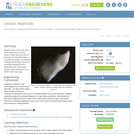
In this lesson, students learn some basic facts about asteroids in our solar system. The main focus is on the size of asteroids and how that relates to the potential danger of an asteroid colliding with the Earth. Students are briefly introduced to the destruction that would ensue should a large asteroid hit, as it did 65 million years ago.
Astronomy is designed to meet the scope and sequence requirements of one- …
Astronomy is designed to meet the scope and sequence requirements of one- or two-semester introductory astronomy courses. The book begins with relevant scientific fundamentals and progresses through an exploration of the solar system, stars, galaxies, and cosmology. The Astronomy textbook builds student understanding through the use of relevant analogies, clear and non-technical explanations, and rich illustrations. Mathematics is included in a flexible manner to meet the needs of individual instructors.
This website has five great astronomy activities! By engaging in these activities, …
This website has five great astronomy activities! By engaging in these activities, you can learn about the Milky Way Galaxy, the Sun, the Big Dipper, and stars!
Intended for all audiences, this textbook is an introduction to the nature …
Intended for all audiences, this textbook is an introduction to the nature of the universe. Use it to research or review our solar system, stars, galaxies, and the history of the universe. Each chapter has a set of corresponding homework questions.
When we look at the night sky, we see stars and the …
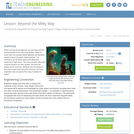
When we look at the night sky, we see stars and the nearby planets of our own solar system. Many of those stars are actually distant galaxies and glowing clouds of dust and gases called nebulae. The universe is an immense space with distances measured in light years. The more we learn about the universe beyond our solar system, the more we realize we do not know. Students are introduced to the basic known facts about the universe, and how engineers help us explore the many mysteries of space.
Students are introduced to our Sun as they explore its composition, what …
Students are introduced to our Sun as they explore its composition, what is happening inside it, its relationship to our planet (our energy source), and the ways engineers help us learn about it.
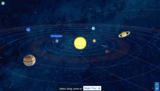
Overview: Blue Coral Guide to the Solar System is an interactive 3D …
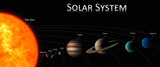
Overview: Blue Coral Guide to the Solar System is an interactive 3D model of the solar system. Freely browse by selecting, dragging, and zooming or step through the grand tour. Each stop along the way contains an optional profile for more detail.
Included in the model is the sun, all 8 planets, Earth's moon, 3 dwarf planets, the asteroid belt, the kuiper belt, the oort cloud, and Haley's comet.
Blue Coral Guide to the Solar System is fully responsive in the web browser for large and small devices in both horizontal and vertical orientations.
In this activity, learners work in teams to construct human lung models …
In this activity, learners work in teams to construct human lung models from small plastic beverage bottles and balloons. Learners use the models to investigate how movements of the diaphragm cause lungs to inflate. This activity can be enhanced by sharing the "Health Hazards of Lunar Dust" Podcast with learners (see related resource link). This resource includes background information and variation ideas.
This course introduces students to climate studies, including beginnings of the solar …
This course introduces students to climate studies, including beginnings of the solar system, time scales, and climate in human history. It is offered to both undergraduate and graduate students with different requirements.
This resource was created by Judy Prewett, in collaboration with Dawn DeTurk, …
This resource was created by Judy Prewett, in collaboration with Dawn DeTurk, Hannah Blomstedt, and Julie Albrecht, as part of ESU2's Integrating the Arts project. This project is a four year initiative focused on integrating arts into the core curriculum through teacher education, practice, and coaching.
This 10-minute video lesson looks at the formation of the Earth which …
This 10-minute video lesson looks at the formation of the Earth which is a the byproduct of a local supernova. [Cosmology and Astronomy playlist: Lesson 38 of 85]
Students acquire a basic understanding of the science and engineering of space …
Students acquire a basic understanding of the science and engineering of space travel as well as a brief history of space exploration. They learn about the scientists and engineers who made space travel possible and briefly examine some famous space missions. Finally, they learn the basics of rocket science (Newton's third law of motion), the main components of rockets and the U.S. space shuttle, and how engineers are involved in creating and launching spacecraft.
This lesson is about the solar system and its objects, such as …
This lesson is about the solar system and its objects, such as planets, moons, asteroids, and comets, it is revolving around the place where each celestial body resides. It engages students in exploring, researching, modeling, and discussing these objects and their characteristics, as well as the factors that make Earth habitable and the importance of space exploration. The lesson has four main parts: an introduction, where students are hooked by a hidden moon rock and learn about the lesson’s objectives and agenda; an exploration, where students work in groups to research various solar system objects using classroom resources and the NASA Solar System Exploration website, formulating questions about the solar system; an activity, where groups create models to represent Earth under different solar system conditions, based on “what if” questions, and present their findings; and a discussion, where a class discussion follows, focusing on the habitability factors of planets and the importance of space exploration. The lesson ends with students writing and peer-reviewing reflections on what they have learned.
This web page features a collection of Easy Java Simulations developed by …
This web page features a collection of Easy Java Simulations developed by secondary teachers for use in introductory high school physics courses. Topics include astronomy, momentum and collision, projectile motion, Gauss's Law and electric field, special relativity, and more. Each simulation is accompanied by a standards-based lesson plan and printable student guides. Users may run the simulations as a Java applet or may directly download a jar file version. The materials in this collection were created with Easy Java Simulations (EJS), a modeling tool that allows users without formal programming experience to generate computer models and simulations. To modify or customize the model, See Related Materials for detailed instructions on installing and running the EJS Modeling and Authoring Tool. This resource is part of Project ITOP (Improving the Teaching of Physics), a graduate program offered at University of Massachusetts-Boston. The archived computer models are hosted and maintained as part of the BU Physics Simulation collection.
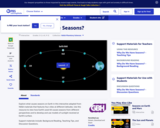
This interactive activity from the Adler Planetarium explains the reasons for the …
This interactive activity from the Adler Planetarium explains the reasons for the seasons. Featured is a game in which Earth must be properly placed in its orbit in order to send Max, the host, to different parts of the world during particular seasons.
No restrictions on your remixing, redistributing, or making derivative works. Give credit to the author, as required.
Your remixing, redistributing, or making derivatives works comes with some restrictions, including how it is shared.
Your redistributing comes with some restrictions. Do not remix or make derivative works.
Most restrictive license type. Prohibits most uses, sharing, and any changes.
Copyrighted materials, available under Fair Use and the TEACH Act for US-based educators, or other custom arrangements. Go to the resource provider to see their individual restrictions.