Student groups are given a set of materials: cardboard, insulating materials, aluminum …
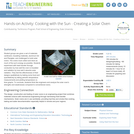
Student groups are given a set of materials: cardboard, insulating materials, aluminum foil and Plexiglas, and challenged to build solar ovens. The ovens must collect and store as much of the sun's energy as possible. Students experiment with heat transfer through conduction by how well the oven is insulated and radiation by how well it absorbs solar radiation. They test the effectiveness of their designs qualitatively by baking something and quantitatively by taking periodic temperature measurements and plotting temperature vs. time graphs. To conclude, students think like engineers and analyze the solar oven's strengths and weaknesses compared to conventional ovens.
Students explore the methods engineers have devised for harnessing sunlight to generate …
Students explore the methods engineers have devised for harnessing sunlight to generate power. First, they investigate heat transfer and heat storage through the construction, testing and use of a solar oven. With a lesson focused on photovoltaic cells, students learn the concepts of energy conversion, conservation of energy, current and voltage. By constructing model solar powered cars, students see these conceptual ideas manifested in modern technology. Furthermore, the solar car project provides opportunities to explore a number of other topics, such as gear ratios and simple mechanics. Both of these design and construction projects are examples of engineering design.
In this project students will research and then build a basic solar …
In this project students will research and then build a basic solar cooker shell made out of cardboard. Then they will run a variety of materials through experiments. Data from the experiments will be used to determine which materials should be added to the solar cooker shell to improve its ability to heat up food.
This project was created as a collaboration between a science and an engineering/woodshop class. The engineering class researched and build the basic solar cooker cardboard shells. The science class tested additional materials to add to the shells to improve the solar cookers. Then the engineering class, following the directions from reports created by the science class, added the materials to the solar cooker shells to create the final products.
Student have learned about the Sun from the Sun, Earth, and Moon science unit. …
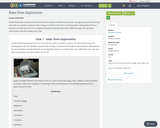
Student have learned about the Sun from the Sun, Earth, and Moon science unit. During the process of learning about the sun students research solar energy. It is hard to do hands on learning when talking about the Sun, however concepts learned can be applied to build a successful solar oven. When the solar over has been constructed, have the student test it out!
In this lesson, students will first discuss where energy comes from, including …
In this lesson, students will first discuss where energy comes from, including sources such as fossil fuels, nuclear, and such renewable technologies as solar. After this initial exploration, students will investigate the three main types of heat transfer: convection, conduction, and radiation. Students will learn how properties describe the ways different materials behave, for instance whether they are insulators or conductors. Students will complete a crossword puzzle to reinforce their vocabulary in this content area. The class will then focus on the acquisition and storage of energy through the design, construction, and testing of a fully functional solar oven.
No restrictions on your remixing, redistributing, or making derivative works. Give credit to the author, as required.
Your remixing, redistributing, or making derivatives works comes with some restrictions, including how it is shared.
Your redistributing comes with some restrictions. Do not remix or make derivative works.
Most restrictive license type. Prohibits most uses, sharing, and any changes.
Copyrighted materials, available under Fair Use and the TEACH Act for US-based educators, or other custom arrangements. Go to the resource provider to see their individual restrictions.