"The Art of the Probable" addresses the history of scientific ideas, in …
"The Art of the Probable" addresses the history of scientific ideas, in particular the emergence and development of mathematical probability. But it is neither meant to be a history of the exact sciences per se nor an annex to, say, the Course 6 curriculum in probability and statistics. Rather, our objective is to focus on the formal, thematic, and rhetorical features that imaginative literature shares with texts in the history of probability. These shared issues include (but are not limited to): the attempt to quantify or otherwise explain the presence of chance, risk, and contingency in everyday life; the deduction of causes for phenomena that are knowable only in their effects; and, above all, the question of what it means to think and act rationally in an uncertain world. Our course therefore aims to broaden students' appreciation for and understanding of how literature interacts with – both reflecting upon and contributing to – the scientific understanding of the world. We are just as centrally committed to encouraging students to regard imaginative literature as a unique contribution to knowledge in its own right, and to see literary works of art as objects that demand and richly repay close critical analysis. It is our hope that the course will serve students well if they elect to pursue further work in Literature or other discipline in SHASS, and also enrich or complement their understanding of probability and statistics in other scientific and engineering subjects they elect to take.
Students examine the structure and function of the human eye, learning some …
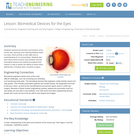
Students examine the structure and function of the human eye, learning some amazing features about our eyes, which provide us with sight and an understanding of our surroundings. Students also learn about some common eye problems and the biomedical devices and medical procedures that resolve or help to lessen the effects of these vision deficiencies, including vision correction surgery.
Students learn about the similarities between the human brain and its engineering …
Students learn about the similarities between the human brain and its engineering counterpart, the computer. Since students work with computers routinely, this comparison strengthens their understanding of both how the brain works and how it parallels that of a computer. Students are also introduced to the "stimulus-sensor-coordinator-effector-response" framework for understanding human and robot actions.
Students continue their exploration of the human senses and their engineering counterparts, …
Students continue their exploration of the human senses and their engineering counterparts, focusing on the auditory sense. Working in small groups, students design, create and run programs to control the motion of LEGO® TaskBots. By doing this, they increase their understanding of the use and function of sound sensors, gain experience writing robot programs, and reinforce their understanding of the sensory process.
Culture, Embodiment, and the Senses will provide an historical and cross-cultural analysis …
Culture, Embodiment, and the Senses will provide an historical and cross-cultural analysis of the politics of sensory experience. The subject will address western philosophical debates about mind, brain, emotion, and the body and the historical value placed upon sight, reason, and rationality, versus smell, taste, and touch as acceptable modes of knowing and knowledge production. We will assess cultural traditions that challenge scientific interpretations of experience arising from western philosophical and physiological models. The class will examine how sensory experience lies beyond the realm of individual physiological or psychological responses and occurs within a culturally elaborated field of social relations. Finally, we will debate how discourse about the senses is a product of particular modes of knowledge production that are themselves contested fields of power relations.
Students learn about the anatomy of the ear and how the ears …
Students learn about the anatomy of the ear and how the ears work as a sound sensor. Ear anatomy parts and structures are explained in detail, as well as how sound is transmitted mechanically and then electrically through them to the brain. Students use LEGO® robots with sound sensors to measure sound intensities, learning how the NXT brick (computer) converts the intensity of sound measured by the sensor input into a number that transmits to a screen. They build on their experiences from the previous activities and establish a rich understanding of the sound sensor and its relationship to the TaskBot's computer.
This lesson highlights the similarities between human sensors and their engineering counterparts. …
This lesson highlights the similarities between human sensors and their engineering counterparts. Taking this approach enables students to view the human body as a system, that is, from the perspective of an engineer. Humans have recreated most human sensors in robots – eyes, ears and sensors for temperature, touch and smell. The lesson inculdes a PowerPoint file that is programmed to run a Jeopardy-style game as a fun assessment tool.
Through six lesson/activity sets, students learn about the functioning of sensors, both …
Through six lesson/activity sets, students learn about the functioning of sensors, both human and robotic. In the activities, student groups use LEGO MINDSTORMS(TM) NXT robots and components to study human senses (sight, hearing, smell, taste, touch) in more detail than in previous units in the series. They also learn about the human made rotation, touch, sound, light and ultrasonic sensors. "Stimulus-sensor-coordinator-effector-response" pathways are used to describe the processes as well as similarities between human/animal and robotic equivalent sensory systems. The important concept of sensors converting/transducing signals is emphasized. Through assorted engineering design challenges, students program the LEGO robots to respond to input from various LEGO sensors. The overall framework reinforces the theme of the human body as a system with sensors that is, from an engineering perspective. PowerPoint® presentations, quizzes and worksheets are provided throughout the unit.
Students are provided with a rigorous background in human "sensors" (including information …
Students are provided with a rigorous background in human "sensors" (including information on the main five senses, sensor anatomies, and nervous system process) and their engineering equivalents, setting the stage for three associated activities involving sound sensors on LEGO® robots. As they learn how robots receive input from sensors, transmit signals and make decisions about how to move, students reinforce their understanding of the human body's sensory process.
This course surveys questions about human behavior and mental life ranging from …
This course surveys questions about human behavior and mental life ranging from how you see to why you fall in love. The great controversies: nature and nurture, free will, consciousness, human differences, self and society. Students are exposed to the range of theoretical perspectives including biological, evolutionary, cognitive, and psychoanalytic. One of the best aspects of Psychology is that you are the subject matter. This makes it possible to do many demonstrations in lecture that allow you to experience the topic under study. Lectures work in tandem with the textbook. The course breaks into small recitations sections to allow discussion, oral presentations, and individual contact with instructors.
Most of the time, we perceive the world as a unified bundle …
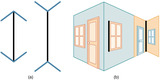
Most of the time, we perceive the world as a unified bundle of sensations from multiple sensory modalities. In other words, our perception is multimodal. This module provides an overview of multimodal perception, including information about its neurobiology and its psychological effects.
Students are introduced to various types of hearing impairments and the types …
Students are introduced to various types of hearing impairments and the types of biomedical devices that engineers have designed to aid people with this physical disability.
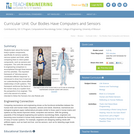
Students learn about the human body's system components, specifically its sensory systems, …
Students learn about the human body's system components, specifically its sensory systems, nervous system and brain, while comparing them to robot system components, such as sensors and computers. The unit's life sciences-to-engineering comparison is accomplished through three lessons and five activities. The important framework of "stimulus-sensor-coordinator-effector-response" is introduced to show how it improves our understanding the cause-effect relationships of both systems. This framework reinforces the theme of the human body as a system from the perspective of an engineer. This unit is the second of a series, intended to follow the Humans Are Like Robots unit.
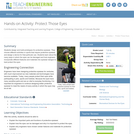
Students design and build prototypes for protective eyewear. They choose different activities …
Students design and build prototypes for protective eyewear. They choose different activities or sports that require protective eyewear and design a device for that particular use. Students learn about the many ways in which the eyes can be damaged and how engineers incorporate different features and materials into eyewear designs to best protect the eyes.
Psychology is designed to meet scope and sequence requirements for the single-semester …
Psychology is designed to meet scope and sequence requirements for the single-semester introduction to psychology course. The book offers a comprehensive treatment of core concepts, grounded in both classic studies and current and emerging research. The text also includes coverage of the DSM-5 in examinations of psychological disorders. Psychology incorporates discussions that reflect the diversity within the discipline, as well as the diversity of cultures and communities across the globe.Senior Contributing AuthorsRose M. Spielman, Formerly of Quinnipiac UniversityContributing AuthorsKathryn Dumper, Bainbridge State CollegeWilliam Jenkins, Mercer UniversityArlene Lacombe, Saint Joseph's UniversityMarilyn Lovett, Livingstone CollegeMarion Perlmutter, University of Michigan
Students observe and test their reflexes, including the (involuntary) pupillary response and …
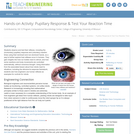
Students observe and test their reflexes, including the (involuntary) pupillary response and (voluntary) reaction times using their dominant and non-dominant hands, as a way to further explore how reflexes occur in humans. They gain insights into how our bodies react to stimuli, and how some reactions and body movements are controlled automatically, without conscious thought. Using information from the associated lesson about how robots react to situations, including the stimulus-to-response framework, students see how engineers use human reflexes as examples for controls for robots.
No restrictions on your remixing, redistributing, or making derivative works. Give credit to the author, as required.
Your remixing, redistributing, or making derivatives works comes with some restrictions, including how it is shared.
Your redistributing comes with some restrictions. Do not remix or make derivative works.
Most restrictive license type. Prohibits most uses, sharing, and any changes.
Copyrighted materials, available under Fair Use and the TEACH Act for US-based educators, or other custom arrangements. Go to the resource provider to see their individual restrictions.