The Framework, re-framed in "plain English" for students and faculty. The goal …
The Framework, re-framed in "plain English" for students and faculty. The goal was to make the ACRL Framework easier to understand (many people don't use iterative in everyday conversation, for example) and to make the connection between information literacy and institutional mission/vision and learning outcomes clear.
AIRS is an open source set of online modules and resources in …
AIRS is an open source set of online modules and resources in research skills and knowledge. It provides the grounding in research processes with practical tools to support you.
AIRS is a mandatory coursework requirement for Higher Degree Research (HDR) students enrolled in a Doctor of Philosophy (PhD) or Master of Philosophy (MPhil), at the Queensland University of Technology (QUT).
Written for students and instructors in an advanced legal research course, this …
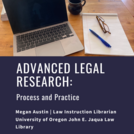
Written for students and instructors in an advanced legal research course, this book uses the steps of the legal research process to facilitate skills practice, collaboration, and reflection. It proposes a hypothetical as a basis for practicing the research process steps and encourages students and instructors to contribute other hypotheticals. The text also includes sample assignments, demonstration videos, and discussion and reflection questions, with opportunities for students and instructors to contribute additional questions. This text uses an approach that emphasizes student reflection on the development of research skills, with the benefit of repeated and consistent formative feedback.
From June 2018 to May 2019, we administered an assessment to 3,446 …
From June 2018 to May 2019, we administered an assessment to 3,446 students, a national sample that matches the demographic profile of high school students in the United States. The six exercises in our assessment gauged students’ ability to evaluate digital sources on the open internet. The results—if they can be summarized in a word—are troubling: •Fifty-two percent of students believed a grainy video claiming to show ballot stuffing in the 2016 Democratic primaries (the video was actually shot in Russia) constituted “strong evidence” of voter fraud in the U.S. Among more than 3,000 responses, only three students tracked down the source of the video, even though a quick search turns up a variety of articles exposing the ruse. Two-thirds of students couldn’t tell the difference between news stories and ads (set off by the words “Sponsored Content”) on Slate’s homepage.Ninety-six percent of students did not consider why ties between a climate change website and the fossil fuel industry might lessen that website’s credibility. Instead of investigating who was behind the site, students focused on superficial markers of credibility: the site’s aesthetics, its top-level domain, or how it portrayed itself on the About page.
In groups, students will design a presentation that will trace the development …
In groups, students will design a presentation that will trace the development of an organ system through the major phyla of the animal kingdom looking for the relationships between structure and function by documenting adaptations.
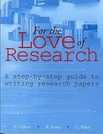
Summary is arguably the most important research-essay-writing skill. There are many methods …
Summary is arguably the most important research-essay-writing skill. There are many methods for summarizing a text. This chapter of For the Love of Research: A Step-by-step Guide to Writing Research Papers provides one. If you are interested in checking out this workbook in its entirety. Please contact Debbie (me) at gilbertd@mjc.edu.
This course introduces students to modern world history and geography. It provides …
This course introduces students to modern world history and geography. It provides an opportunity for students to learn and further develop foundational research and writing skills by incorporating practice into every class session. Early in the course, students select a country to study, then all research and writing activities are focused on that country. It also utilizes the United Nations Sustainable Development Goals to help students explore their country.The course utilizes openly licensed textbooks and publicly available materials as course materials.This survey course is intended for freshmen and sophomore-level students who are interested in exploring historical, political and social contexts beyond their own. Students will have ample opportunities to practice foundational skills including writing, research, source citation, critical thinking and public speaking.It was originally taught over 13 weeks as part of a Fulbright US Scholar grant in the International College at Tunghai University in Taichung Taiwan. It was developed with support from the Open Education for a Better World Program.
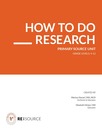
This How To Do Research Unit Guide provides a lesson-to-lesson foundation for …
This How To Do Research Unit Guide provides a lesson-to-lesson foundation for teaching:● What primary sources are● Real vs. fake information (evaluating sources)● Document analysis● Different ways to obtain information● How to formulate research questions● How to find answers to research questions● The hows and whys of citations (annotated bibliography)By the time students get to high school, they should have a basic understanding of how to effectively do research. Considering that there are so many steps involved in the research process, the earlier these necessary skills are taught, the more time students will be able to devote to theiractual projects. Moreover, in today’s world, information literacy needs to be achieved at an earlier age, so students can learn to be smart consumers, responsible sharers, and presenters of information. Throughout the research process, students will learn that there will be dead ends, questions that are too broad or too narrow, questions that do not have answers. This is an accurate reflection of what their experiences will continue to be as they move into higher level research projects in their educational careers.
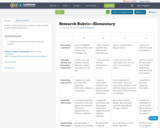
Deb Baker created this after consulting with faculty, librarians, and colleagues from …
Deb Baker created this after consulting with faculty, librarians, and colleagues from around the country. The idea was to create a practical tool for assessing information literacy that anyone could use, was easy to norm, and focused on what students could do and where research instruction could be improved to increase students' information literacy. This rubric can help improve student success and information literacy learning outcomes in research assignments for any course. Used early in the semester it can serve as a diagnostic tool for supporting student researchers in developing the skills and habits of mind needed to successfully find and use information to answer a question, support a thesis, or solve a problem. Students could even use it to self-assess.
This 2-credit course provides an introduction to research by learning to identify, …
This 2-credit course provides an introduction to research by learning to identify, find, evaluate, incorporate, and cite appropriate sources using a range of research tools. This course is designed for an online class environment and was taught as such in Spring 2020. The course materials have been collaboratively developed by Tacoma Community College librarians, and uses a combination of openly licensed, open access, and library resources.
Locating, retrieving, evaluating, and using information is an important part of the …
Locating, retrieving, evaluating, and using information is an important part of the educational experience in the 21st century. The Pot of Gold is an interactive web-based tutorial for teaching basic information literacy concepts to First Year students at Notre Dame. Learner analysis reveals that students come to Notre Dame with highly disparate information literacy skills. This instructional product provides the student with the opportunity to assess his own skill level and address learning gaps that might affect research and other information-seeking performance.Pot of Gold also provides a quick review or update for the experienced researcher, particularly when interdisciplinary research requires seeking information from unfamiliar sources.
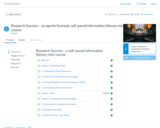
What is information literacy? Simply put, it's the skills and habits that …
What is information literacy? Simply put, it's the skills and habits that allow you to find and use information. At MCC it is a Core Learning Outcome -- one of the areas you will demonstrate competency in before you graduate. In the Academic Catalog, MCC states that Information Literacy is:
"The ability to know when there is a need for information, to be able to identify, locate, evaluate and effectively and responsibly use and share that information for the problem at hand."
The way information literacy is assessed at MCC is through research assignments. When you see instructions that ask you to find, use and cite sources, you're doing research.
This course will help you succeed in research assignments.
It is divided into five self-paced chapters that progress through the stages of a student research process. Each chapter should take roughly 30 minutes to complete, and covers two to three learning outcomes that align with the Framework for Information Literacy in Higher Education, adopted by the Association of College & Research Libraries (ACRL) in 2016.
This course is adapted by Deb Baker from "Information Literacy for College Students" by Amanda Burbage & Olivia Reinauer, licensed under CC BY 4.0. Many resources included in the course have been reused/remixed and may hold different versions of Creative Commons licenses. Please note that if you use or adapt any of the individual resources this course, you should abide by the licensing for that specific resource.
These chapters present a series of short readings with discussion questions and …
These chapters present a series of short readings with discussion questions and exercises related to basic research skills. Topics relate to the whole research process from identifying a topic through presenting one’s own work and address both library research as well as searching for and evaluating sources on the open web.
This work was originally created to serve the needs of IS1111 Tackling a Wicked Problem taught at Plymouth State University. You can see these chapters in the context of the other course readings at wicked-problem.press.plymouth.edu. This version has been revised to remove references to institution-specific resources and programs in the hopes that these chapters may be useful in other contexts.
While the title, Researching Wicked Problems, implies a narrow applicability, this content addresses basic information literacy skills useful in a variety of contexts at a level appropriate for first year college students.
RAISE: Researcher Advanced Information Skills and Education is an independent-learning tool designed …
RAISE: Researcher Advanced Information Skills and Education is an independent-learning tool designed to build the research skills of Southern Cross University postgraduate students. The four modules cover search tips, advanced search tools, managing your research information, and disseminating your research.
Contains files to print and play SEEK!, a card game to help …
Contains files to print and play SEEK!, a card game to help students improve their information literacy - in particular, the ability to construct a search strategy.
Each small group of students researches one aspect of the same big …
Each small group of students researches one aspect of the same big topic, such as the Gold Rush, and teaches what they have learned to the rest of the class.
The primary sources in this set can be used for inquiry-based learning …
The primary sources in this set can be used for inquiry-based learning exercises and projects. Each document falls under the umbrella topic of voter education, and students are encouraged to annotate in the margins in order to support the development of document analysis and critical thinking skills. Suggested projects that make use of this set’s primary sources are also included for the educator as a springboard for research-based projects.
As a student one often struggles with developing a research question, finding …
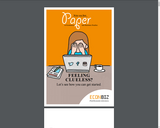
As a student one often struggles with developing a research question, finding scholarly papers or citing correctly. The booklet “Write your best Paper” (pdf) summarizes the most important topics in a step by step instruction with a timeline and practical tips.
No restrictions on your remixing, redistributing, or making derivative works. Give credit to the author, as required.
Your remixing, redistributing, or making derivatives works comes with some restrictions, including how it is shared.
Your redistributing comes with some restrictions. Do not remix or make derivative works.
Most restrictive license type. Prohibits most uses, sharing, and any changes.
Copyrighted materials, available under Fair Use and the TEACH Act for US-based educators, or other custom arrangements. Go to the resource provider to see their individual restrictions.