This resource requires students to present the solution to a multi-step problem …
This resource requires students to present the solution to a multi-step problem in the form of valid chains of reasoning, using symbols appropriately. Students must use the four operations with whole numbers to solve problems.
This site teaches Reasoning with Equations and Inequalities to High Schoolers through …
This site teaches Reasoning with Equations and Inequalities to High Schoolers through a series of 5909 questions and interactive activities aligned to 36 Common Core mathematics skills.
This class is the second half of an intensive survey of cognitive …
This class is the second half of an intensive survey of cognitive science for first-year graduate students. Topics include visual perception, language, memory, cognitive architecture, learning, reasoning, decision-making, and cognitive development. Topics covered are from behavioral, computational, and neural perspectives.
This undergraduate course is designed to introduce students to cognitive processes. The …
This undergraduate course is designed to introduce students to cognitive processes. The broad range of topics covers each of the areas in the field of cognition, and presents the current thinking in this discipline. As an introduction to human information processing and learning, the topics include the nature of mental representation and processing, the architecture of memory, pattern recognition, attention, imagery and mental codes, concepts and prototypes, reasoning and problem solving.
Explores the theory and research related to information processing, focusing on attention, …
Explores the theory and research related to information processing, focusing on attention, perception, memory storage and information retrieval. Also highlights work in artificial intelligence and cognitive neuroscience which serves to describe and explain cognitive processes.
This course will explore the state of the art in common sense …
This course will explore the state of the art in common sense knowledge, and class projects will design and build interfaces that can exploit this knowledge to make more usable and helpful interfaces. This year's theme will be about how common sense knowledge differs in different languages and cultures, and how machine understanding of this knowledge can help increase communication between people, and between people and machines.
This course will explore the state of the art in common sense …
This course will explore the state of the art in common sense knowledge, and class projects will design and build interfaces that can exploit this knowledge to make more usable and helpful interfaces. Course requirements will consist of critiques of class readings (about 2 papers/week), and a final project (paper or computer implementation project). Grades will be based primarily on the projects, as well as a small component for class and online participation
Social media has become an increasingly popular and convenient platform in recent …
Social media has become an increasingly popular and convenient platform in recent years. However, it has also given rise to opinions often perceived as factual and reliable, despite being misleading or false. According to two studies conducted by the Pew Research Center, in 2018, 14% of social media users claimed to have changed their views due to the content they saw on social media. This percentage increased to 23% in 2020, representing a significant surge of 60%.
This is a text-based STEM Inquiry, focusing on the mathematical standard of …
This is a text-based STEM Inquiry, focusing on the mathematical standard of making inferences and justifying conclusions while evaluating reports based on data. The unit culminates in students presenting their findings comparing local to national data regarding the relationships between educational attainment and financial earnings.
Advances in cognitive science have resolved, clarified, and sometimes complicated some of …
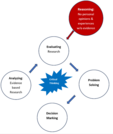
Advances in cognitive science have resolved, clarified, and sometimes complicated some of the great questions of Western philosophy: what is the structure of the world and how do we come to know it; does everyone represent the world the same way; what is the best way for us to act in the world. Specific topics include color, objects, number, categories, similarity, inductive inference, space, time, causality, reasoning, decision-making, morality and consciousness. Readings and discussion include a brief philosophical history of each topic and focus on advances in cognitive and developmental psychology, computation, neuroscience, and related fields. At least one subject in cognitive science, psychology, philosophy, linguistics, or artificial intelligence is required. An additional project is required for graduate credit.
This course analyzes seminal work directed at the development of a computational …
This course analyzes seminal work directed at the development of a computational understanding of human intelligence, such as work on learning, language, vision, event representation, commonsense reasoning, self reflection, story understanding, and analogy. It reviews visionary ideas of Turing, Minsky, and other influential thinkers and examines the implications of work on brain scanning, developmental psychology, and cognitive psychology. There is an emphasis on discussion and analysis of original papers; students taking the graduate version complete additional exercises and a substantial term project.
Microwave and RF Design: Modules focuses on the design of systems based …
Microwave and RF Design: Modules focuses on the design of systems based on microwave modules. The use of modules has become increasingly important in RF and microwave engineering for rapidly realizing high performance microwave systems. When integration is ultimately to be used, building a system up using modules provides a rapid means of prototyping and testing system concepts. A wide variety of RF modules including amplifiers, local oscillators, switches, circulators, isolators, phase detectors, frequency multipliers and dividers, phase-locked loops, and direct digital synthesizers are considered. Detailed design strategies for synthesizing filters based on parallel coupled lines are presented. The reader will gain an appreciation of design by synthesis. This book is suitable as both an undergraduate and graduate textbook, as well as a career-long reference book.
This course is designed to promote reasoning, problem-solving and modeling through thematic …
This course is designed to promote reasoning, problem-solving and modeling through thematic units focused on mathematical practices while reinforcing and extending content in Number and Quantity, Algebra, Functions, Statistics and Probability, and Geometry. It is a yearlong course taught using student-centered pedagogy.
Mathematical Reasoning: Writing and Proof is designed to be a text for …
Mathematical Reasoning: Writing and Proof is designed to be a text for the first course in the college mathematics curriculum that introduces students to the processes of constructing and writing proofs and focuses on the formal development of mathematics. The primary goals of the text are to help students:
· Develop logical thinking skills and to develop the ability to think more abstractly in a proof oriented setting.
· Develop the ability to construct and write mathematical proofs using standard methods of mathematical proof including direct proofs, proof by contradiction, mathematical induction, case analysis, and counterexamples.
· Develop the ability to read and understand written mathematical proofs.
· Develop talents for creative thinking and problem solving.
· Improve their quality of communication in mathematics. This includes improving writing techniques, reading comprehension, and oral communication in mathematics.
· Better understand the nature of mathematics and its language.
This text also provides students with material that will be needed for their further study of mathematics.
Mathematical Reasoning: Writing and Proof is a text for the first college …
Mathematical Reasoning: Writing and Proof is a text for the first college mathematics course that introduces students to the processes of constructing and writing proofs and focuses on the formal development of mathematics. Version 3 of this book is almost identical to Version 2.1. The main change is that the preview activities in Version 2.1 have been renamed to beginning activities in Version 3. This was done to emphasize that these activities are meant to be completed before starting the rest of the section and are not just a short preview of what is to come in the rest of the section.
This resource allow teachers and parents to plan for and use Philosophical …
This resource allow teachers and parents to plan for and use Philosophical Inquiry in the classroom or in a small group setting. When we encourage students to think deeply and to express their thinking we see that it helps them to interact better as learning in general classroom discussions.
Intern Prescot Nelson at Succinct Psychology (Psychcinct), under the guidance of professor …
Intern Prescot Nelson at Succinct Psychology (Psychcinct), under the guidance of professor Daniel Reynolds, created the entire course series for the Psych2e Openstax textbook. We are allowing everyone to share and embed this resource.
No restrictions on your remixing, redistributing, or making derivative works. Give credit to the author, as required.
Your remixing, redistributing, or making derivatives works comes with some restrictions, including how it is shared.
Your redistributing comes with some restrictions. Do not remix or make derivative works.
Most restrictive license type. Prohibits most uses, sharing, and any changes.
Copyrighted materials, available under Fair Use and the TEACH Act for US-based educators, or other custom arrangements. Go to the resource provider to see their individual restrictions.