The topics covered under this course include elements of nuclear physics for …
The topics covered under this course include elements of nuclear physics for engineering students, basic properties of the nucleus and nuclear radiations, quantum mechanical calculations of deuteron bound-state wave function and energy, n-p scattering cross-section, transition probability per unit time and barrier transmission probability. Also explored are binding energy and nuclear stability, interactions of charged particles, neutrons, and gamma rays with matter, radioactive decays, energetics and general cross-section behavior in nuclear reactions.
This course explores elements of nuclear physics for engineering students. It covers …
This course explores elements of nuclear physics for engineering students. It covers basic properties of the nucleus and nuclear radiations; quantum mechanical calculations of deuteron bound-state wave function and energy; n-p scattering cross section; transition probability per unit time and barrier transmission probability. It also covers binding energy and nuclear stability; interactions of charged particles, neutrons, and gamma rays with matter; radioactive decays; and energetics and general cross section behavior in nuclear reactions.
6.728 is offered under the department's "Devices, Circuits, and Systems" concentration. The …
6.728 is offered under the department's "Devices, Circuits, and Systems" concentration. The course covers concepts in elementary quantum mechanics and statistical physics, introduces applied quantum physics, and emphasizes an experimental basis for quantum mechanics. Concepts covered include: Schrodinger's equation applied to the free particle, tunneling, the harmonic oscillator, and hydrogen atom, variational methods, Fermi-Dirac, Bose-Einstein, and Boltzmann distribution functions, and simple models for metals, semiconductors, and devices such as electron microscopes, scanning tunneling microscope, thermonic emitters, atomic force microscope, and others.
This resource is a video abstract of a research paper created by …
This resource is a video abstract of a research paper created by Research Square on behalf of its authors. It provides a synopsis that's easy to understand, and can be used to introduce the topics it covers to students, researchers, and the general public. The video's transcript is also provided in full, with a portion provided below for preview:
"Artificial intelligence is transforming our way of life. Able to spot patterns invisible to the human eye, algorithms are learning how to make our lives easier, safer, and more fun. That power is not lost on materials researchers. During the next decade, artificial intelligence or AI-driven research could fundamentally transform how new and better materials are developed. What’s more, it might even revamp how materials research itself is carried out, enabling promising new materials and processes to be developed more quickly. Machine learning methods come in a variety of flavors, with some requiring more guidance, or “supervision,” from researchers. But, generally, a machine-learning algorithm designed to discover and understand the behavior of materials looks for patterns connecting the composition, structure, and properties of known materials..."
The rest of the transcript, along with a link to the research itself, is available on the resource itself.
This course uses the theory and application of atomistic computer simulations to …
This course uses the theory and application of atomistic computer simulations to model, understand, and predict the properties of real materials. Specific topics include: energy models from classical potentials to first-principles approaches; density functional theory and the total-energy pseudopotential method; errors and accuracy of quantitative predictions: thermodynamic ensembles, Monte Carlo sampling and molecular dynamics simulations; free energy and phase transitions; fluctuations and transport properties; and coarse-graining approaches and mesoscale models. The course employs case studies from industrial applications of advanced materials to nanotechnology. Several laboratories will give students direct experience with simulations of classical force fields, electronic-structure approaches, molecular dynamics, and Monte Carlo. This course was also taught as part of the Singapore-MIT Alliance (SMA) programme as course number SMA 5107 (Atomistic Computer Modeling of Materials). Acknowledgements Support for this course has come from the National Science Foundation's Division of Materials Research (grant DMR-0304019) and from the Singapore-MIT Alliance.
This video segment adapted from A Science Odyssey takes a look at …
This video segment adapted from A Science Odyssey takes a look at the scale of the atom and the tremendous amount of space between the electrons and the nucleus. If all this empty space exists in matter, how can any substance be solid?
This resource is a video abstract of a research paper created by …
This resource is a video abstract of a research paper created by Research Square on behalf of its authors. It provides a synopsis that's easy to understand, and can be used to introduce the topics it covers to students, researchers, and the general public. The video's transcript is also provided in full, with a portion provided below for preview:
"A new addition to the International Space Station marks the beginning of exciting new explorations of exotic matter. This is BECCAL, the Bose-Einstein Condensate and Cold Atom Laboratory. A joint venture between NASA and the German Aerospace Center, BECCAL will enable scientists across the globe to eliminate one pesky force that plagues earthbound experiments: gravity. A Bose-Einstein condensate is a state of matter formed by cooling a gas of extremely low density to just above absolute zero. Systems like this enable scientists to study aspects of quantum mechanics on a relatively big scale, and could hold the key to bridging quantum mechanics to general relativity. Methods for generating Bose-Einstein condensates vary according to how they trap atoms, using either optics or magnets to do the trick. But typical experiments are hampered by the force of gravity. In a standard setup, gravity deforms optical and magnetic traps..."
The rest of the transcript, along with a link to the research itself, is available on the resource itself.
A work in progress, CK-12 Chemistry Teacher's Edition supports its Chemistry book …
A work in progress, CK-12 Chemistry Teacher's Edition supports its Chemistry book covering: Matter; Atomic Structure; The Elements; Stoichiometry; Chemical Kinetics; Physical States of Matter; Thermodynamics; Nuclear and Organic Chemistry.
The theoretical frameworks of Hartree-Fock theory and density functional theory are presented …
The theoretical frameworks of Hartree-Fock theory and density functional theory are presented in this course as approximate methods to solve the many-electron problem. A variety of ways to incorporate electron correlation are discussed. The application of these techniques to calculate the reactivity and spectroscopic properties of chemical systems, in addition to the thermodynamics and kinetics of chemical processes, is emphasized. This course also focuses on cutting edge methods to sample complex hypersurfaces, for reactions in liquids, catalysts and biological systems.
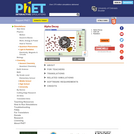
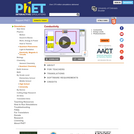
Experiment with conductivity in metals, plastics and photoconductors. See why metals conduct …
Experiment with conductivity in metals, plastics and photoconductors. See why metals conduct and plastics don't, and why some materials conduct only when you shine a flashlight on them.
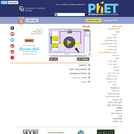
Experiment with conductivity in metals, plastics and photoconductors. See why metals conduct …
Experiment with conductivity in metals, plastics and photoconductors. See why metals conduct and plastics don't, and why some materials conduct only when you shine a flashlight on them.
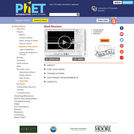
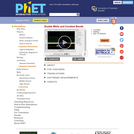
Explore tunneling splitting in double well potentials. This classic problem describes many …
Explore tunneling splitting in double well potentials. This classic problem describes many physical systems, including covalent bonds, Josephson junctions, and two-state systems such as spin 1/2 particles and ammonia molecules.
This video, adapted from NASA, presents rare experimental evidence from the Fermi …
This video, adapted from NASA, presents rare experimental evidence from the Fermi Gamma-ray Space Telescope supporting Einstein's prediction that space-time is smooth.
This class discusses the origin of electrical, magnetic and optical properties of …
This class discusses the origin of electrical, magnetic and optical properties of materials, with a focus on the acquisition of quantum mechanical tools. It begins with an analysis of the properties of materials, presentation of the postulates of quantum mechanics, and close examination of the hydrogen atom, simple molecules and bonds, and the behavior of electrons in solids and energy bands. Introducing the variation principle as a method for the calculation of wavefunctions, the course continues with investigation of how and why materials respond to different electrical, magnetic and electromagnetic fields and probes and study of the conductivity, dielectric function, and magnetic permeability in metals, semiconductors, and insulators. A survey of common devices such as transistors, magnetic storage media, optical fibers concludes the semester. Note: The Magnetics unit was taught by co-instructor David Paul; that material is not available at this time.
This course discusses applications of electromagnetic and equivalent quantum mechanical principles to …
This course discusses applications of electromagnetic and equivalent quantum mechanical principles to classical and modern devices. It covers energy conversion and power flow in both macroscopic and quantum-scale electrical and electromechanical systems, including electric motors and generators, electric circuit elements, quantum tunneling structures and instruments. It studies photons as waves and particles and their interaction with matter in optoelectronic devices, including solar cells, displays, and lasers. The instructors would like to thank Scott Bradley, David Friend, Ta-Ming Shih, and Yasuhiro Shirasaki for helping to develop the course, and Kyle Hounsell, Ethan Koether, and Dmitri Megretski for their work preparing the lecture notes for OCW publication.
This course describes how electronic, optical and magnetic properties of materials originate …
This course describes how electronic, optical and magnetic properties of materials originate from their electronic and molecular structure and how these properties can be designed for particular applications. It offers experimental exploration of the electronic, optical and magnetic properties of materials through hands-on experimentation and practical materials examples.
No restrictions on your remixing, redistributing, or making derivative works. Give credit to the author, as required.
Your remixing, redistributing, or making derivatives works comes with some restrictions, including how it is shared.
Your redistributing comes with some restrictions. Do not remix or make derivative works.
Most restrictive license type. Prohibits most uses, sharing, and any changes.
Copyrighted materials, available under Fair Use and the TEACH Act for US-based educators, or other custom arrangements. Go to the resource provider to see their individual restrictions.