This lesson plan helps students prepare for the agricultural industry and storytelling …
This lesson plan helps students prepare for the agricultural industry and storytelling through photography. They will learn the basics of how to operate a camera, perfect the lighting, and line up the composition for the perfect photo.
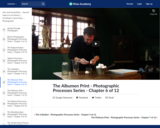
The albumen silver print, invented in 1850, was the most popular photographic …
The albumen silver print, invented in 1850, was the most popular photographic printing process of the 19th century. To make albumen silver prints, a sheet of paper is coated with albumen (egg white) and salts, then sensitized with a solution of silver nitrate. The paper is exposed in contact with a negative and printed out, which means that the image is created solely by the action of light on the sensitized paper without any chemical development. Because the paper is coated with albumen, the silver image is suspended on the surface of the paper rather than absorbed into the paper fibers. The result is a sharp image with fine detail on a smooth, glossy surface. This project is made possible by a grant from the U.S. Institute of Museum and Library Services, grant number MA-10-13-0194.
This site contains links to thousands of the most famous documentary photographs …
This site contains links to thousands of the most famous documentary photographs ever produced. The Farm Security Administrations's photographs cover the Great Depression, while the Office of War Administration's photographs look at the mobilization effort for World War II.
The focus of this lesson is to provide reading material and strategies …
The focus of this lesson is to provide reading material and strategies for idea development for an analytical essay. The reading will be based on the article “The ‘Pictures Generation” and students will be also asked to select a selfie image of themselves or of another person. The class discussion will foster a community of idea sharing which will translate well as supporting points in response to the writing prompt which will be given to students.
In 1943, Ansel Adams (1902-1984), America's best-known photographer, documented the Manzanar War …
In 1943, Ansel Adams (1902-1984), America's best-known photographer, documented the Manzanar War Relocation Center in California and the Japanese Americans interned there during World War II. The collection presents for the first time side-by-side digital scans of both Adams's 242 original negatives and his 209 photographic prints, allowing viewers to see his darkroom technique and in particular how he cropped his prints. Adams's Manzanar work is a departure from his signature style of landscape photography. Although a majority of the photographs are portraits, the images also include views of daily life, agricultural scenes, and sports and leisure activities.
In this activity, students will practice discussing their hobbies, likes, and dislikes. …
In this activity, students will practice discussing their hobbies, likes, and dislikes. They will be able to describe their daily activities. Students will also be able to discuss preferences they have about their daily activities. Students will learn to ask others questions about their schedule and daily activities.Can-Do Statements:I can ask and answer questions about my hobbies.I can talk about my favorite hobby and my least favorite hobby.I know how to use "after" or "before" in a sentence.
Sanaz Mazinani is an artist with a background in political activism who …
Sanaz Mazinani is an artist with a background in political activism who uses art to inspire dialogue about perceptions of cultural identity. In the latest episode of Art School, she describes her current art practice. Using online media focusing on world news and pop culture as her source material, she creates symmetrical photo collages and videos that abstract familiar images and invite viewers to reconsider visual culture and its meaning and influence on public opinion and social justice. In this episode of Art School, she describes her current art practice and the intentions behind her recent installation at the Asian Art Museum in San Francisco.
In the second video Mazinani expands on the intention of traditional of Islamic ornamentation.
This course is an exploration of visual art forms and their cultural …
This course is an exploration of visual art forms and their cultural connections for the student with little experience in the visual arts. It includes a brief study of art history and in depth studies of the elements, media, and methods used in creative processes and thought. Upon successful completion of this course, students will be able to: interpret examples of visual art using a five-step critical process that includes description, analysis, context, meaning, and judgment; identify and describe the elements and principles of art; use analytical skills to connect formal attributes of art with their meaning and expression; explain the role and effect of the visual arts in societies, history, and other world cultures; articulate the political, social, cultural, and aesthetic themes and issues that artists examine in their work; identify the processes and materials involved in art and architectural production; utilize information to locate, evaluate, and communicate information about visual art in its various forms. Note that this course is an alternative to the Saylor FoundationĺÎĺ_ĺĚĺ_s ARTH101A and has been developed through a partnership with the Washington State Board for Community and Technical Colleges; the Saylor Foundation has modified some WSBCTC materials. This free course may be completed online at any time. (Art History 101B)
Students will learn about the jazz singer Billie Holiday and the sociohistorical …
Students will learn about the jazz singer Billie Holiday and the sociohistorical context in which she performed. They will learn how discriminatory statutes (called Jim Crow laws) affected daily life. They will also analyze how movement is created in photographs and the effect of a photographer's point of view on composition. Finally, students will photograph a musician, paying attention to what can be communicated through point of view.
Students will learn about axial movements and locomotor movements by discussing dancers …
Students will learn about axial movements and locomotor movements by discussing dancers depicted in a drawing and photograph. They will then practice combining axial and locomotor movements. They will describe how artists depict a dancer's motion in drawing and photography. They will also analyze how an artist creates movement and emphasis through contrast, composition, and leading lines, and then experiment with photography to capture motion in dance.
From the ancient discovery of the camera obscura to the 18th century …
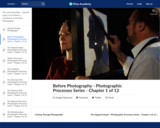
From the ancient discovery of the camera obscura to the 18th century mechanical devices used to create silhouettes such as the physionotrace, this initial chapter explores the inventions and inventors that preceded photography. It recreates the experiments of Johann Schulze who proved the light sensitivity of certain silver salts and Thomas Wedgwood’s early attempts to make photographic images. These early pioneers contributed to the discovery of photography in 1839. This project is made possible by a grant from the U.S. Institute of Museum and Library Services, grant number MA-10-13-0194.
Advanced-level students will write narratives from the perspective of slaves depicted in …
Advanced-level students will write narratives from the perspective of slaves depicted in rare photographs, and then create a print depicting a moment from the narratives.
Breaking the frame: Ways of Reading Native Photography My OER showcases the …
Breaking the frame: Ways of Reading Native Photography
My OER showcases the use of Native American photography as a means of enabling students to connect with historical and contemporary Native issues. Using specific in-class exercises as examples I will show how Native photography addresses issues of racial identity, stereotypes, the sexualizing of Native bodies, and Native American history. I will discuss how the writing of the formal analysis of this photography as art also enables students to engage with the art through a reading that elucidates the contemporary lives of Native individuals and communities. The OER will show how interactive exploration of artistic meaning, and the messages therein, in Native photography leads to increased student intellectual awareness and understanding of the indigenous world around them.
Students create and use pinhole cameras to understand how artists use and …
Students create and use pinhole cameras to understand how artists use and manipulate light to capture images in photographs. They shoot and develop photographs made with pinhole cameras. They compare and contrast a nineteenth-century image, photographs taken with a pinhole camera, and pictures created with a digital camera or camera phone.
Students create pinhole cameras to understand that light travels in a straight …
Students create pinhole cameras to understand that light travels in a straight path. They describe the lines and shapes in a nineteenth-century photograph of a building and then use their pinhole cameras to trace the architecture of their school building.
Students create pinhole cameras to learn how artists manipulate light to make …
Students create pinhole cameras to learn how artists manipulate light to make photographs. They describe and analyze a nineteenth-century photograph and use their cameras to capture the architecture of their school or other buildings.
SYNOPSIS: In this lesson, students watch videos and learn about photography to …
SYNOPSIS: In this lesson, students watch videos and learn about photography to implement photography techniques in their stop motion projects.
SCIENTIST NOTES: This lesson focuses on photographic stop motion animation techniques. Climate change can be a part of this lesson. All materials used in the lesson have been verified and are suitable for teaching. In this light, this lesson is credible and recommended for the classroom.
POSITIVES: -The photography and stop motion video examples are all related to climate change to spark intrigue and start discussions. -There is deep learning about photography techniques.
ADDITIONAL PREREQUISITES: -This is lesson 3 of 4 in our 3rd-5th grade Animate for the Animals unit. -The teacher will need to organize worksheets for students. -The teacher will need to ensure that there are devices available if the Investigate section is done individually or in small groups.
DIFFERENTIATION: -Student partners could be chosen by the teacher to ensure good academic and social balance. -Students could explore the Investigate section in groups instead of having the teacher lead the discussion. The whole class could come back together to discuss their new knowledge after the groups are finished.
Ranu Mukherjee creates "Hybrid films" using layers of video, paintings and collage …
Ranu Mukherjee creates "Hybrid films" using layers of video, paintings and collage to create moving images. In the latest episode of Art School, Mukherjee unpacks the narrative and details behind her newest piece, Home and the World, which examines cultural hybridity, the aftermath of colonialism, and feminist questions. Inspired by a scene from a film by Satyajit Ray, as well as the composition of traditional Indian lithographs, Mukherjee combined these influences with her own visual culture to create a subtle but complex moving image.
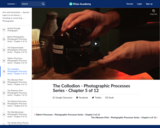
Introduced in 1851, by Frederick Scott Archer, the wet collodion process was …
Introduced in 1851, by Frederick Scott Archer, the wet collodion process was a fairly simple, if somewhat cumbersome photographic process. A 2% solution of collodion, bearing a very small percentage of potassium iodide, was poured over a plate of glass, leaving a thin, clear film containing the halide. The plate was then placed in a solution of silver nitrate. When removed from the silver, the collodion film contained a translucent yellow compound of light-sensitive silver iodide. The plate was exposed still wet and then developed by inspection under red light. Once the plate was washed and dried, it was coated with a protective varnish. The collodion process replaced the daguerreotype as the predominant photographic process by the end of the 1850’s. It was eventually replaced in the 1880’s with the introduction of the gelatin silver process. This project is made possible by a grant from the U.S. Institute of Museum and Library Services, grant number MA-10-13-0194.
No restrictions on your remixing, redistributing, or making derivative works. Give credit to the author, as required.
Your remixing, redistributing, or making derivatives works comes with some restrictions, including how it is shared.
Your redistributing comes with some restrictions. Do not remix or make derivative works.
Most restrictive license type. Prohibits most uses, sharing, and any changes.
Copyrighted materials, available under Fair Use and the TEACH Act for US-based educators, or other custom arrangements. Go to the resource provider to see their individual restrictions.