Word Count: 70634 (Note: This resource's metadata has been created automatically by …
Word Count: 70634
(Note: This resource's metadata has been created automatically by reformatting and/or combining the information that the author initially provided as part of a bulk import process.)
Students engage in hands-on, true-to-life research experiences on air quality topics chosen …
Students engage in hands-on, true-to-life research experiences on air quality topics chosen for personal interest through a unit composed of one lesson and five associated activities. Using a project-based learning approach suitable for secondary science classrooms and low-cost air quality monitors, students gain the background and skills needed to conduct their own air quality research projects. The curriculum provides: 1) an introduction to air quality science, 2) data collection practice, 3) data analysis practice, 4) help planning and conducting a research project and 5) guidance in interpreting data and presenting research in professional poster format. The comprehensive curriculum requires no pre-requisite knowledge of air quality science or engineering. This curriculum takes advantage of low-cost, next-generation, open-source air quality monitors called Pods. These monitors were developed in a mechanical engineering lab at the University of Colorado Boulder and are used for academic research as well as education and outreach. The monitors are made available for use with this curriculum through AQ-IQ Kits that may be rented from the university by teachers. Alternatively, nearly the entire unit, including the student-directed projects, could also be completed without an air quality monitor. For example, students can design research projects that utilize existing air quality data instead of collecting their own, which is highly feasible since much data is publically available. In addition, other low-cost monitors could be used instead of the Pods. Also, the curriculum is intentionally flexible, so that the lesson and its activities can be used individually. See the Other section for details about the Pods and ideas for alternative equipment, usage without air quality monitors, and adjustments to individually teach the lesson and activities.
D-Lab: Design addresses problems faced by undeserved communities with a focus on …
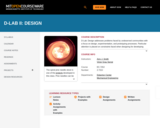
D-Lab: Design addresses problems faced by undeserved communities with a focus on design, experimentation, and prototyping processes. Particular attention is placed on constraints faced when designing for developing countries. Multidisciplinary teams work on semester-long projects in collaboration with community partners, field practitioners, and experts in relevant fields. Topics covered include design for affordability, design for manufacture, sustainability, and strategies for working effectively with community partners and customers. Students may continue projects begun in EC.701J D-Lab I: Development.
Welcome to 2.007! This course is a first subject in engineering design. …
Welcome to 2.007! This course is a first subject in engineering design. With your help, this course will be a great learning experience exposing you to interesting material, challenging you to think deeply, and providing skills useful in professional practice. A major element of the course is design of a robot to participate in a challenge that changes from year to year. This year, the theme is cleaning up the planet as inspired by the movie Wall-E. From its beginnings in 1970, the 2.007 final project competition has grown into an Olympics of engineering. See this MIT News story for more background, a photo gallery, and videos about this course.
The purpose of this course is to convey knowledge of the various …
The purpose of this course is to convey knowledge of the various physical processes associated with slurry handling and transport during dredging. This knowledge is needed for the design of dredging equipment and for planning efficient equipment operations. The various processes are discussed and theories and simulation models that describe the processes are presented and compared during the course. The course can be broken down into four elements: 1. Pumps and engines a. Pump characteristics and cavitation b. Influence of particles on pump characteristics. 2. Hydraulic transport in pipelines a. Two-phase (solid-liquid) flow through pipelines b. Newtonian slurries c. Non Newtonian slurries d. Inclined and long pipelines. 3. Pump and pipeline systems a. Operation point and areas b. Production factors. 4. Case studies
Introduction to dynamics and vibration of lumped-parameter models of mechanical systems. Three-dimensional …
Introduction to dynamics and vibration of lumped-parameter models of mechanical systems. Three-dimensional particle kinematics. Force-momentum formulation for systems of particles and for rigid bodies (direct method). Newton-Euler equations. Work-energy (variational) formulation for systems particles and for rigid bodies (indirect method). Virtual displacements and work. Lagrange's equations for systems of particles and for rigid bodies. Linearization of equations of motion. Linear stability analysis of mechanical systems. Free and forced vibration of linear damped lumped parameter multi-degree of freedom models of mechanical systems. Application to the design of ocean and civil engineering structures such as tension leg platforms. This subject was originally offered in Course 13 (Department of Ocean Engineering) as 13.013J. In 2005, ocean engineering became part of Course 2 (Department of Mechanical Engineering), and this subject merged with 2.003.
Lagrangian and Bond Graph Methods Short Description: This open education resource presents …
Lagrangian and Bond Graph Methods
Short Description: This open education resource presents effective system modelling methods, including Lagrangian and bond graph, and the application of a relevant engineering software tool, 20-sim. The content is designed for engineering students and professionals in the field to support their understanding and application of these methods for modelling, simulation, and design of engineering systems. The text also includes videos showing selected worked-out examples.
Long Description: This textbook emphasizes the fundamentals of modelling methods—including Lagrangian and bond graph—and introduces a software tool for modelling and simulation to support the design of common engineering systems. This approach minimizes the time-consuming effort of manipulating and extracting system equations and writing computer code for integrating and finding their solution. We believe that our approach helps both students and professionals currently working in the field to become more productive engineers. Videos of selected worked-out examples help the reader understand the topic and applications for real-world engineering systems. This book comprises of 11 chapters.
Word Count: 41611
ISBN: 978-1-990132-09-4
(Note: This resource's metadata has been created automatically by reformatting and/or combining the information that the author initially provided as part of a bulk import process.)
Students follow the steps of the engineering design process (EDP) while learning …
Students follow the steps of the engineering design process (EDP) while learning about assistive devices and biomedical engineering. They first go through a design-build-test activity to learn the steps of the cyclical engineering design process. Then, during the three main activities (7 x 55 minutes each) student teams are given a fictional client statement and follow the EDP steps to design products an off-road wheelchair, a portable wheelchair ramp, and an automatic floor sweeper computer program. Students brainstorm ideas, identify suitable materials and demonstrate different methods of representing solutions to their design problems scale drawings or programming descriptions, and simple models or classroom prototypes.
This course focuses on the thermal, luminous, and acoustic behavior of buildings, …
This course focuses on the thermal, luminous, and acoustic behavior of buildings, examining the basic scientific principles underlying these phenomena and introducing students to technologies and analysis techniques for designing comfortable indoor environments. Students are challenged to apply these techniques and explore the role light, energy, and sound can play in shaping architecture.
This course introduces finite element methods for the analysis of solid, structural, …
This course introduces finite element methods for the analysis of solid, structural, fluid, field, and heat transfer problems. Steady-state, transient, and dynamic conditions are considered. Finite element methods and solution procedures for linear and nonlinear analyses are presented using largely physical arguments. The homework and a term project (for graduate students) involve use of the general purpose finite element analysis program ADINA. Applications include finite element analyses, modeling of problems, and interpretation of numerical results.
Finite element analysis is now widely used for solving complex static and …
Finite element analysis is now widely used for solving complex static and dynamic problems encountered in engineering and the sciences. In these two video courses, Professor K. J. Bathe, a researcher of world renown in the field of finite element analysis, teaches the basic principles used for effective finite element analysis, describes the general assumptions, and discusses the implementation of finite element procedures for linear and nonlinear analyses. These videos were produced in 1982 and 1986 by the MIT Center for Advanced Engineering Study.
UCSD Division of Physical Sciences presents a discussion on global warming and …
UCSD Division of Physical Sciences presents a discussion on global warming and the prospects of a hydrogen economy. The featured speakers are: Joseph J. Romm, executive director of the Center for Energy and Climate Solutions and author of The Hype About Hydrogen - Fact and Fiction in the Race to Save the Climate; and Franklin M. (Lynn) Orr, Jr. professor of petroleum engineering and project director of the Global Climate and Energy Project at Stanford University. (59 minutes)
The Girls Who Build: Make Your Own Wearables workshop for high school …
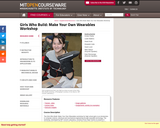
The Girls Who Build: Make Your Own Wearables workshop for high school girls is an introduction to computer science, electrical and mechanical engineering through wearable technology. The workshop, developed by MIT Lincoln Laboratory, consists of two major hands-on projects in manufacturing and wearable electronics. These include 3D printing jewelry and laser cutting a purse, as well as programming LEDs to light up when walking. Participants learn the design process, 3D computer modeling, and machine shop tools, in addition to writing code and building a circuit.
This textbook provides an introduction to the MATLAB programming language for first-year …
This textbook provides an introduction to the MATLAB programming language for first-year mechanical engineering students enrolled in ME 160. Designed to follow the content taught in class, this book provides a supplement to in-class learning that is presented at a level that is understandable to a student with no experience coding before coming to Iowa State University.
Students further their understanding of the engineering design process while combining mechanical …
Students further their understanding of the engineering design process while combining mechanical engineering and bioengineering to create an automated medical device. During the activity, students are given a fictional client statement and are required to follow the steps of the design process to create medical devices that help reduce the workload for hospital workers and increase the quality of patient care.
2.51 is a 12-unit subject, serving as the Mechanical Engineering Department's advanced …
2.51 is a 12-unit subject, serving as the Mechanical Engineering Department's advanced undergraduate course in heat and mass transfer. The prerequisites for this course are the undergraduate courses in thermodynamics and fluid mechanics, specifically Thermal Fluids Engineering I and Thermal Fluids Engineering II or their equivalents. This course covers problems of heat and mass transfer in greater depth and complexity than is done in those courses and incorporates many subjects that are not included or are treated lightly in those courses; analysis is given greater emphasis than the use of correlations. Course 2.51 is directed at undergraduates having a strong interest in thermal science and graduate students who have not previously studied heat transfer.
This course begins by introducing students to aspects of fluid dynamics relevant …
This course begins by introducing students to aspects of fluid dynamics relevant to transport and deposition of particulate sedimentary materials. Emphasis is on the structure of turbulent shear flows and the forces exerted by fluid motions on bed of loosed sediment. With fluid dynamics as background, the course deals with sediment movement as bed load and suspended load, and with the geometry, kinematics, and dynamics of ripple and dune bed forms. The course concludes with basic material on the styles of current-generated primary sedimentary structures, with emphasis on cross stratification.
Short Description: A collection of readings and exercises aligned with the course, …
Short Description: A collection of readings and exercises aligned with the course, ME 270, Introduction to Mechanical Engineering Design, at Iowa State University. This course provides an overview of mechanical engineering design with applications to thermal and mechanical systems, and an introduction to current design practices used in industry. As part of the course design, learners will complete a semester-long team project focused on addressing societal needs.
Long Description: A collection of readings and exercises aligned with the course, ME 270, Introduction to Mechanical Engineering Design, at Iowa State University. This course provides an overview of mechanical engineering design with applications to thermal and mechanical systems, and an introduction to current design practices used in industry. As part of the course design, learners will complete a semester-long team project focused on addressing societal needs.
Word Count: 19507
Included H5P activities: 71
(Note: This resource's metadata has been created automatically by reformatting and/or combining the information that the author initially provided as part of a bulk import process.)
Level 1 | Renton Technical College | January 2021 Long Description: This …
Level 1 | Renton Technical College | January 2021
Long Description: This book is an introduction of the SolidWorks software from a Mechanical Design role. It prepares students for beginning mechanical design and drafting and becoming a certified SolidWorks Associate.
Word Count: 27885
(Note: This resource's metadata has been created automatically by reformatting and/or combining the information that the author initially provided as part of a bulk import process.)
No restrictions on your remixing, redistributing, or making derivative works. Give credit to the author, as required.
Your remixing, redistributing, or making derivatives works comes with some restrictions, including how it is shared.
Your redistributing comes with some restrictions. Do not remix or make derivative works.
Most restrictive license type. Prohibits most uses, sharing, and any changes.
Copyrighted materials, available under Fair Use and the TEACH Act for US-based educators, or other custom arrangements. Go to the resource provider to see their individual restrictions.