This resource is a video abstract of a research paper created by …
This resource is a video abstract of a research paper created by Research Square on behalf of its authors. It provides a synopsis that's easy to understand, and can be used to introduce the topics it covers to students, researchers, and the general public. The video's transcript is also provided in full, with a portion provided below for preview:
"3D-printed with microscale precision, these tiny architectural marvels could be the key to making high-temperature ceramics less vulnerable to fracture. The implications could span across the numerous areas these materials are used, from aerospace to tissue engineering. The blueprint for these hardy structures is reported in the Journal of Materials Research Volume 33, Issue No. 3, earning honors as the 2018 JMR Paper of the Year. Researchers built the miniature trusses layer by layer using a technique called projection microstereolithography. In this process, a UV-light pattern is scanned across a polymer bath composed of photo-active ceramic building blocks. The silicon-based polymer solidifies at every point traced by the UV beam. Subsequent heating in a high-temperature furnace activates the polymer structures, baking off volatile organics, to produce silicon oxycarbide structures. The team then put these structures to the test..."
The rest of the transcript, along with a link to the research itself, is available on the resource itself.
This resource is a video abstract of a research paper created by …
This resource is a video abstract of a research paper created by Research Square on behalf of its authors. It provides a synopsis that's easy to understand, and can be used to introduce the topics it covers to students, researchers, and the general public. The video's transcript is also provided in full, with a portion provided below for preview:
"When modern 3D printing was invented in the early 1980s, few could have predicted the influence it has today. At no other time in history has it been this easy to transform a sketch into the real thing. And while that feat has proven immensely useful for constructing complex machines, it is unlikely more meaningful anywhere else today than in the field of biomedicine. With the ability to churn out standard or custom prosthetics, devices, and even test models, the 3D printing of biomaterials is revolutionizing medical care. One of the greatest conveniences afforded by biomedical 3D printing is the ability to manufacture parts on demand. Common load-bearing prosthetics, such as those for knee or hip replacements, no longer have to be built in bulk and benched before use. Virtually stored print files can be called upon and processed into parts as soon as they are needed in the clinic, with the printing material and method suited to the part’s function and placement..."
The rest of the transcript, along with a link to the research itself, is available on the resource itself.
Students define and classify alloys as mixtures, while comparing and contrasting the …
Students define and classify alloys as mixtures, while comparing and contrasting the properties of alloys to those of pure substances. Students learn that engineers investigate the structures and properties of alloys for biomedical and transportation applications. Pre- and post-assessment handouts are provided.
Acting as engineering teams, students take measurements and make calculations to determine …
Acting as engineering teams, students take measurements and make calculations to determine the specific strength of various alloys and then report their data to the rest of the class. Using this class data, students write data-based recommendations to NASA regarding the best alloy to use in the construction of the engine and engine turbines for the Space Launch System that will eventually be used to transport astronauts to Mars.
Students investigate the bone structure of a turkey femur and then create …
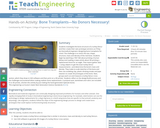
Students investigate the bone structure of a turkey femur and then create their own prototype versions as if they are biomedical engineers designing bone transplants for a bird. The challenge is to mimic the size, shape, structure, mass and density of the real bone. Students begin by watching a TED Talk about printing a human kidney and reading a news article about 3D printing a replacement bone for an eagle. Then teams gather data—using calipers to get the exact turkey femur measurements—and determine the bone’s mass and density. They make to-scale sketches of the bone and then use modeling clay, plastic drinking straws and pipe cleaners to create 3D prototypes of the bone. Next, groups each cut and measure a turkey femur cross-section, which they draw in CAD software and then print on a 3D printer. Students reflect on the design/build process and the challenges encountered when making realistic bone replacements. A pre/post-quiz, worksheet and rubric are included. If no 3D printer, shorten the activity by just making the hand-generated replicate bones.
Students explore the chemical identities of polymeric materials frequently used in their …
Students explore the chemical identities of polymeric materials frequently used in their everyday lives. They learn how chemical composition affects the physical properties of the materials that they encounter and use frequently, as well as how cross-linking affects the properties of polymeric materials.
This resource is a video abstract of a research paper created by …
This resource is a video abstract of a research paper created by Research Square on behalf of its authors. It provides a synopsis that's easy to understand, and can be used to introduce the topics it covers to students, researchers, and the general public. The video's transcript is also provided in full, with a portion provided below for preview:
"What makes rocket engines tough enough to withstand the incredibly high temperatures needed to escape Earth’s atmosphere? A closer look reveals part of the answer. Like tiny brick walls, the boundaries between these microscopic grains help stop the motion of defects that could lead to cracking. Keeping grains small, therefore, helps keep materials like this alloy strong and intact. But under certain conditions, some grains can start to grow--and fast--putting an otherwise durable material, and all it protects, at risk of serious damage. While researchers have generally attributed rapid grain growth to a single, common mechanism, a team from Sandia National Laboratories suggests that not all fast-moving grains are created equally. That insight might force scientists and engineers to rethink how to make metals stronger—and safer. Abnormally fast-growing grains are an important topic in materials research because of the risk they pose to the structural integrity of metal parts..."
The rest of the transcript, along with a link to the research itself, is available on the resource itself.
Students are introduced to the multidisciplinary field of material science. Through a …
Students are introduced to the multidisciplinary field of material science. Through a class demo and PowerPoint® presentation, they learn the basic classes of materials (metals, ceramics, polymers, composites) and how they differ from one another, considering concepts such as stress, strain, ductile, brittle, deformation and fracture. Practical examples help students understand how the materials are applied, and further information about specific research illustrates how materials and material science are useful in space exploration. A worksheet and quiz are provided.
This resource is a video abstract of a research paper created by …
This resource is a video abstract of a research paper created by Research Square on behalf of its authors. It provides a synopsis that's easy to understand, and can be used to introduce the topics it covers to students, researchers, and the general public. The video's transcript is also provided in full, with a portion provided below for preview:
"By coupling gold nanoparticles with a film of liquid crystals, researchers have assembled a structure whose optical properties can be modulated plasmonically. Able to switch between reflective and transparent, this “photonic sandwich” could find applications as a controllable light filter or smart mirror. Under light of a certain color, electrons in plasmonic nanoparticles sway in unison, generating a distinct optical signature sensitive to the size and shape of the nanoparticles and their immediate environment. For that reason, plasmonic nanoparticles have been used as biological and chemical sensors. And because that quivering of electrons can generate heat, these tiny particles have been valuable in sizzling tumor cells away with better-than-surgical precision. Despite these advanced applications, researchers are just beginning to understand how photo-excited nanoparticles deliver heat to their surroundings..."
The rest of the transcript, along with a link to the research itself, is available on the resource itself.
This resource is a video abstract of a research paper created by …
This resource is a video abstract of a research paper created by Research Square on behalf of its authors. It provides a synopsis that's easy to understand, and can be used to introduce the topics it covers to students, researchers, and the general public. The video's transcript is also provided in full, with a portion provided below for preview:
"For more than 5,000 years, metals and alloys have been formed in roughly the same way—propelling civilization from the Bronze Age to the Industrial Revolution and to the Aerospace Age. Now there’s a new technique on the horizon that could help us take another big leap forward. It’s called high-entropy alloying, and the latest Focus issue of the Journal of Materials Research showcases scientists’ and engineers’ latest efforts in understanding high-entropy alloys and their potential applications. Traditional physical metallurgy uses an element with attractive properties as a base, and adds small amounts of other elements to improve those and other properties. Over thousands of years, various elements have been used as the base: first copper, then iron, then one by one across the periodic table, until researchers developed the first titanium alloys in the 1950s. It’s a method that’s proven incredibly effective. But there are signs that the approach may be reaching its natural limit..."
The rest of the transcript, along with a link to the research itself, is available on the resource itself.
Students explore materials engineering by modifying the material properties of water. Specifically, …
Students explore materials engineering by modifying the material properties of water. Specifically, they use salt to lower the freezing point of water and test it by making ice cream. Using either a simple thermometer or a mechatronic temperature sensor, students learn about the lower temperature limit at which liquid water can exist such that even if placed in contact with a material much colder than 0 degrees Celsius, liquid water does not get colder than 0 °C. This provides students with an example of how materials can be modified (engineered) to change their equilibrium properties. They observe that when mixed with salt, liquid water's lower temperature limit can be dropped. Using salt-ice mixtures to cool the ice cream mixes to temperatures lower than 0 °C works better than ice alone.
This book is a cloned version of Information Sources in Chemical and …
This book is a cloned version of Information Sources in Chemical and Materials Engineering by Alison Henry, published using Pressbooks under a CC BY (Attribution) license. It may differ from the original.
This resource is a video abstract of a research paper created by …
This resource is a video abstract of a research paper created by Research Square on behalf of its authors. It provides a synopsis that's easy to understand, and can be used to introduce the topics it covers to students, researchers, and the general public. The video's transcript is also provided in full, with a portion provided below for preview:
"In September of 2016, a violent storm left South Australia without power. At the time, 57% of the region's power came from wind and solar-a stark contrast to the coal-dominated energy mix of its neighbors to the east. To some politicians and backers of coal, it was proof that renewable energy couldn't be trusted. To renewable energy pioneers, it was a technical challenge: could a large-enough battery cushion the swings in wind and solar power? In a recent review article published in MRS Energy & Sustainability, energy experts weigh in, considering-among other factors-the political and legal ramifications of going big with batteries. The summer after South Australia's big blackout, the state government doubled down and announced the construction of the world's biggest battery. Within 100 days, the clean-energy company Tesla delivered a 129-MWh lithium-ion battery, all for $91 million without government subsidies..."
The rest of the transcript, along with a link to the research itself, is available on the resource itself.
This resource is a video abstract of a research paper created by …
This resource is a video abstract of a research paper created by Research Square on behalf of its authors. It provides a synopsis that's easy to understand, and can be used to introduce the topics it covers to students, researchers, and the general public. The video's transcript is also provided in full, with a portion provided below for preview:
"Many materials scientists are in the business of “feeling” things out. Using a testing method known as nanoindentation, they’re able to tell how hard or strong a material is (and, to some extent, what it’s made of) much the same way we do—by pressing down on it. Now, researchers at the National Institute of Standards and Technology have expanded the technique to include an important material behavior previously inaccessible to these robotic fingertips: viscoelasticity. This new ability could help researchers better predict how up-and-coming supermaterials such as carbon nanotube-polymer composites behave, leading to the design of stronger and safer materials. Think about the last time you shopped for a new mattress. At some point, you probably considered going with the memory foam option (swayed, perhaps, by its billing as a NASA-designed material). What makes memory foam able to contour to your body is its viscoelastic properties..."
The rest of the transcript, along with a link to the research itself, is available on the resource itself.
Material Science problems for the WeBWorK open online homework system. Includes problems …
Material Science problems for the WeBWorK open online homework system. Includes problems from second- and third-year level (third year topics specifically aimed at mechanical engineering students).
The "tested" problems have been deployed in a class. The "untested" problems have been tested by the creators, but not yet deployed in a class.
These problems need to be uploaded into an instance of WeBWorK to use/assign them.
Examines the ways in which people in ancient and contemporary societies have …
Examines the ways in which people in ancient and contemporary societies have selected, evaluated, and used materials of nature, transforming them to objects of material culture. Some examples: glass in ancient Egypt and Rome; powerful metals in the Inka empire; rubber processing in ancient Mexico. Explores ideological and aesthetic criteria often influential in materials development. Laboratory/workshop sessions provide hands-on experience with materials discussed in class. Subject complements 3.091. Enrollment may be limited.
This resource is a video abstract of a research paper created by …
This resource is a video abstract of a research paper created by Research Square on behalf of its authors. It provides a synopsis that's easy to understand, and can be used to introduce the topics it covers to students, researchers, and the general public. The video's transcript is also provided in full, with a portion provided below for preview:
"It took scientists more than 25 years to work out the structure of silicon’s 7x7 surface reconstruction. Since reaching that milestone, experimental and theoretical studies have supported that this reconstruction produces a conductive, metallic surface. But new data gathered by an international team of researchers from Spain, the Philippines, France, and the United Kingdom say otherwise—a contradiction that could have technological implications for the integration of 2D silicon into electronic devices. The most widely accepted picture of silicon 111 ’s 7x7 surface reconstruction is the so-called dimer-adatom-stacking fault model. Here, dangling bonds produced by cleaving the bulk crystal occur on silicon adatoms, which are bonded to underlying bulk-silicon atoms, and on rest atoms in the lower layer. The rearrangement of charge associated with this structure produces an odd number of electrons, which implies that the surface should be metallic..."
The rest of the transcript, along with a link to the research itself, is available on the resource itself.
This resource is a video abstract of a research paper created by …
This resource is a video abstract of a research paper created by Research Square on behalf of its authors. It provides a synopsis that's easy to understand, and can be used to introduce the topics it covers to students, researchers, and the general public. The video's transcript is also provided in full, with a portion provided below for preview:
"A new 3D-printable hydrogel could provide the perfect platform for growing, studying and perhaps even repairing critical brain cells linked to diseases such as multiple sclerosis. This is an oligodendrocyte. Oligodendrocytes pave a protein-rich path along neuronal axons that helps relay and even boost electrical signals. That makes communication across the vast central nervous system possible. Disruption of that critical function can lead to weakness, numbness or even paralysis, hallmarks of diseases like multiple sclerosis. While researchers have slowly gained a better understanding of how and why oligodendrocyte function is compromised, collectively, that work paints a grainy picture of what’s really going on. Not only is it virtually impossible to watch these destructive processes unfold inside the body. But also, methods designed to recreate the behavior of these cells in the lab are often too simplistic, offering a 2D view of what is inherently a 3D process..."
The rest of the transcript, along with a link to the research itself, is available on the resource itself.
This resource is a video abstract of a research paper created by …
This resource is a video abstract of a research paper created by Research Square on behalf of its authors. It provides a synopsis that's easy to understand, and can be used to introduce the topics it covers to students, researchers, and the general public. The video's transcript is also provided in full, with a portion provided below for preview:
"As materials scientists know well, one reliable way to make strong metals even stronger is to shrink their already-tiny crystalline grains. It’s a time-tested technique that’s made today’s cars, planes, and armor safer than ever. But at the nanoscale, grains are notoriously fickle. Their strong tendency to grow makes it nearly impossible for researchers to chase higher levels of strength. But that could soon change. A new computer model developed by researchers from MIT shows how nano-sized grains might be stabilized in metal alloys. Their findings could provide the blueprint for constructing harder and stronger metals. Alloying one metal with another is one technique that has helped researchers push grain sizes to smaller and smaller scales—thanks to a process known as segregation. As the grains in a metal shrink, the addition of a small amount of an alloying metal segregate, or adhere, to the boundaries between different grains..."
The rest of the transcript, along with a link to the research itself, is available on the resource itself.
Students conduct an experiment to determine how varying the composition of a …
Students conduct an experiment to determine how varying the composition of a construction material affects its strength. They make several adobe bricks with differing percentages of sand, soil, fibrous material and water. They test the bricks for strength by dropping them onto a concrete surface from progressively greater heights. Students graph the experiment results and use what they learn to design their own special mix that maximizes the bricks' strength. During the course of the experiment, students learn about variables (independent, dependent, control) and the steps of the engineering design process.
No restrictions on your remixing, redistributing, or making derivative works. Give credit to the author, as required.
Your remixing, redistributing, or making derivatives works comes with some restrictions, including how it is shared.
Your redistributing comes with some restrictions. Do not remix or make derivative works.
Most restrictive license type. Prohibits most uses, sharing, and any changes.
Copyrighted materials, available under Fair Use and the TEACH Act for US-based educators, or other custom arrangements. Go to the resource provider to see their individual restrictions.