The lesson begins with a demonstration introducing students to the force between …
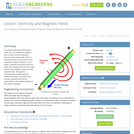
The lesson begins with a demonstration introducing students to the force between two current carrying loops, comparing the attraction and repulsion between the loops to that between two magnets. After formal lecture on Ampere's law, students begin to use the concepts to calculate the magnetic field around a loop. This is applied to determine the magnetic field of a toroid, imagining a toroid as a looped solenoid.
This is the first of a two-semester subject sequence that provides the …
This is the first of a two-semester subject sequence that provides the foundations for contemporary research in selected areas of atomic and optical physics. Topics covered include the interaction of radiation with atoms: resonance; absorption, stimulated and spontaneous emission; methods of resonance, dressed atom formalism, masers and lasers, cavity quantum electrodynamics; structure of simple atoms, behavior in very strong fields; fundamental tests: time reversal, parity violations, Bell's inequalities; and experimental methods.
This Freshman Advising Seminar surveys the many applications of magnets and magnetism. …
This Freshman Advising Seminar surveys the many applications of magnets and magnetism. To the Chinese and Greeks of ancient times, the attractive and repulsive forces between magnets must have seemed magical indeed. Through the ages, miraculous curative powers have been attributed to magnets, and magnets have been used by illusionists to produce "magical" effects. Magnets guided ships in the Age of Exploration and generated the electrical industry in the 19th century. Today they store information and entertainment on disks and tapes, and produce sound in speakers, images on TV screens, rotation in motors, and levitation in high-speed trains. Students visit various MIT projects related to magnets (including superconducting electromagnets) and read about and discuss the history, legends, pseudoscience, science, and technology of types of magnets, including applications in medicine. Several short written reports and at least one oral presentation will be required of each participant.
This lesson begins with a demonstration prompting students to consider how current …
This lesson begins with a demonstration prompting students to consider how current generates a magnetic field and the direction of the field that is generated. Through formal lecture, students learn Biot-Savart's law in order to calculate, most simply, the magnetic field produced in the center of a circular current carrying loop. For applications, students find it is necessary to integrate the field produced over all small segments in an actual current carrying wire.
This lesson discusses the result of a charge being subject to both …
This lesson discusses the result of a charge being subject to both electric and magnetic fields at the same time. It covers the Hall effect, velocity selector, and the charge to mass ratio. Given several sample problems, students learn to calculate the Hall Voltage dependent upon the width of the plate, the drift velocity, and the strength of the magnetic field. Then students learn to calculate the velocity selector, represented by the ratio of the magnitude of the fields assuming the strength of each field is known. Finally, students proceed through a series of calculations to arrive at the charge to mass ratio. A homework set is included as an evaluation of student progress.
Students design and construct electromagnets that must pick up 10 staples. They …
Students design and construct electromagnets that must pick up 10 staples. They begin with only minimal guidance, and after the basic concept is understood, are informed of the properties that affect the strength of that magnet. They conclude by designing their own electromagnets to complete the challenge of separating scrap steel from scrap aluminum for recycling, and share it with the class.
Students use the same method as in the activity from lesson 2 …
Students use the same method as in the activity from lesson 2 of this unit to explore the magnetism due to electric current instead of a permanent magnet. Students use a compass and circuit to trace the magnetic field lines induced by the electric current moving through the wire. Students develop an understanding of the effect of the electrical current on the compass needle through the induced magnetic field and understand the complexity of a three dimensional field system.
Students are challenged to design a method for separating steel from aluminum …
Students are challenged to design a method for separating steel from aluminum based on magnetic properties as is frequently done in recycling operations. To complicate the challenge, the magnet used to separate the steel must be able to be switched off to allow for the recollection of the steel. Students must ultimately design, test, and present an effective electromagnet.
Student teams investigate the properties of electromagnets. They create their own small …
Student teams investigate the properties of electromagnets. They create their own small electromagnet and experiment with ways to change its strength to pick up more paper clips. Students learn about ways that engineers use electromagnets in everyday applications.
Students use a compass and a permanent magnet to trace the magnetic …
Students use a compass and a permanent magnet to trace the magnetic field lines produced by the magnet. By positioning the compass in enough spots around the magnet, the overall magnet field will be evident from the collection of arrows representing the direction of the compass needle. In activities 3 and 4 of this unit, students will use this information to design a way to solve the grand challenge of separating metal for a recycling company.
The grand challenge for this legacy cycle unit is for students to …
The grand challenge for this legacy cycle unit is for students to design a way to help a recycler separate aluminum from steel scrap metal. In previous lessons, they have looked at how magnetism might be utilized. In this lesson, students think about how they might use magnets and how they might confront the problem of turning the magnetic field off. Through the accompanying activity students explore the nature of an electrically induced magnetic field and its applicability to the needed magnet.
In this activity, the students will complete the grand challenge and design …
In this activity, the students will complete the grand challenge and design an electromagnet to separate steel from aluminum for the recycler. In order to do this, students compare the induced magnetic field of an electric current with the magnetic field of a permanent magnet and must make the former look like the latter. They discover that looping the current produces the desired effect and find ways to further strengthen the magnetic field.
In this introduction to light energy, students learn about reflection and refraction …
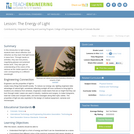
In this introduction to light energy, students learn about reflection and refraction as they learn that light travels in wave form. Through hands-on activities, they see how prisms, magnifying glasses and polarized lenses work. They also gain an understanding of the colors of the rainbow as the visible spectrum, each color corresponding to a different wavelength.
This course is designed to be a survey of the various subdisciplines …
This course is designed to be a survey of the various subdisciplines of geophysics (geodesy, gravity, geomagnetism, seismology, and geodynamics) and how they might relate to or be relevant for other planets. No prior background in Earth sciences is assumed, but students should be comfortable with vector calculus, classical mechanics, and potential field theory.
Through this lesson and its series of hands-on mini-activities, students answer the …
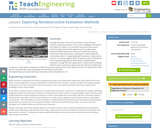
Through this lesson and its series of hands-on mini-activities, students answer the question: How can we investigate and measure the inside of an object or its structure if we cannot take it apart? Unlike the destructive nuclear weapon test (!), nondestructive evaluation (NDE) methods are able to accomplish this. After an introductory slide presentation, small groups rotate through five mini-activity stations: 1) applying Maxwell’s equations, 2) generating currents, 3) creating magnetic fields, 4) solving a system of equations, and 5) understanding why the finite element method (FEM) is important. Through the short experiments, students become familiar with the science and physics being used and make the mathematical connections. They explore components of NDE and see how engineers find unseen flaws and cracks in materials that make aircraft. A pre/post quiz, slide presentation and worksheet are included.
Play with a bar magnet and coils to learn about Faraday's law. …
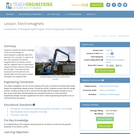
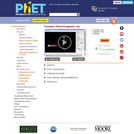
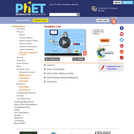
Play with a bar magnet and coils to learn about Faraday's law. Move a bar magnet near one or two coils to make a light bulb glow. View the magnetic field lines. A meter shows the direction and magnitude of the current. View the magnetic field lines or use a meter to show the direction and magnitude of the current. You can also play with electromagnets, generators and transformers!
Light a light bulb by waving a magnet. This demonstration of Faraday's …
Light a light bulb by waving a magnet. This demonstration of Faraday's Law shows you how to reduce your power bill at the expense of your grocery bill.
Light a light bulb by waving a magnet. This demonstration of Faraday's …
Light a light bulb by waving a magnet. This demonstration of Faraday's Law shows you how to reduce your power bill at the expense of your grocery bill.
Students use a simple set up consisting of a current carrying wire …
Students use a simple set up consisting of a current carrying wire and a magnet to explore the forces which enable biomedical imaging. In doing so, students run a current through a wire and then hold magnets in various positions to establish and explore the magnetic force acting on the wire. They move the magnets and change the current in the wire to explore how the force changes.
No restrictions on your remixing, redistributing, or making derivative works. Give credit to the author, as required.
Your remixing, redistributing, or making derivatives works comes with some restrictions, including how it is shared.
Your redistributing comes with some restrictions. Do not remix or make derivative works.
Most restrictive license type. Prohibits most uses, sharing, and any changes.
Copyrighted materials, available under Fair Use and the TEACH Act for US-based educators, or other custom arrangements. Go to the resource provider to see their individual restrictions.