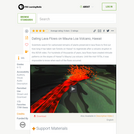
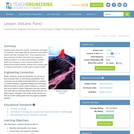
In this video segment adapted from NOVA, scientists search for carbonized remains …
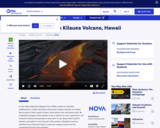
In this video segment adapted from NOVA, scientists search for carbonized remains of plants preserved in lava flows to find out how long it has taken rain forests on Hawaii to regenerate after a volcanic eruption.
This article, written for students in grades 4-5, discusses the world's most …
This article, written for students in grades 4-5, discusses the world's most southern active volcano, Mt. Erebus of Antarctica. Modified versions are available for students in younger grades.
While learning about volcanoes, magma and lava flows, students learn about the …
While learning about volcanoes, magma and lava flows, students learn about the properties of liquid movement, coming to understand viscosity and other factors that increase and decrease liquid flow. They also learn about lava composition and its risk to human settlements.
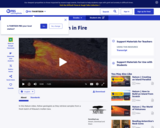
In this video segment adapted from NOVA, scientist Mike Garcia draws lava …
In this video segment adapted from NOVA, scientist Mike Garcia draws lava samples at the foot of the active Kilauea volcano to see if it is related to its neighboring volcano, Mauna Loa.
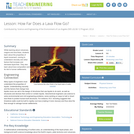
Students learn how volume, viscosity and slope are factors that affect the …
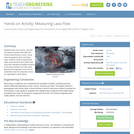
Students learn how volume, viscosity and slope are factors that affect the surface area that lava covers. Using clear transparency grids and liquid soap, students conduct experiments, make measurements and collect data. They also brainstorm possible solutions to lava flow problems as if they were geochemical engineers, and come to understand how the properties of lava are applicable to other liquids.
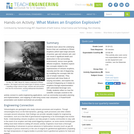
Students observe an in-classroom visual representation of a volcanic eruption. The water-powered …
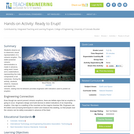
Students observe an in-classroom visual representation of a volcanic eruption. The water-powered volcano demonstration is made in advance, using sand, hoses and a waterballoon, representing the main components of all volcanoes. During the activity, students observe, measure and sketch the volcano, seeing how its behavior provides engineers with indicators used to predict an eruption.
Students learn about the causes, composition and types of volcanoes. They begin …
Students learn about the causes, composition and types of volcanoes. They begin with an overview of the Earth's interior and how volcanoes form. Once students know about how a volcano functions, they learn how engineers predict eruptions. In a class demonstration, students watch and measure a mock volcanic eruption and observe the phases of an eruption, seeing how a volcano gets its shape and provides us with clues to predict a blast.
Students learn about the underlying factors that can contribute to Plinian eruptions …
Students learn about the underlying factors that can contribute to Plinian eruptions (which eject large amounts of pumice, gas and volcanic ash, and can result in significant death and destruction in the surrounding environment), versus more gentle, effusive eruptions. Students explore two concepts related to the explosiveness of volcanic eruptions, viscosity and the rate of degassing, by modelling the concepts with the use of simple materials. They experiment with three fluids of varying viscosities, and explore the concept of degassing as it relates to eruptions through experimentation with carbonated beverage cans. Finally, students reflect on how the scientific concepts covered in the activity connect to useful engineering applications, such as community evacuation planning and implementation, and mapping of safe living zones near volcanoes. A PowerPoint® presentation and student worksheet are provided.
No restrictions on your remixing, redistributing, or making derivative works. Give credit to the author, as required.
Your remixing, redistributing, or making derivatives works comes with some restrictions, including how it is shared.
Your redistributing comes with some restrictions. Do not remix or make derivative works.
Most restrictive license type. Prohibits most uses, sharing, and any changes.
Copyrighted materials, available under Fair Use and the TEACH Act for US-based educators, or other custom arrangements. Go to the resource provider to see their individual restrictions.