Most exoplanets are found through indirect methods: measuring the dimming of a …
Most exoplanets are found through indirect methods: measuring the dimming of a star that happens to have a planet pass in front of it, called the transit method, or monitoring the spectrum of a star for the tell-tale signs of a planet pulling on its star and causing its light to subtly Doppler shift. Space telescopes have found thousands of planets by observing “transits,” the slight dimming of light from a star when its tiny planet passes between it and our telescopes. Other detection methods include gravitational lensing, the so-called “wobble method.”---------------------------------------Distant Nature: Astronomy Exercises 2016 by Stephen Tuttle under license "Creative Commons Attribution Non-Commercial Share Alike".
Using the planetarium program Stellarium, you will display the evening sky just …
Using the planetarium program Stellarium, you will display the evening sky just after sunset for the date and location of your birthplace. You will determine the times of the sunrise, sunset, and moon rise on your birthday, note the phase of the moon, and observe planetary positions and visibility. ---------------------------------------Distant Nature: Astronomy Exercises 2016 by Stephen Tuttle under license "Creative Commons Attribution Non-Commercial Share Alike".
In 1610, Galileo made the first telescopic survey of the Milky Way …
In 1610, Galileo made the first telescopic survey of the Milky Way and discovered that it is composed of a multitude of individual stars. Today, we know that the Milky Way comprises our view inward of the huge cosmic pinwheel that we call the Milky Way Galaxy and that is our home. Moreover, our Galaxy is now recognized as just one galaxy among many billions of other galaxies in the cosmos.---------------------------------------Distant Nature: Astronomy Exercises 2016 by Stephen Tuttle under license "Creative Commons Attribution Non-Commercial Share Alike".
Growing up at a time when the Hubble Space Telescope orbits above …
Growing up at a time when the Hubble Space Telescope orbits above our heads and giant telescopes are springing up on the great mountaintops of the world, you may be surprised to learn that we were not sure about the existence of other galaxies for a very long time. The very idea that other galaxies exist used to be controversial. Even into the 1920s, many astronomers thought the Milky Way encompassed all that exists in the universe. The evidence found in 1924 that meant our Galaxy is not alone was one of the great scientific discoveries of the twentieth century.---------------------------------------Distant Nature: Astronomy Exercises 2016 by Stephen Tuttle under license "Creative Commons Attribution Non-Commercial Share Alike".
This activity will focus on Kepler's Law which concerns planetary motion.---------------------------------------Distant Nature: …
This activity will focus on Kepler's Law which concerns planetary motion.---------------------------------------Distant Nature: Astronomy Exercises 2016 by Stephen Tuttle under license "Creative Commons Attribution Non-Commercial Share Alike".
Edwin Hubble examined the spectra of many galaxies, looking for the red …
Edwin Hubble examined the spectra of many galaxies, looking for the red (longer wavelengths) or blue (shorter wavelengths) shifts in the spectra, indicating relative motion. To his surprise, not only did all of the galaxies appear to be moving, but all were moving away from us, no matter the direction of the galaxy. In addition, he found most galaxies exhibited a redshift, and the redshift was larger the further it was from our galaxy.Distant Nature: Astronomy Exercises 2016 by Stephen Tuttle under license "Creative Commons Attribution Non-Commercial Share Alike".
Galileo, in 1612, demonstrated that the Sun rotates on its axis with …
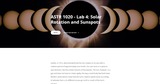
Galileo, in 1612, demonstrated that the Sun rotates on its axis with a rotation period of approximately one month. Our star turns in a west-to-east direction, like the orbital motions of the planets. The Sun, however, is a gas and does not have to rotate rigidly, the way a solid body like Earth does. Modern observations show that the Sun’s rotation speed varies according to latitude; that is, it’s different as you go north or south of the Sun’s equator. Between 1826 and 1850, Heinrich Schwabe, a German pharmacist and amateur astronomer kept daily records of the number of sunspots. What he was looking for was a planet inside the orbit of Mercury, which he hoped to find by observing its dark silhouette as it passed between the Sun and Earth. Unfortunately, he failed to find the hoped-for planet, but his diligence paid off with an even more important discovery: the sunspot cycle. He found that the number of sunspots varied systematically, in cycles about a decade long. In this laboratory, you will engage in tracking the Sun like Galileo and Schwabe during a six-day cycle and then do a simple calculation of the rotational period of our sun.---------------------------------------Distant Nature: Astronomy Exercises 2016 by Stephen Tuttle under license "Creative Commons Attribution Non-Commercial Share Alike".
Given the spectral classification of a distant giant star, you will use …
Given the spectral classification of a distant giant star, you will use the H-R diagram to estimate its absolute magnitude and luminosity. From the distance modulus formula, you will estimate its distance via spectroscopic parallax. From the spectral type, you will estimate its surface temperature and then use the luminosity formula to estimate the diameter of your giant star.---------------------------------------Distant Nature: Astronomy Exercises 2016 by Stephen Tuttle under license "Creative Commons Attribution Non-Commercial Share Alike".
A plot of luminosity vs. time is a ‘light curve’. In this …
A plot of luminosity vs. time is a ‘light curve’. In this laboratory, we will use a light curve to determine the diameter of two stars in a binary system. --------------------------------------- Distant Nature: Astronomy Exercises 2016 by Stephen Tuttle under license "Creative Commons Attribution Non-Commercial Share Alike".
This laboratory measures the parallax shift of the Delta Leonis and uses …
This laboratory measures the parallax shift of the Delta Leonis and uses a Spectral Classification Table to calculate the radius of this star from its temperature.---------------------------------------Distant Nature: Astronomy Exercises 2016 by Stephen Tuttle under license "Creative Commons Attribution Non-Commercial Share Alike".
This laboratory consists of two parts. In part A, we will follow …
This laboratory consists of two parts. In part A, we will follow Hubble’s method of measuring distances. Using pulsation time periods, we will obtain the absolute magnitude of a Cepheid variable and convert this absolute magnitude into luminosity which will, in turn, give us the distance. In Part B, we will use spectral shift (the Doppler effect) to determine the Hubble Constant. --------------------------------------- Distant Nature: Astronomy Exercises 2016 by Stephen Tuttle under license "Creative Commons Attribution Non-Commercial Share Alike".
In Part B, we will use a Python computer coding script to …
In Part B, we will use a Python computer coding script to obtain a spectral redshift of a galaxy (M100). From this redshift, we will use the Doppler formula to find a recession speed. From this speed, we will apply Hubble’s Law to obtain the Hubble Constant.---------------------------------------Distant Nature: Astronomy Exercises 2016 by Stephen Tuttle under license "Creative Commons Attribution Non-Commercial Share Alike".
These HyperDocs are intended to be used as standalone lab resources for …
These HyperDocs are intended to be used as standalone lab resources for an online Anatomy & Physiology 1 Lab.Within the Study Activities section at the end of each document, the red, bolded, and capitalized words are meant to be replaced at the instructor's discretion.
This is the laboratory component of Anatomy & Physiology I. The concepts …
This is the laboratory component of Anatomy & Physiology I. The concepts covered range from anatomical terminology, directional terms, body orientation to exercises on tissues, the integumentary, skeletal, muscular and nervous systems.
This is the open educational resource for BIO2311: Anatomy & Physiology I. …
This is the open educational resource for BIO2311: Anatomy & Physiology I. This site provides all you will need for the course including a syllabus, link to the textbook, lecture notes, assignments, and all other related resources.
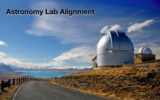
This is a list of 175+ publically available astronomy labs, aligned with chapters …
This is a list of 175+ publically available astronomy labs, aligned with chapters from Astronomy by Fraknoi, Morrison, and Wolff (from OpenStax). Alignment determined by list curators, not the lab authors.Resource developed as part of Lane Community College's Astronomy OER project. Resource is not affiliated with OpenStax.Image modified from public domain image "Mount Saitn John Observatory" by Bernard Stagg.
No restrictions on your remixing, redistributing, or making derivative works. Give credit to the author, as required.
Your remixing, redistributing, or making derivatives works comes with some restrictions, including how it is shared.
Your redistributing comes with some restrictions. Do not remix or make derivative works.
Most restrictive license type. Prohibits most uses, sharing, and any changes.
Copyrighted materials, available under Fair Use and the TEACH Act for US-based educators, or other custom arrangements. Go to the resource provider to see their individual restrictions.