
Unrestricted Use
CC BY
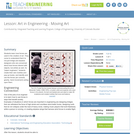
Students learn how forces are used in the creation of art. They come to understand that it is not just bridge and airplane designers who are concerned about how forces interact with objects, but artists as well. As "paper engineers," students create their own mobiles and pop-up books, and identify and use the forces (air currents, gravity, hand movement) acting upon them.
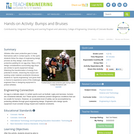
Athletes often wear protective gear to keep themselves safe in contact sports. In this spirit, students follow the steps of engineering design process as they design, build and test protective padding for an egg drop. Many of the design considerations surrounding egg drops are similar to sports equipment design. Watching the transformation of energy from potential to kinetic, observing the impact and working under material constraints introduces students to "sports engineering" and gives them a chance to experience some of the challenges engineers face in designing equipment to protect athletes.
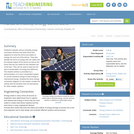
Students evaluate various everyday energy conversion devices and draw block flow diagrams to show the forms and states of energy into and out of the device. They also identify the forms of energy that are useful and the desired output of the device as well as the forms that are not useful for the intended use of the item. This can be used to lead into the law of conservation of energy and efficiency. The student activity is preceded by a demonstration of a more complicated system to convert chemical energy to heat energy to mechanical energy. Drawing the block energy conversion diagram for this system models the activity that the students then do themselves for other simpler systems.
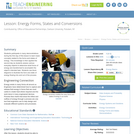
The students participate in many demonstrations during the first day of this lesson to learn basic concepts related to the forms and states of energy. This knowledge is then applied the second day as they assess various everyday objects to determine what forms of energy are transformed to accomplish the object's intended task. The students use block diagrams to illustrate the form and state of energy flowing into and out of the process.
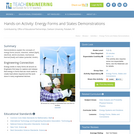
Demonstrations explain the concepts of energy forms (sound, chemical, radiant [light], electrical, atomic [nuclear], mechanical, thermal [heat]) and states (potential, kinetic).
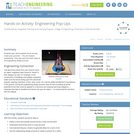
Students learn about applied forces as they create pop-up-books the art of paper engineering. They also learn the basic steps of the engineering design process.
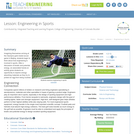
Imagining themselves arriving at the Olympic gold medal soccer game in Beijing, students begin to think about how engineering is involved in sports. After a discussion of kinetic and potential energy, an associated hands-on activity gives students an opportunity to explore energy absorbing materials as they try to protect an egg from being crushed.

Students learn about water poverty and how water engineers can develop appropriate solutions to a problem that is plaguing nearly a sixth of the world's population. Students follow the engineering design process to design a gravity-fed water system. They choose between different system parameters such as pipe sizes, elevation differentials between entry and exit pipes, pipe lengths and tube locations to find a design that provides the maximum flow and minimum water turbidity (cloudiness) at the point of use. In this activity, students play the role of water engineers by designing and building model gravity-fed water systems, learning the key elements necessary for viable projects that help improve the lives people in developing communities.
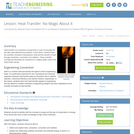
Heat transfer is an important concept that is a part of everyday life yet often misunderstood by students. In this lesson, students learn the scientific concepts of temperature, heat and the transfer of heat through conduction, convection and radiation. These scientific concepts are illustrated by comparison to magical spells used in the Harry Potter stories.
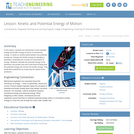
In this lesson, students are introduced to both potential energy and kinetic energy as forms of mechanical energy. A hands-on activity demonstrates how potential energy can change into kinetic energy by swinging a pendulum, illustrating the concept of conservation of energy. Students calculate the potential energy of the pendulum and predict how fast it will travel knowing that the potential energy will convert into kinetic energy. They verify their predictions by measuring the speed of the pendulum.

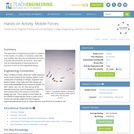
The application of engineering principles is explored in the creation of mobiles. As students create their own mobiles, they take into consideration the forces of gravity and convection air currents. They learn how an understanding of balancing forces is important in both art and engineering design.

Investigate why and how spacecraft must dissipate energy when landing back on Earth, or on Mars, or anywhere else for that matter.

Astronaut Jack "2fish" Fischer stopped by for the latest episode of the Smithsonian's ISS Science and tried out a hands-on experiment involving boiling water.

Learn what happens to the friction caused by the space shuttle rubbing against air molecules during landing. Also, find out more with an easy science demonstration on the power of friction.

Explore how pressure changes impact water.
Students will demonstrate their understanding of friction through the use of various activities.

Astronaut Randy Bresnik talks about the landing. Also see how the energy from a landing is dissipated in a hands-on classroom activity.

Students will use the Design Process to build and test multiple wind turbine designs in order to generate electricity.