This class addresses some of the important issues involved with the planning, …
This class addresses some of the important issues involved with the planning, development, and implementation of lean enterprises. People, technology, process, and management dimensions of an effective lean manufacturing company are considered in a unified framework. Particular emphasis is placed on the integration of these dimensions across the entire enterprise, including product development, production, and the extended supply chain. Analysis tools as well as future trends and directions are explored. A team project is a key component of this subject.
Deze cursus geeft een introductie op de massa- en energienetwerken die de …
Deze cursus geeft een introductie op de massa- en energienetwerken die de ruggengraat vormen van de economie. De belangrijkste energie- en industriesystemen worden vanuit verschillende perspectieven besproken.
- Kaartkennis van energie- & industriesystemen, met name in Nederland - Voorraden en stromen, elektriciteitsinfrastructuur, elektriciteitstransport, aardgasinfrastructuur, drink- en afvalwater, industrie, warmte- en CO2-netwerken, toekomstige energie- & industriesystemen - Vraag- en aanbodfluctuaties, balanshandhaving
This course is an introduction to the consideration of technology as the …
This course is an introduction to the consideration of technology as the outcome of particular technical, historical, cultural, and political efforts, especially in the United States during the 19th and 20th centuries. Topics include industrialization of production and consumption, development of engineering professions, the emergence of management and its role in shaping technological forms, the technological construction of gender roles, and the relationship between humans and machines.
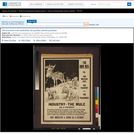
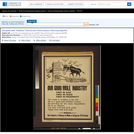
Poster showing a mule "American industry" braying, having just kicked "Kaiserism," "Pacifist," …
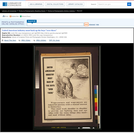
Poster showing a mule "American industry" braying, having just kicked "Kaiserism," "Pacifist," and "Hard times." Title continues: Industry - the mule as patriot. American industry is loyal - it is out for the flag. It subscribed to the Liberty Loan with four feet. You can bleed it almost to death for the Red Cross. Don't make any mistake, industry is doing its bit. Give industry a show as a patriot. Issued by the National Industrial Conservation Movement, 30 Church Street, New York City. Copies supplied on request. No. E-1.
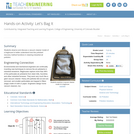
Students observe and discuss a vacuum cleaner model of a baghouse to …
Students observe and discuss a vacuum cleaner model of a baghouse to better understand how this pollutant recovery method functions in cleaning industrial air pollution.
Students observe and discuss a cup and pencil model of a cyclone …
Students observe and discuss a cup and pencil model of a cyclone to better understand the science behind how this pollutant recovery method functions in cleaning industrial air pollution.
In this project, students are all assigned citizen roles on a fictitious …
In this project, students are all assigned citizen roles on a fictitious island community. Each citizen role has a set of values that they will maintain while the community argues how to recover from its economic decline. Two different industries have proposed to operate from the island, and students debate through a town council meeting, whether to bring one, both, or neither of these industries to the island, and if so, under what conditions.
Poster showing a mule "Industry" on a treadmill powering a factory, which …
Poster showing a mule "Industry" on a treadmill powering a factory, which is producing "Shoes," "Drugs," "Clothes," "Hats." The mule is bothered by flies labeled "Strife," "Unfair laws," "Agitator," and "Taxation." Title continues: Our mule is wedded to his job. He is a good and faithful worker. He provides for his many dependents. He is no Slacker. Use him well and he'll smile. Abuse him and he'll balk. Moral--Give industry a chance to make a living for ITS family. Issued by the National Industrial Conservation Movement, 30 Church Street, New York City. Copies supplied on request. No. E-8.
This resource is a video abstract of a research paper created by …
This resource is a video abstract of a research paper created by Research Square on behalf of its authors. It provides a synopsis that's easy to understand, and can be used to introduce the topics it covers to students, researchers, and the general public. The video's transcript is also provided in full, with a portion provided below for preview:
"For thousands of years, the Nile has provided bountiful gifts to the people who make their home around its banks, offering food, a means of transport, irrigation, and fertile soil. But there is a limit to how much the Nile can give. Already in the 1970s, Egypt began fully utilizing the available resources of the Nile. Any additional demand has been met virtually, through imports of food. Now, research suggests that within the next decade, Egypt is poised to import as much “virtual water” as it receives from the Nile. In a new study from MIT, researchers compiled water and crop data for Egypt spanning the past 60 years. That gave them one of the most detailed looks at modern water use ever produced for the country, and helped them understand Egypt’s trade in “virtual water”. Virtual water refers to the hidden flow of water in food and commodities. For example, it takes about 1100 tons of water to produce one ton of maize in Egypt..."
The rest of the transcript, along with a link to the research itself, is available on the resource itself.
To develop an understanding of modern industrial technologies that clean up and …
To develop an understanding of modern industrial technologies that clean up and prevent air pollution, students build and observe a variety of simple models of engineering pollutant recovery methods: scrubber, electrostatic precipitator, cyclone and baghouse. In an associated literacy activity, students become more aware of global environmental problems and play a part in their solution by writing environmental action campaign letters.
Ready for Industry™ (RFI) is a resource that includes 5 self-paced courses …
Ready for Industry™ (RFI) is a resource that includes 5 self-paced courses that create a bridge betweenstandard education and the knowledge needed to succeed in industry, targeted at late high school, earlypost-secondary and/or workforce.
Poster showing lines of men and women entering a factory. Issued by …
Poster showing lines of men and women entering a factory. Issued by the National Industrial Conservation Movement, 30 Church Street, New York City. Copies supplied on request. No. F-4.
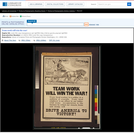
Poster showing Uncle Sam driving a wagon of supplies and munitions, "American …
Poster showing Uncle Sam driving a wagon of supplies and munitions, "American Industry," drawn by two horses "Wage Earner" and Wage Payer." A tiny bird comments, "He had no use for a whip." Title continues: Every loyal worker is a soldier in a uniform of overalls. Every loyal employer is an officer in our industrial army. Co-operation is the harness by which our muscle, brain and money will drive America to victory! Issued by the National Industrial Conservation Movement, 30 Church Street, New York City. Copies supplied on request. No. F-2.
This course considers how the visual and material world of "nature" has …
This course considers how the visual and material world of "nature" has been reshaped by industrial practices, ideologies, and institutions, particularly in nineteenth- and twentieth-century America. Topics include land-use patterns; the changing shape of cities and farms; the redesign of water systems; the construction of roads, dams, bridges, irrigation systems; the creation of national parks; ideas about wilderness; and the role of nature in an industrial world. From small farms to suburbia, Walden Pond to Yosemite, we will ask how technological and natural forces have interacted, and whether there is a place for nature in a technological world. Acknowledgement This class is based on one originally designed and taught by Prof. Deborah Fitzgerald. Her Fall 2004 version can be viewed by following the link under Archived Courses on the right side of this page.
Our linked subjects are (1) the historical process by which the meaning …
Our linked subjects are (1) the historical process by which the meaning of technology has been constructed, and (2) the concurrent transformation of the environment. To explain the emergence of technology as a pivotal word (and concept) in contemporary public discourse, we will examine responses — chiefly political and literary — to the development of the mechanic arts, and to the linked social, cultural, and ecological transformation of 19th- and 20th-century American society, culture, and landscape. Note: In the interests of freshness and topicality we regard the STS.464 syllabus as sufficiently flexible to permit some — mostly minor — variations from year to year. One example of a different STS.464 syllabus can be found in STS.464 Cultural History of Technology, Spring 2005.
Poster showing German soldiers overseeing slave labor in a factory, and whipping …
Poster showing German soldiers overseeing slave labor in a factory, and whipping one of the workers. B3002 Wt 5852/2598 10M 6/18. E3114. Title from item.
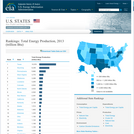
Ranks all 50 states in total energy production. Includes links to tables …
Ranks all 50 states in total energy production. Includes links to tables which rank production of crude oil, natural gas, coal, and electricity; crude oil emissions; total energy consumption; and energy prices.
This collection uses primary sources to explore the Transatlantic Slave Trade. Digital …
This collection uses primary sources to explore the Transatlantic Slave Trade. Digital Public Library of America Primary Source Sets are designed to help students develop their critical thinking skills and draw diverse material from libraries, archives, and museums across the United States. Each set includes an overview, ten to fifteen primary sources, links to related resources, and a teaching guide. These sets were created and reviewed by the teachers on the DPLA's Education Advisory Committee.
A somewhat puzzling commentary on two issues: slavery and economic protectionism. The …
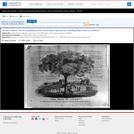
A somewhat puzzling commentary on two issues: slavery and economic protectionism. The date of the print is uncertain, but it may have appeared as part of the reaction against the Walker Tariff of 1846. A Northern bias is expressed on both issues. The text is abolitionist on the one hand and laments the absence of federal protection for American industry on the other. The author of the piece (which is less a cartoon than an arrangement of didactic tableaux) presents through his characters a number of reasoned arguments on the respective economics of slave and free industry and suggests a parallel between the hardships posed by the lack of protection for American manufacturers and the plight of the slaves. The irony of the piece rests on the fact that only the Southern slaveholder, whose interests were best served by the 1846 tariff, enjoys the shade of the symbolic Liberty Tree, which looms up in the foreground. Slave owner, fanned by a Negro slave: "Surrounded by Slaves & basking at ease by their labor we can have a clearer conception of the value of Liberty." Man borne in a litter by slaves: "Rather than submit to be a slave I would make our State a cemetery of Freemen." Slaves working under the whip of an overseer at right: "I had as lief work as not. If I had my own time to do it in." and "Who likes to be bound down to a Massa." Another: "Give me my own Country before Slavery." Further right a group of slaves converse: "Poor Sampson is dead!" "Is there nothing we can do?" "How many poor fellows heads have been stuck upon poles!" "The American People will come to a sense of Justice." "If they won't liberate "us," let our Children be free." "Our rejoicing on Bobalition days shew we are not the savages the white people take us to be." "And should our children be free when they are born they might learn the habits of industry & for hire do more work than any of our brethren are now willing to do." "We must be away Massa will see us." In the right background is a steam sawmill whose proprietor frets over his slaves, who run off saying, "Let's have a play spell" and "I'll be off." The owner laments, "What shall I do with my Slaves, they cost me more than their income, and they are more plague than profit, & if I could devise any means to get rid of them, what a triumph it would be--how can it be done without being a serious evil." The left half of the composition represents the North. Near the Liberty Tree two farmers converse: "I would not have a Slave to till my soil, to carry me, to fan me, to tremble when I wake for all the wealth that sinews bought & sold have earnt." "No! dear as freedom is, & in my heart's just estimation prized above all price I'd rather be myself the slave & wear the bonds than fasten them on him." Nearby a group of gentlemen speak: "O America! vast--wide--extended; a population increasing almost past calculation, embracing within thy limits some of almost every nation a refuge for the weary & distressed a home for the free; But O Slavery!! where will be thy bounds?" "Slaves cannot breathe in England, if their lungs receive 'its air' that moment they are free-- they touch 'that Country & their Shackles fall." In the background is a textile mill. Outside are several groups of mill girls. Their conversations concern the tariff and its effects: "What a noise the Southerners have been making about the Tariff." "I hope it is all over now." Second group: "I think if they will protect us Girls from the operation of foreign legislation as well as seamen against Pirates, we can make cloth as cheap as any body." "I dont believe English Girls can do more than we can." "The machinery went well to day." "I wove seventy yards." "I have got so as to tend three Looms." A third group: "I wonder what effect the taking the duty off Linen will have?" "Well in proportion as linen is used there will be less Cotton." "I Guess it will set the poor Irishmen to raising Flax." In the center, beyond the tree, a man on horseback leads a black woman carrying a bundle toward the right or Southern side of the print.|Title appears as it is written on the item.|Forms part of: American cartoon print filing series (Library of Congress)|Published in: American political prints, 1766-1876 / Bernard F. Reilly. Boston : G.K. Hall, 1991, entry 1846-13.
Poster showing a monumental man "American Industry" standing on an industrialized shoreline, …
Poster showing a monumental man "American Industry" standing on an industrialized shoreline, and offering boxes of food, supplies, and munitions to Europe across the sea. Title continues: Wage-earners and wage-payers are industrial patriots with a mutual interest in Democracy. They must work shoulder to shoulder to provide our fighting men and our Allies with the many things they need - and need without delay. Issued by the National Industrial Conservation Movement, 30 Church Street, New York City. Copies supplied on request. No. F-3.
No restrictions on your remixing, redistributing, or making derivative works. Give credit to the author, as required.
Your remixing, redistributing, or making derivatives works comes with some restrictions, including how it is shared.
Your redistributing comes with some restrictions. Do not remix or make derivative works.
Most restrictive license type. Prohibits most uses, sharing, and any changes.
Copyrighted materials, available under Fair Use and the TEACH Act for US-based educators, or other custom arrangements. Go to the resource provider to see their individual restrictions.