For too many Americans, the history class in Ferris Bueller’s Day Off …
For too many Americans, the history class in Ferris Bueller’s Day Off (remember the teacher’s plaintive question, “anyone, anyone?”) is all too familiar. Our approach is meant to challenge this false and familiar image of history: understanding and reconstructing the past requires ways of thinking, reading, and questioning much more engaging and challenging than mere memorization. Teaching in a way that differs from your own schooling experience is not necessarily easy to imagine, let alone execute. Especially given the many pressures and demands on teachers today. This part of the Historical Thinking Matters website is devoted to providing instructional resources for teacher educators who want to challenge these iconic pictures of history instruction and start preparing their students to teach for historical thinking.
This project provides a model for engaging students in an investigation of …
This project provides a model for engaging students in an investigation of authentic materials from the past. The students will be provided with four primary sources and questions to guide their investigation. A wealth of other primary resources can be accessed on the websites listed in the reference section.
The History Engine is an educational tool that gives students the opportunity …
The History Engine is an educational tool that gives students the opportunity to learn history by doing the work—researching, writing, and publishing—of an historian. The result is an ever-growing collection of historical articles or "episodes" that paint a wide-ranging portrait of life in the United States throughout its history, available in our online database to scholars, teachers, and the general public.The History Engine project aims to enhance historical education and research for teachers, students, and scholars alike. It allows undergraduate professors to introduce a more collaborative and creative approach to history into their classrooms, while maintaining rigorous academic standards. The History Engine gives students a more intimate experience with the process of history. Participants who work with the History Engine project learn the craft of an historian: they examine primary documents, place these documents in a larger historical context using secondary sources, and prepare cogent analysis of their sources for the public eye. Finally, the History Engine provides a way for professors to take advantage of digital technology in their classrooms while maintaining rigorous academic standards. The cumulative database provides all the easy-access and searchability of other websites, but also subjects its contents to a careful academic screening process on the part of library staff, archivists, professors, and teaching assistants.
How do historians analyze sources from the past? KA's historian Kim Kutz …
How do historians analyze sources from the past? KA's historian Kim Kutz Elliott and grammarian David Rheinstrom continue their conversation about how to interpret Roosevelt's First Inaugural Address.
What's the difference between a primary source and a secondary source? KA's …
What's the difference between a primary source and a secondary source? KA's historian Kim Kutz Elliott and grammarian David Rheinstrom discuss reading sources by examining Franklin Delano Roosevelt's First Inaugural Address.
The Indian Ocean Basin is becoming an important topic in middle and …
The Indian Ocean Basin is becoming an important topic in middle and high school world history and geography courses, but one for which there are few instructional resources. This web-based resource helps teachers incorporate the Indian Ocean into world history studies by illustrating a variety of interactions that took place in the Indian Ocean during each era. The material is assembled into an integrated and user-friendly teaching tool for students in upper elementary, middle and high school. It offers students the chance to investigate primary sources that illustrate historical interactions, helping them to become more adept at the analytical historical thinking skills that are required by virtually all state history standards today.
In the United States, the nineteenth century was a time of tremendous …
In the United States, the nineteenth century was a time of tremendous growth and change. The new nation experienced a shift from a farming economy to an industrial one, major westward expansion, displacement of native peoples, rapid advances in technology and transportation, and a civil war. In this lesson, works of art from the nineteenth century are paired with written documents, including literary selections, a letter, and a speech. As budding historians, students can use these primary sources from the nineteenth century to reconstruct the influence of technology, geography, economics, and politics on daily life. In this lesson students will: Learn about daily life in the United States in the 1800s through visual art and literature; Understand some of the ways in which nineteenth-century life was affected by technology, geography, economics, and politics; Apply critical-thinking skills to consider the various choices artists and writers have made in depicting daily life around them; Make personal connections to the nineteenth century by placing themselves in the contexts of works of art and readings.
This lesson address the questions: 1. What did the Republic of Korea …
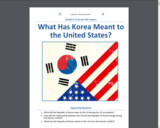
This lesson address the questions: 1. What did the Republic of Korea mean to the US during the US occupation? 2. How did the relationship between the US and the Republic of Korea change during the Korean conflict? 3. What has the Republic of Korea meant to the US since the Korean conflict?
Within These Walls...tells the stories of five families who lived in this …
Within These Walls...tells the stories of five families who lived in this house over 200 years and made history in their kitchens and parlors, through everyday choices and personal acts of courage and sacrifice. In this online exhibition from the Smithsonian's National Museum of American History, students will learn how the Smithsonian acquired the house at 16 Elm Street Ipswich, Massachusetts and saved more than a dozen family stories and 200 years of American social history. They will also learn some of the methods historians and curators used to learn about this house's past, the ways that it changed over time, and the people who lived in it.
No restrictions on your remixing, redistributing, or making derivative works. Give credit to the author, as required.
Your remixing, redistributing, or making derivatives works comes with some restrictions, including how it is shared.
Your redistributing comes with some restrictions. Do not remix or make derivative works.
Most restrictive license type. Prohibits most uses, sharing, and any changes.
Copyrighted materials, available under Fair Use and the TEACH Act for US-based educators, or other custom arrangements. Go to the resource provider to see their individual restrictions.