(Complete Item Description)
- Abstract:
-
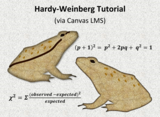
This 15-minute video lesson explains allele and genotype frequency in populations using the Hardy-Weinberg Equilibrium. [Biology playlist: Lesson 16 of 71].
- Subject:
-
Science and Technology
- Grade Level:
-
Secondary,
Post-secondary
- Collection:
-
Khan Academy
Rate this resource by using the left and right arrow keys and pressing Enter.
Remix and Share
(Complete Item Description)
- Abstract:
-
This course describes biological changes that happen on a very large scale, across entire populations of organisms and over the course of millions of years, in the form of evolution and ecology. Upon successful completion of this course, students will be able to: Use their understanding of Mendelian genetics and patterns of inheritance to predict genotypes and phenotypes of offspring or work backwards to identify the genotypes and phenotypes of a parental generation; Distinguish between inheritance patterns that involve autosomal vs. sex-linked traits and identify the respective consequences of each type of inheritance; Identify what distinguishes DarwinŐs theory of evolution from other arguments that attempt to explain diversity across species and/or many generations; Identify which of many types of natural selection is acting on a particular population/species; Identify which of many types of sexual selection is acting on a particular population/species; Identify the factors that alter the frequencies of alleles in populations over time and describe the effects of these factors on populations; Recognize, read, and create phylogenies and cladograms, using them to explain evolutionary relationships; Determine the ecological interactions affecting a particular community and identify the effects of specific relationships (e.g. symbiosis, competition) on species within that community; Distinguish between world biomes in terms of their climate, nutrient cycles, energy flow, and inhabitants; Use their knowledge of nutrient cycles and energy flow to estimate the effect that changes in physical or biological factors would have on a particular ecosystem. (Biology 102; See also: Psychology 204)
- Subject:
-
Science and Technology
- Grade Level:
-
Post-secondary
- SubTopics:
-
Ecosystems
- Collection:
-
Saylor Foundation
Rate this resource by using the left and right arrow keys and pressing Enter.
Read the Fine Print
No restrictions on your remixing, redistributing, or making derivative works. Give credit to the author, as required.
Your remixing, redistributing, or making derivatives works comes with some restrictions, including how it is shared.
Your redistributing comes with some restrictions. Do not remix or make derivative works.
Copyrighted materials, available under Fair Use and the TEACH Act for US-based educators, or other custom arrangements. Go to the resource provider to see their individual restrictions.