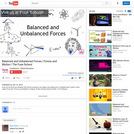
How do we find out whether the forces acting on an object …
How do we find out whether the forces acting on an object are balanced or unbalanced? Learn in this video from the "Forces and Motion" chapter of the Virtual School GCSE / K12 Physics.
Are you a passionate teacher who would like to reach tens of thousands of learners? Get in touch: vsteam@fusion-universal.com Find out more: http://www.thevirtualschool.com Follow us: http://www.youtube.com/virtualschooluk Friend us: http://www.facebook.com/virtualschooluk
Teach the world.
This video is distributed under a Creative Commons License: Attribution-NonCommercial-NoDerivs CC BY-NC-ND
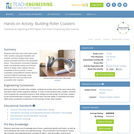
Students build their own small-scale model roller coasters using pipe insulation and …
Students build their own small-scale model roller coasters using pipe insulation and marbles, and then analyze them using physics principles learned in the associated lesson. They examine conversions between kinetic and potential energy and frictional effects to design roller coasters that are completely driven by gravity. A class competition using different marbles types to represent different passenger loads determines the most innovative and successful roller coasters.
This course introduces the concepts, techniques, and devices used to measure engineering …
This course introduces the concepts, techniques, and devices used to measure engineering properties of materials. There is an emphasis on measurement of load-deformation characteristics and failure modes of both natural and fabricated materials. Weekly experiments include data collection, data analysis, and interpretation and presentation of results.
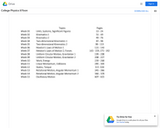
This course is designed for the student in science, electronic technology, or …
This course is designed for the student in science, electronic technology, or a health profession such as physical therapy. Subject matter covered will include: principles of mechanics, concurrent forces, nonconcurrent forces, friction, elasticity, motion, forces and motion, work and energy, power, impulse and momentum, and simple harmonic motion. A non-calculus approach.
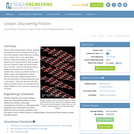
With a simple demonstration activity, students are introduced to the concept of …
With a simple demonstration activity, students are introduced to the concept of friction as a force that impedes motion when two surfaces are in contact. Then, in the Associated Activity (Sliding and Stuttering), they work in teams to use a spring scale to drag an object such as a ceramic coffee cup along a table top or the floor. The spring scale allows them to measure the frictional force that exists between the moving cup and the surface it slides on. By modifying the bottom surface of the cup, students can find out what kinds of surfaces generate more or less friction. They also discover that both static and kinetic friction are involved when an object initially at rest is caused to slide across a surface.
Using the same method for measuring friction that was used in the …
Using the same method for measuring friction that was used in the previous lesson (Discovering Friction), students design and conduct experiments to determine if the amount of area over which an object contacts a surface it is moving across affects the amount of friction encountered.
Using the same method for measuring friction that was used in the …
Using the same method for measuring friction that was used in the previous lesson (Discovering Friction), students design and conduct an experiment to determine if weight added incrementally to an object affects the amount of friction encountered when it slides across a flat surface. After graphing the data from their experiments, students can calculate the coefficients of friction between the object and the surface it moved upon, for both static and kinetic friction.
Student groups are provided with a generic car base on which to …
Student groups are provided with a generic car base on which to design a device/enclosure to protect an egg on or in the car as it rolls down a ramp at increasing slopes. During this in-depth physics/science/technology activity, student teams design, build and test their creations to meet the design challenge, and are expected to perform basic mathematical calculations using collected data, including a summative cost to benefit ratio.
In this activity, students will learn about and apply the Laws of …
In this activity, students will learn about and apply the Laws of Physics to successfully launch and land a raw egg. The activity frames the problem around designing and building a bottle rocket that will protect a raw egg being launched into the air at least seven meters. Resources included in this lesson are found at the bottom of this document and include:
-Teacher guide -Physics note sheets on motion, speed, velocity, acceleration, momentum, force, friction, Newton’s Laws of Motion, potential and kinetic energy and gravity. -Egg Launch Instructions -Link to Bottle Rocket Launching Instructions -Links to videos -Post Assessment
In this activity, students will learn about and apply the Laws of …
In this activity, students will learn about and apply the Laws of Physics to successfully launch and land a raw egg. The activity frames the problem around designing and building a bottle rocket that will protect a raw egg being launched into the air at least seven meters. Resources included in this lesson are found at the bottom of this document and include:
-Teacher guide -Physics note sheets on motion, speed, velocity, acceleration, momentum, force, friction, Newton’s Laws of Motion, potential and kinetic energy and gravity. -Egg Launch Instructions -Link to Bottle Rocket Launching Instructions -Links to videos -Post Assessment
In this activity, students will learn about and apply the Laws of …
In this activity, students will learn about and apply the Laws of Physics to successfully launch and land a raw egg. The activity frames the problem around designing and building a bottle rocket that will protect a raw egg being launched into the air at least seven meters. Resources included in this lesson are found at the bottom of this document and include:
-Teacher guide -Physics note sheets on motion, speed, velocity, acceleration, momentum, force, friction, Newton’s Laws of Motion, potential and kinetic energy and gravity. -Egg Launch Instructions -Link to Bottle Rocket Launching Instructions -Links to videos -Post Assessment
Learn about conservation of energy with a skater dude! Build tracks, ramps …
Learn about conservation of energy with a skater dude! Build tracks, ramps and jumps for the skater and view the kinetic energy, potential energy and friction as he moves. You can also take the skater to different planets or even space!
Learn about conservation of energy with a skater dude! Build tracks, ramps …
Learn about conservation of energy with a skater dude! Build tracks, ramps and jumps for the skater and view the kinetic energy, potential energy and friction as he moves. You can also take the skater to different planets or even space!
Students will: Predict the kinetic and potential energy of objects Design a …
Students will: Predict the kinetic and potential energy of objects Design a skate park Examine how kinetic and potential energy interact with each other
This activity utilizes hands-on learning with the conservation of energy and the …
This activity utilizes hands-on learning with the conservation of energy and the interaction of friction. Students use a roller coaster track and collect position data. The students then calculate velocity, and energy data. After the lab, students relate the conversion of potential and kinetic energy to the conversion of energy used in a hybrid car.
Secondary educators across Lebanon County, Pennsylvania developed lesson plans to integrate the …
Secondary educators across Lebanon County, Pennsylvania developed lesson plans to integrate the Pennsylvania Career Education and Work Standards with the content they teach. This work was made possible through a partnership between the South Central PA Workforce Investment Board (SCPa Works) and Lancaster-Lebanon Intermediate Unit 13 (IU13) and was funded by a Teacher in the Workplace Grant Award from the Pennsylvania Department of Labor and Industry. This lesson plan was developed by one of the talented educators who participated in this project during the 2018-2019 school year.
This resource provides basic information on four types of friction - sliding, …
This resource provides basic information on four types of friction - sliding, static, rolling, and fluid. It is aimed primarily at an upper elementary or lower middle school curriculum.
Based on what they have already learned about friction, students formulate hypotheses …
Based on what they have already learned about friction, students formulate hypotheses concerning the effects of weight and contact area on the amount of friction between two surfaces. In the Associated Activities (Does Weight Matter? and Does Area Matter?), students design and conduct simple experiments to test their hypotheses, using procedures similar to those used in the previous lesson (Discovering Friction). An analysis of their data will reveal the importance of weight to normal friction (the friction that occurs as a result of surface roughness) and the importance of surface area to the friction that occurs between smooth surfaces due to molecular attraction. Based on their data, students will also be able to calculate coefficients of friction for the materials tested, and compare these to published values for various materials.
Students use wood, wax paper and oil to investigate the importance of …
Students use wood, wax paper and oil to investigate the importance of lubrication between materials and to understand the concept of friction. Using wax paper and oil placed between pieces of wood, the function of lubricants between materials is illustrated. Students extend their understanding of friction to bones and joints in the skeletal system and become aware of what engineers can do to help reduce friction in the human body as well as in machines.
Explore pressure in the atmosphere and underwater. Reshape a pipe to see …
Explore pressure in the atmosphere and underwater. Reshape a pipe to see how it changes fluid flow speed. Experiment with a leaky water tower to see how the height and water level determine the water trajectory.
No restrictions on your remixing, redistributing, or making derivative works. Give credit to the author, as required.
Your remixing, redistributing, or making derivatives works comes with some restrictions, including how it is shared.
Your redistributing comes with some restrictions. Do not remix or make derivative works.
Most restrictive license type. Prohibits most uses, sharing, and any changes.
Copyrighted materials, available under Fair Use and the TEACH Act for US-based educators, or other custom arrangements. Go to the resource provider to see their individual restrictions.