Theoretical topics of fluid dynamics relevant to natural phenomena or man-made hazards …
Theoretical topics of fluid dynamics relevant to natural phenomena or man-made hazards in water and atmosphere. Basic law of fluid motion. Scaling and approximations. Slow flows, with applications to drag on a particle and mud flow on a slope. Boundary layers: jets and plumes in pure fluids or in porous media. Thermal and buoyancy effects, selective withdrawal and internal waves. Transient boundary layers in impulsive flows or waves. Induced streaming and mass transport. Dispersion in steady flows or in waves. Effects of earth rotation on coastal flows. Wind induced flow in shallow seas. Stratified seas and coastal upwelling.
Bernoulli's principle relates the pressure of a fluid to its elevation and …
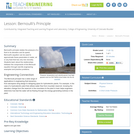
Bernoulli's principle relates the pressure of a fluid to its elevation and its speed. Bernoulli's equation can be used to approximate these parameters in water, air or any fluid that has very low viscosity. Students learn about the relationships between the components of the Bernoulli equation through real-life engineering examples and practice problems.
This lesson introduces students to the concept of air pressure. Students will …
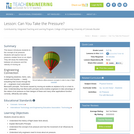
This lesson introduces students to the concept of air pressure. Students will explore how air pressure creates force on an object. They will study the relationship between air pressure and the velocity of moving air.
Students are introduced to chemical engineering and learn about its many different …
Students are introduced to chemical engineering and learn about its many different applications. They are provided with a basic introduction to matter and its different properties and states. An associated hands-on activity gives students a chance to test their knowledge of the states of matter and how to make observations using their five senses: touch, smell, sound, sight and taste.
Students explore the densities and viscosities of fluids as they create a …
Students explore the densities and viscosities of fluids as they create a colorful 'rainbow' using household liquids. While letting the fluids in the rainbow settle, students conduct 'The Great Viscosity Race,' another short experiment that illustrates the difference between viscosity and density. Later, students record the density rainbow with sketches and/or photography.
This resource provides basic information on four types of friction - sliding, …
This resource provides basic information on four types of friction - sliding, static, rolling, and fluid. It is aimed primarily at an upper elementary or lower middle school curriculum.
This course covers the fundamental driving forces for transport—chemical gradients, electrical interactions, …
This course covers the fundamental driving forces for transport—chemical gradients, electrical interactions, and fluid flow—as applied to the biology and biophysics of molecules, cells, and tissues.
Students discover fluid dynamics related to buoyancy through experimentation and optional photography. …
Students discover fluid dynamics related to buoyancy through experimentation and optional photography. Using one set of fluids, they make light fluids rise through denser fluids. Using another set, they make dense fluids sink through a lighter fluid. In both cases, they see and record beautiful fluid motion. Activities are also suitable as class demonstrations. The natural beauty of fluid flow opens the door to seeing the beauty of physics in general.
This class provides students with an introduction to principal concepts and methods …
This class provides students with an introduction to principal concepts and methods of fluid mechanics. Topics covered in the course include pressure, hydrostatics, and buoyancy; open systems and control volume analysis; mass conservation and momentum conservation for moving fluids; viscous fluid flows, flow through pipes; dimensional analysis; boundary layers, and lift and drag on objects. Students will work to formulate the models necessary to study, analyze, and design fluid systems through the application of these concepts, and to develop the problem-solving skills essential to good engineering practice of fluid mechanics in practical applications.
While learning about volcanoes, magma and lava flows, students learn about the …
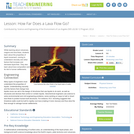
While learning about volcanoes, magma and lava flows, students learn about the properties of liquid movement, coming to understand viscosity and other factors that increase and decrease liquid flow. They also learn about lava composition and its risk to human settlements.
How can you lift a heavy metal table using air? In this …
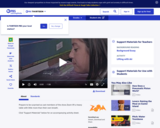
How can you lift a heavy metal table using air? In this video segment adapted from ZOOM, cast members succeed in lifting a table using their own breath and a few plastic bags.
In this fun, engaging activity, students are introduced to a unique type …
In this fun, engaging activity, students are introduced to a unique type of fluid ferrofluids whose shape can be influenced by magnetic fields! Students act as materials engineers and create their own ferrofluids. They are challenged to make magnetic ink out of ferrofluids and test their creations to see if they work. Concurrently, they learn more about magnetism, surfactants and nanotechnology. As they observe fluid properties as a standalone-fluid and under an imposed magnetic field, they come to understand the components of ferrofluids and their functionality.
This lesson explores the drag force on airplanes. The students will be …
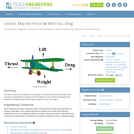
This lesson explores the drag force on airplanes. The students will be introduced to the concept of conservation of energy and how it relates to drag. Students will explore the relationship between drag and the shape, speed and size of an object.
Students learn how volume, viscosity and slope are factors that affect the …
Students learn how volume, viscosity and slope are factors that affect the surface area that lava covers. Using clear transparency grids and liquid soap, students conduct experiments, make measurements and collect data. They also brainstorm possible solutions to lava flow problems as if they were geochemical engineers, and come to understand how the properties of lava are applicable to other liquids.
Students calculate the viscosity of various household fluids by measuring the amount …
Students calculate the viscosity of various household fluids by measuring the amount of time it takes marble or steel balls to fall given distances through the liquids. They experience what viscosity means, and also practice using algebra and unit conversions.
Student teams are challenged to evaluate the design of several liquid soaps …
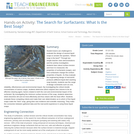
Student teams are challenged to evaluate the design of several liquid soaps to answer the question, “Which soap is the best?” Through two simple teacher class demonstrations and the activity investigation, students learn about surface tension and how it is measured, the properties of surfactants (soaps), and how surfactants change the surface properties of liquids. As they evaluate the engineering design of real-world products (different liquid dish washing soap brands), students see the range of design constraints such as cost, reliability, effectiveness and environmental impact. By investigating the critical micelle concentration of various soaps, students determine which requires less volume to be an effective cleaning agent, factors related to both the cost and environmental impact of the surfactant. By investigating the minimum surface tension of the soap, students determine which dissolves dirt and oil most effectively and thus cleans with the least effort. Students evaluate these competing criteria and make their own determination as to which of five liquid soaps make the “best” soap, giving their own evidence and scientific reasoning. They make the connection between gathered data and the real-world experience in using these liquid soaps.
Students use their understanding of projectile physics and fluid dynamics to find …
Students use their understanding of projectile physics and fluid dynamics to find the water pressure in water guns. By measuring the range of the water jets, they are able to calculate the theoretical pressure. Students create graphs to analyze how the predicted pressure relates to the number of times they pump the water gun before shooting.
No restrictions on your remixing, redistributing, or making derivative works. Give credit to the author, as required.
Your remixing, redistributing, or making derivatives works comes with some restrictions, including how it is shared.
Your redistributing comes with some restrictions. Do not remix or make derivative works.
Most restrictive license type. Prohibits most uses, sharing, and any changes.
Copyrighted materials, available under Fair Use and the TEACH Act for US-based educators, or other custom arrangements. Go to the resource provider to see their individual restrictions.