A First Course in Linear Algebra is an introductory textbook aimed at …
A First Course in Linear Algebra is an introductory textbook aimed at college-level sophomores and juniors. Typically students will have taken calculus, but it is not a prerequisite. The book begins with systems of linear equations, then covers matrix algebra, before taking up finite-dimensional vector spaces in full generality. The final chapter covers matrix representations of linear transformations, through diagonalization, change of basis and Jordan canonical form. Determinants and eigenvalues are covered along the way.
A college (or advanced high school) level text dealing with the basic …
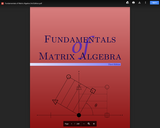
A college (or advanced high school) level text dealing with the basic principles of matrix and linear algebra. It covers solving systems of linear equations, matrix arithmetic, the determinant, eigenvalues, and linear transformations. Numerous examples are given within the easy to read text. This third edition corrects several errors in the text and updates the font faces.
This course introduces quantitative approaches to understanding brain and cognitive functions. Topics …
This course introduces quantitative approaches to understanding brain and cognitive functions. Topics include mathematical description of neurons, the response of neurons to sensory stimuli, simple neuronal networks, statistical inference and decision making. It also covers foundational quantitative tools of data analysis in neuroscience: correlation, convolution, spectral analysis, principal components analysis, and mathematical concepts including simple differential equations and linear algebra.
5.73 covers fundamental concepts of quantum mechanics: wave properties, uncertainty principles, Schrödinger …
5.73 covers fundamental concepts of quantum mechanics: wave properties, uncertainty principles, Schrödinger equation, and operator and matrix methods. Basic applications of the following are discussed: one-dimensional potentials (harmonic oscillator), three-dimensional centrosymmetric potentials (hydrogen atom), and angular momentum and spin. The course also examines approximation methods: variational principle and perturbation theory.
Learn Differential Equations: Up Close with _Gilbert Strang and_ Cleve Moler is …
Learn Differential Equations: Up Close with _Gilbert Strang and_ Cleve Moler is an in-depth series of videos about differential equations and the MATLAB® ODE suite. These videos are suitable for students and life-long learners to enjoy. About the Instructors Gilbert Strang is the MathWorks Professor of Mathematics at MIT. His research focuses on mathematical analysis, linear algebra and PDEs. He has written textbooks on linear algebra, computational science, finite elements, wavelets, GPS, and calculus. Cleve Moler is chief mathematician, chairman, and cofounder of MathWorks. He was a professor of math and computer science for almost 20 years at the University of Michigan, Stanford University, and the University of New Mexico. These videos were produced by The MathWorks and are also available on The MathWorks website.
This course covers matrix theory and linear algebra, emphasizing topics useful in …
This course covers matrix theory and linear algebra, emphasizing topics useful in other disciplines such as physics, economics and social sciences, natural sciences, and engineering. It parallels the combination of theory and applications in Professor Strang’s textbook Introduction to Linear Algebra. Course Format This course has been designed for independent study. It provides everything you will need to understand the concepts covered in the course. The materials include:
A complete set of Lecture Videos by Professor Gilbert Strang. Summary Notes for all videos along with suggested readings in Prof. Strang's textbook Linear Algebra. Problem Solving Videos on every topic taught by an experienced MIT Recitation Instructor. Problem Sets to do on your own with Solutions to check your answers against when you're done. A selection of Java® Demonstrations to illustrate key concepts. A full set of Exams with Solutions, including review material to help you prepare.
This is a basic subject on matrix theory and linear algebra. Emphasis …
This is a basic subject on matrix theory and linear algebra. Emphasis is given to topics that will be useful in other disciplines, including systems of equations, vector spaces, determinants, eigenvalues, similarity, and positive definite matrices.
MathsCasts are produced by the mathematics support centres at Swinburne University, the …
MathsCasts are produced by the mathematics support centres at Swinburne University, the University of Limerick and Loughborough University. They are part of an ongoing collaborative research project to develop high quality resources and investigate the effectiveness of MathsCasts to support mathematics learning. They are targeted at prerequisite to first year level, in a range of subjects such as: Engineering, Sciences, Business, Computing and Technology.
Together, this course and 8.06 Quantum Physics III cover quantum physics with …
Together, this course and 8.06 Quantum Physics III cover quantum physics with applications drawn from modern physics. Topics covered in this course include the general formalism of quantum mechanics, harmonic oscillator, quantum mechanics in three-dimensions, angular momentum, spin, and addition of angular momentum. The lectures and lecture notes for this course form the basis of Zwiebach’s textbook Mastering Quantum Mechanics published by MIT Press in April 2022.
8.322 is the second semester of a two-semester subject on quantum theory, …
8.322 is the second semester of a two-semester subject on quantum theory, stressing principles. Topics covered include: time-dependent perturbation theory and applications to radiation, quantization of EM radiation field, adiabatic theorem and Berry's phase, symmetries in QM, many-particle systems, scattering theory, relativistic quantum mechanics, and Dirac equation.
No restrictions on your remixing, redistributing, or making derivative works. Give credit to the author, as required.
Your remixing, redistributing, or making derivatives works comes with some restrictions, including how it is shared.
Your redistributing comes with some restrictions. Do not remix or make derivative works.
Most restrictive license type. Prohibits most uses, sharing, and any changes.
Copyrighted materials, available under Fair Use and the TEACH Act for US-based educators, or other custom arrangements. Go to the resource provider to see their individual restrictions.