You must be logged in to perform this action.
Remix and Share

-
(Complete Item Description)
- Abstract:
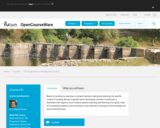
Theoretical topics of fluid dynamics relevant to natural phenomena or man-made hazards in water and atmosphere. Basic law of fluid motion. Scaling and approximations. Slow flows, with applications to drag on a particle and mud flow on a slope. Boundary layers: jets and plumes in pure fluids or in porous media. Thermal and buoyancy effects, selective withdrawal and internal waves. Transient boundary layers in impulsive flows or waves. Induced streaming and mass transport. Dispersion in steady flows or in waves. Effects of earth rotation on coastal flows. Wind induced flow in shallow seas. Stratified seas and coastal upwelling.
- Subject:
- Science and Technology
- Grade Level:
- Post-secondary
- Collection:
-
MIT OpenCourseWare
Read the Fine Print

-
(Complete Item Description)
- Abstract:
'Aviation Memories' is described as a 'virtual multi-channel video installation.' The work begins as an introduction to possible installations of video work, showing (with diagrams and animation) how monitors and related objects would be placed in a gallery setting. As the content of the video itself is described and presented, the work blurs the line between art object and planning document. Many of the images presented are derived from the illustrations of Jan Vredeman de Vries (1527-1604). Architectural themes prevail. Archival footage of collapsing buildings is incorporated. The work is approximately seven minutes long.'Grafix' were generated using Fairlight CVI at Dekart Video. The Jones Frame and Buffer, Jones Keyer/Colorizer was used at the Experimental Television Center. Mirage was used through Broadway Video. A Casio CZ 101 was used for sound.
- Subject:
- Arts, Science and Technology
- Collection:
-
WGBH Open Vault
Read the Fine Print

-
(Complete Item Description)
- Abstract:
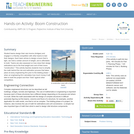
Students will build their own towers using some of the techniques they have learned. The materials will consist of balsa wood and glue. General guidelines are provided, but the students will have a lot of freedom with their design to encourage them to implement what they have learned about structural engineering.
- Subject:
- Mathematics and Statistics, Science and Technology
- Grade Level:
- Primary, Secondary
- Collection:
-
TeachEngineering
Read the Fine Print

-
(Complete Item Description)
- Abstract:
This curricular unit introduces students to basic Civil Engineering concepts in an exciting and interactive manner. Bridges and skyscrapers, the two most visible products of Civil Engineers, will be discussed in depth. Students will have a chance to design and build balsa wood structures, as well as understand the design principles behind these structures that allow them to withstand vertical and lateral forces. There is also an emphasis on how materials absorb different types of forces. Since the ability to visualize in three dimensions is imperative to civil engineers, there is a visual, hands-on activity designed to teach three dimensional coordinate systems.
- Subject:
- Mathematics and Statistics, Science and Technology
- Grade Level:
- Primary, Secondary
- Collection:
-
TeachEngineering
Read the Fine Print

-
(Complete Item Description)
- Abstract:
In the exploration of ways to use solar energy, students investigate the thermal energy storage capacities of different test materials to determine which to use in passive solar building design.
- Subject:
- Mathematics and Statistics, Science and Technology
- Grade Level:
- Primary
- SubTopics:
-
Energy
- Collection:
-
TeachEngineering
Remix and Share

-
(Complete Item Description)
- Abstract:
Based on working on exercises on project decision making and planning, the specific context of working abroad in general and in developing countries in particular is illustrated, with regard to socio-cultural aspects, planning and financing of projects, roles of (consulting) engineers and contractors, local materials, techniques and knowledge and environmental issues.
- Subject:
- Science and Technology
- Grade Level:
- Post-secondary
- Collection:
-
Delft University OpenCourseWare
Remix and Share

-
(Complete Item Description)
- Abstract:
D-Lab: Energy offers a hands-on, project-based approach that engages students in understanding and addressing the applications of small-scale, sustainable energy technology in developing countries where compact, robust, low-cost systems for generating power are required. Projects may include micro-hydro, solar, or wind turbine generators along with theoretical analysis, design, prototype construction, evaluation and implementation. Students will have the opportunity both to travel to Nicaragua during spring break to identify and implement projects. D-Lab: Energy is part of MIT's D-Lab program, which fosters the development of appropriate technologies and sustainable solutions within the framework of international development.
- Subject:
- Science and Technology, Social Sciences
- Grade Level:
- Post-secondary
- SubTopics:
-
Energy
,
Industrial and Agricultural Impacts
,
Green Building and Design
- Collection:
-
MIT OpenCourseWare
Remix and Share

-
(Complete Item Description)
- Abstract:
Survey of information technology covering database modeling, design, and implementation with an emphasis on relational databases and SQL. Internet technologies: http, html, XML, SOAP, security. Brief introduction to components and middleware. Introduction to design and implementation of multi-tier architectures, benchmarks, and performance. Data networking protocols and technologies. Students complete project that covers requirements/design, data model, database implementation, web site, and system architecture. This course is an intensive review of information technology. It covers topics in software development methods, data modeling and databases, application development, Web standards and development, system integration, security, and data communications. Most of the homework sets lead the class through a project in which a database and Web application are designed and constructed, using good software process and addressing security, network and other issues. The project, which is done in two-person teams, provides hands-on experience to complement the lectures and readings. Recitations discuss readings and provide more detailed information on the software tools used. The course goal is to cover the key concepts in the major areas of information technology, to enable students to successfully understand, work with and manage IT efforts as part of supply chain, transportation or civil engineering projects.
- Subject:
- Science and Technology
- Grade Level:
- Post-secondary
- Collection:
-
MIT OpenCourseWare
Remix and Share

-
(Complete Item Description)
- Abstract:
The purpose of this course is to convey knowledge of the various physical processes associated with slurry handling and transport during dredging. This knowledge is needed for the design of dredging equipment and for planning efficient equipment operations. The various processes are discussed and theories and simulation models that describe the processes are presented and compared during the course.
The course can be broken down into four elements:
1. Pumps and engines
a. Pump characteristics and cavitation
b. Influence of particles on pump characteristics.
2. Hydraulic transport in pipelines
a. Two-phase (solid-liquid) flow through pipelines
b. Newtonian slurries
c. Non Newtonian slurries
d. Inclined and long pipelines.
3. Pump and pipeline systems
a. Operation point and areas
b. Production factors.
4. Case studies
- Subject:
- Science and Technology
- Grade Level:
- Post-secondary
- Collection:
-
Delft University OpenCourseWare
Remix and Share

-
Read the Fine Print

-
(Complete Item Description)
- Abstract:
The profession of engineering is grouped into specialized disciplines that have developed in response to societal needs. No matter what their field, whether one of the "big four" fields of civil, computer, electrical, or mechanical engineering, or a specialty discipline like ocean engineering, all engineers possess a mix of creativity and smarts. They excel in mathematics or science and spatial relations, and they use these talents to synthesize information, solve problems, and innovate. In this collection of images adapted from The American Society for Engineering Education, learn more about the many fields that make up the engineering profession. Grades 3-12.
- Subject:
- Science and Technology
- Grade Level:
- Primary, Secondary
- Collection:
-
Teachers' Domain
Remix and Share

-
(Complete Item Description)
- Abstract:
Core requirements for Environmental M.Eng. program. Designed to teach about environmental engineering through the use of case studies, computer software tools, and seminars from industrial experts. Case studies provide basis for group project as well as individual thesis. Past case studies have included the MMR Superfund site on Cape Cod; restoration of the Florida Everglades; dredging of Boston Harbor; local watershed trading programs; appropriate wastewater treatment technology for Brazil; point-of-use water treatment for Nepal, Brownfields Development in Providence, RI, and water resource planning for the island of Cyprus. Students must register for 1.782 for Fall term, IAP, and Spring term.
- Subject:
- Science and Technology
- Grade Level:
- Post-secondary
- SubTopics:
-
Water
,
Green Building and Design
,
Pollution
- Collection:
-
MIT OpenCourseWare
Remix and Share

-
(Complete Item Description)
- Abstract:
Explores fluid properties, hydrostatics, fluid dynamics, similitude, energy and momentum principles, closed conduit flow, open channel flow, and flow measurement. Includes laboratory exercises in flow measurement, open channel flow, pipe friction, physical modeling, and data collection.
- Subject:
- Science and Technology
- Grade Level:
- Post-secondary
- Collection:
-
Utah State University OpenCourseWare
Remix and Share

-
(Complete Item Description)
- Abstract:
Students in ESD.00 work on projects to address large, complex and seemingly intractable real-world problems, such as energy supply, environmental issues, health care delivery, and critical infrastructure (e.g., telecommunications, water supply, and transportation). The course introduces interdisciplinary approaches - rooted in engineering, management, and the social sciences - to considering these critical contemporary issues. Small, faculty-led teams select an engineering systems term project to illustrate one or more of these approaches.
- Subject:
- Science and Technology, Social Sciences
- Grade Level:
- Post-secondary
- SubTopics:
-
Green Building and Design
- Collection:
-
MIT OpenCourseWare
Remix and Share

-
(Complete Item Description)
- Abstract:
This subject provides an introduction to modeling and simulation (IM/S), covering continuum methods, atomistic and molecular simulation (e.g. molecular dynamics) as well as quantum mechanics. These tools play an increasingly important role in modern engineering. You will get hands-on training in both the fundamentals and applications of these methods to key engineering problems. The lectures will provide an exposure to areas of application, based on the scientific exploitation of the power of computation. We will use web based applets for simulations and thus extensive programming skills are not required.
- Subject:
- Science and Technology
- Grade Level:
- Post-secondary
- Collection:
-
MIT OpenCourseWare
Remix and Share

-
(Complete Item Description)
- Abstract:
The I-35W bridge collapse in Minneapolis in August 2007, resulting in at least 13 deaths, illustrates the importance of structural integrity. This unit looks at the investigation that followed the collapse of the Silver Bridge over the Ohio River in 1967 which demonstrates how the study of safe design and the assessment of components and structures under load is of increasing importance in engineering design.
- Subject:
- Science and Technology
- Grade Level:
- Post-secondary
- Collection:
-
Open University OpenLearn
Read the Fine Print

-
(Complete Item Description)
- Abstract:
Students will be challenged to design and construct a tower out of newspaper. They will have limited supplies including newspaper, tape, and scissors since engineers are often restricted by economic reasons as to how much material they can use in their building. The students will be building for height and stability, and their towers must be designed to withstand a lateral "wind" load.
- Subject:
- Mathematics and Statistics, Science and Technology
- Grade Level:
- Primary, Secondary
- Collection:
-
TeachEngineering
Remix and Share

-
(Complete Item Description)
- Abstract:
Project Evaluation covers methodologies for evaluating civil engineering projects, which typically are large-scale and long-lived and involve many economic, financial, social and environmental factors. The course places an emphasis on dealing with uncertainty. Students learn basic techniques of engineering economics, including net present value analysis, life-cycle costing, benefit-cost analysis, and other approaches to project evaluation. Examples are drawn from both contemporary and historical projects in various fields, including transportation systems, urban development, energy and environmental projects, water resource management, telecommunications systems, and other elements of the public and private projects and programs.
- Subject:
- Business, Science and Technology
- Grade Level:
- Post-secondary
- SubTopics:
-
Green Building and Design
- Collection:
-
MIT OpenCourseWare
Read the Fine Print

-
(Complete Item Description)
- Abstract:
In this lesson, students learn about major landforms (e.g., mountains, rivers, plains, valleys, canyons and plateaus) and how they occur on the Earth's surface. They learn about the civil and geotechnical engineering applications of geology and landforms, including the design of transportation systems, mining, mapping and measuring natural hazards.
- Subject:
- Mathematics and Statistics, Science and Technology
- Grade Level:
- Primary
- Collection:
-
TeachEngineering
Read the Fine Print

-
(Complete Item Description)
- Abstract:
Skyscrapers are one of the most glorified products of Civil Engineering and contain an interesting history of progress and development. In this lesson, the students will learn about the history of the world's tallest free standing structures and the basic design principles behind their success. Students will build their own newspaper skyscrapers with limited materials and time, trying to achieve a maximum height and the ability to withstand a "hurricane wind" force. Discussion will concentrate on materials, forces that a skyscraper needs to withstand, and basic structural design.
- Subject:
- Mathematics and Statistics, Science and Technology
- Grade Level:
- Primary, Secondary
- Collection:
-
TeachEngineering