Advanced Algebra II provides three complementary resources for teachers and students that combine to provide a friendly, easy-to-understand explanation of Algebra II concepts. The main text, "Activities and Homework", consists of a series of worksheets for both in-class group work as well as homework assignments. The concepts behind those activities are described in detail in the "Conceptual Explanations" text. The third book, the "Teacher's Guide", provides instructors with guides and suggestions for presenting these materials.
Over a period of time, I have developed a set of in-class assignments, homeworks, and lesson plans, that work for me and for other people who have tried them. If I give you the in-class assignments and the homeworks, but not the lesson plans, you only have ⅔ of the story; and it may not make sense without the other third. So instead, I am giving you everything: the in-class assignments and the homeworks (the Homework and Activities book), the detailed explanations of all the concepts (the Conceptual Explanations book), and the lesson plans (the Teacher's Guide). Once you read them over, you will know exactly what I have done.
This digital textbook was reviewed for its alignment with California content standards.
Students explore the science of biology in an interactive and engaging way. This online resource provides a powerful framework for connecting the big ideas of biology to the California standards.
This digital textbook was reviewed for its alignment with California content standards.
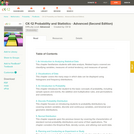
Submitted as part of the California Learning Resource Network (CLRN) Phase 3 Digital Textbook Initiative (CA DTI3), CK-12 Advanced Probability and Statistics introduces students to basic topics in statistics and probability but finishes with the rigorous topics an advanced placement course requires. Includes visualizations of data, introduction to probability, discrete probability distribution, normal distribution, planning and conducting a study, sampling distributions, hypothesis testing, regression and correlation, Chi-Square, analysis of variance, and non-parametric statistics.
Submitted as part of the California Learning Resource Network (CLRN) Phase 3 Digital Textbook Initiative (CA DTI3), CK-12 Foundation’s high school Biology FlexBook covers cell biology, genetics, evolution, ecology, botany, zoology, and physiology. This digital textbook was reviewed for its alignment with California content standards.
Submitted as part of the California Learning Resource Network (CLRN) Phase 3 Digital Textbook Initiative (CA DTI3), CK-12 Foundation’s Chemistry - Second Edition FlexBook covers the full course of chemistry topics taught in high school. This digital textbook was reviewed for its alignment with California content standards. The 25 chapters cover measurement in chemistry, matter and energy, the atomic theory, Bohr model of the atom, chemical periodicity, behavior of gases, acid and bases, stoichometry, covalent bonds and formulas, electron configuration of atoms.
CK-12 users should treat this FlexBook as an online textbook for Earth Science courses. This FlexBook underwent a thorough review conducted by practicing teachers, domain experts, copyeditors, and technical editors. It can be used in its current form, "flexed" (customized), and/or printed by the user. CK-12 supports feedback on all of its FlexBooks so that they can be continually improved and updated, while remaining aligned with state standards and curriculum guidelines.
This digital textbook was reviewed for its alignment with California content standards.
CK-12's Geometry delivers a full course of study in the mathematics of shape and space for the high school student, relating the ancient logic and modern applications of measurement and description to its essential elements, processes of reasoning and proof, parallel and perpendicular lines, congruence and similarity, relationships within triangles and among quadrilaterals, trigonometry of right triangles, circles, perimeter, area, surface area, volume, and geometric transformations.
This digital textbook was reviewed for its alignment with California content standards
CK-12’s Life Science delivers a full course of study in the life sciences for the high school student, relating an understanding of the history, disciplines, tools, and modern techniques of science to the exploration of living things, the building blocks of life, genetics and evolution, the kingdoms of life, the human body, and the ecology of living communities.
This digital textbook was reviewed for its alignment with California content standards.
CK-12 Single Variable Calculus delivers a well-integrated course for the college-bound high school student covering advanced placement topics of functions, limits, and continuity; derivatives and applications of derivatives; integration and applications of definite integrals; transcendental functions; integration techniques; and infinite series.
This digital textbook was reviewed for its alignment with California content standards.
This textbook covers topics such as Trigonometry and Right Angles, Circular Functions, Trigonometric Identities, Inverse Functions, Trigonometric Equations, Triangles and Vectors, as well as Polar Equations and Complex Numbers. It can also be used in conjunction with other directed courses in Mathematical Analysis or Linear Algebra as a full course in Precalculus. This digital textbook was reviewed for its alignment with California content standards.
This Internet resource provides introductory information, concept or skill development in Mathematics for grade 9, 10, 11, and 12 students who are at grade level in a single student situation. This text was initially written by David Guichard. The single variable material (not including infinite series) was originally a modification and expansion of notes written by Neal Koblitz at the University of Washington, who generously gave permission to use, modify, and distribute his work. New material has been added, and old material has been modified, so some portions now bear little resemblance to the original.
This digital textbook was reviewed for its alignment with California content standards.
The textbook "Calculus" by Gilbert Strang, is a modern calculus text written in a human-friendly style. Published in 1991 and still in print from Wellesley-Cambridge Press, the book is a useful resource for educators and self-learners alike. It is well organized, covers single variable and multivariable calculus in depth, and is rich with applications. There is also an online Instructor's Manual and a student Study Guide.
This digital textbook was reviewed for its alignment with California content standards.
The following course contains assignments and analysis for an Open Source Earth Science course for grades 9 - 10. The collection has been prepared from resources contributed by teachers and partner educational organizations on Curriki, an online community for creating and sharing open source curricula. The Open Source Earth Science course has been organized to meet the CA Science Standards for Earth Sciences in grades 9 - 10, as adopted by the California State Board of Education.
This digital textbook was reviewed for its alignment with California content standards.
This is a calculus textbook at the college Freshman level based on Abraham Robinson's infinitesimals, which date from 1960. Robinson's modern infinitesimal approach puts the intuitive ideas of the founders of the calculus on a mathematically sound footing, and is easier for beginners to understand than the more common approach via limits.
This digital textbook was reviewed for its alignment with California content standards.
A comprehensive analysis of all the components of the climate system (atmosphere, ocean, ice sheets, etc) and of all the interactions between them is out of the scope of any course or book. We have thus chosen here to provide only a brief overview of the processes that rule the behaviour of those different components. More detailed descriptions are provided in meteorology, oceanography and glaciology courses for instance. Our first goal here is rather to provide enough information on the interactions between the different elements of the climate system and on the dominant feedbacks to allow the student to analyse the variability of the climate and its response to a perturbation. By this mean, the reader should be able to understand the dominant causes of past climate changes and to critically evaluate the projections of the climate change over the next centuries or millennia.
Because of the complexity of the climate system, many analyses devoted to a quantitative estimate of climate change or climate variability rely on the use of comprehensive three-dimensional numerical models. However, simple models are also widely used to underline clearly the fundamental properties of the climate. Our second goal is thus to give the student the bases to understand how climate model are built and how they could be used to make quantitative estimate of climate variability and climate change as well as to illustrate how models could be used to understand the most important concepts of climate science.
This digital textbook was reviewed for its alignment with California content standards.
The following comprehensive collection contains a full course of study for an Open Source Chemistry course for grades 9 ‐ 12. The collection has been prepared from resources contributed by teachers and partner educational organizations on Curriki. The Open Source Chemistry course has been organized to meet the CA Science Standards for Chemistry in grades 9 ‐ 12
This series of six books is intended for a one-year introductory course of the type typically taken by biology majors. Algebra and trig are used, and there are optional calculus-based sections.
This digital textbook was reviewed for its alignment with the content standards only; California’s Social Content Review criteria were not applied. Districts, schools, and individuals planning to take advantage of this free textbook are reminded to conduct their own review to determine whether this resource meets their instructional needs.
No restrictions on your remixing, redistributing, or making derivative works.
Give credit to the author, as required.
Your remixing, redistributing, or making derivatives works comes with some
restrictions, including how it is shared.
Your redistributing comes with some restrictions. Do not remix or make
derivative works.
Copyrighted materials, available under Fair Use and the TEACH Act for US-based
educators, or other custom arrangements. Go to the resource provider to see
their individual restrictions.