Theoretical topics of fluid dynamics relevant to natural phenomena or man-made hazards in water and atmosphere. Basic law of fluid motion. Scaling and approximations. Slow flows, with applications to drag on a particle and mud flow on a slope. Boundary layers: jets and plumes in pure fluids or in porous media. Thermal and buoyancy effects, selective withdrawal and internal waves. Transient boundary layers in impulsive flows or waves. Induced streaming and mass transport. Dispersion in steady flows or in waves. Effects of earth rotation on coastal flows. Wind induced flow in shallow seas. Stratified seas and coastal upwelling.
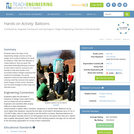
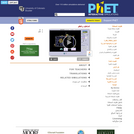
Experiment with a helium balloon, a hot air balloon, or a rigid sphere filled with different gases. Discover what makes some balloons float and others sink.
Subject:
Mathematics and Statistics, Science and Technology
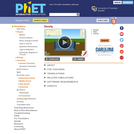
When will objects float and when will they sink? Learn how buoyancy works with blocks. Arrows show the applied forces, and you can modify the properties of the blocks and the fluid.
Subject:
Mathematics and Statistics, Science and Technology
This illustrated demonstration from the NOVA Web site explains the concepts of buoyancy and density by showing what happens when different kinds of wood blocks are dropped in water.
This interactive brainteaser from the NOVA Web site challenges you to figure out what happens to the water level when a rock is resting in a boat and when it is submerged in water.
Students will conduct a simple experiment to see how the water level changes in a beaker when a lump of clay sinks in the water and when the same lump of clay is shaped into a bowl that floats in the water. They will notice that the floating clay displaces more water than the sinking clay does, a result that will probably surprise them. They will then determine the mass of water that is displaced when the clay floats in the water. A comparison of this mass to the mass of the clay itself should reveal that they are approximately the same.
Subject:
Mathematics and Statistics, Science and Technology
This activity has students create a Cartesian diver, which will act in some ways like a submarine. Students will adjust the amount of air and water in an inverted test tube (the "diver") so that it at first barely floats in a water-filled bottle. Then, they will squeeze the closed bottle to create higher water pressure, causing the diver to sink. Releasing the bottle allows the diver to float again. Written instructions, a list of materials, and illustrations are included.
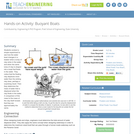
Each student uses a small quantity of modeling clay to make a boat that will float in a tub of water. The object is to build a boat that will hold as much weight as possible without sinking. In the process of designing and testing their boats, students discover some of the basic principles of boat design and gain first-hand experience with concepts such as buoyancy and density.
Subject:
Mathematics and Statistics, Science and Technology
This inquiry-based learning activity allows students to explore the relationships between mass, volume, density, and buoyancy as they manipulate various materials to construct a submersible "vehicle" for deep-sea research.
This curricular unit introduces students to the important concept of density. The focus is on the more easily understood densities of solids, but students can also explore the densities of liquids and gases. Students devise methods to determine the densities of solid objects, including the method of water displacement to determine volumes of irregularly-shaped objects. By comparing densities of various solids to the density of water, and by considering the behavior of different solids when placed in water, students conclude that ordinarily, objects with densities greater than water will sink, while those with densities less than water will float. Students then explore the principle of buoyancy, and through further experimentation arrive at Archimedes' principle, which states that a floating object displaces a mass of water equal to its own mass. They may also be surprised to discover that a floating object displaces more water than a sinking object of the same volume.
Subject:
Mathematics and Statistics, Science and Technology
This lesson introduces students to the important concept of density. The focus is on the more easily understood densities of solids, but students can also explore the densities of liquids and gases. Students devise methods to determine the densities of solid objects, including the method of water displacement to determine volumes of irregularly-shaped objects. By comparing densities of various solids to the density of water, and by considering the behavior of different solids when placed in water, students conclude that ordinarily, objects with densities greater than water will sink, while those with densities less than water will float. Density is an important material property for engineers to understand.
Subject:
Mathematics and Statistics, Science and Technology
Students discover fluid dynamics related to buoyancy through experimentation and optional photography. Using one set of fluids, they make light fluids rise through denser fluids. Using another set, they make dense fluids sink through a lighter fluid. In both cases, they see and record beautiful fluid motion. Activities are also suitable as class demonstrations. The natural beauty of fluid flow opens the door to seeing the beauty of physics in general.
Subject:
Mathematics and Statistics, Science and Technology
Students investigate how melting ice can affect sea level rise. Students will practice the steps involved in a scientific investigation as they learn why ice formations on land -- not those on water -- will cause a rise in sea level upon melting. Activity can be a teacher led demonstration or student laboratory. Grades 3-8. This resource is part of the Our Changing Ocean and Estuaries Series.
No restrictions on your remixing, redistributing, or making derivative works.
Give credit to the author, as required.
Your remixing, redistributing, or making derivatives works comes with some
restrictions, including how it is shared.
Your redistributing comes with some restrictions. Do not remix or make
derivative works.
Copyrighted materials, available under Fair Use and the TEACH Act for US-based
educators, or other custom arrangements. Go to the resource provider to see
their individual restrictions.