(Complete Item Description)
- Abstract:
-
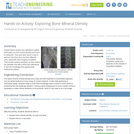
In this activity about bones, learners' jaws will drop when a bone is tied in a knot! A rib or turkey/chicken leg bone is placed in a jar of vinegar. After two weeks, the calcium in the bone dissolves in the vinegar, so the bone is able to bend, sometimes into a knot. This activity can also be done with an egg, which is described at the end of this lesson. Use this experiment to illustrate the anatomy of bones and the process of ossification. This activity is featured on pp.13-14 of the "Bones: More Than They Appear" unit of study for 4th, 5th, and 6th grade learners.
- Subject:
-
Science and Technology,
Social Sciences
- Grade Level:
-
Primary,
Secondary
- Collection:
-
Children's Museum of Indianapolis
Rate this resource by using the left and right arrow keys and pressing Enter.
Read the Fine Print
(Complete Item Description)
- Abstract:
-
This patient education program explains bone densitometry and its importance in treating and preventing osteoporosis. This is a MedlinePlus Interactive Health Tutorial from the National Library of Medicine, designed and developed by the Patient Education Institute.
- Subject:
-
Science and Technology
- Grade Level:
-
Post-secondary
- Collection:
-
H.E.A.L.
Rate this resource by using the left and right arrow keys and pressing Enter.
Read the Fine Print
(Complete Item Description)
- Abstract:
-
In this activity related to bones and the artist Georgia O'Keeffe, learners create artworks inspired by natural objects. Learners first research and discuss the artwork of O'Keeffe. Then learners create a work of art based on found objects in nature using various media (watercolor, chalk, colored pencil, etc.). Upon completion of the project, the artwork can be displayed in a mural. Use this activity to help learners investigate how bones and natural objects are used in art. This activity is featured on pp.43-44 of the "Bones: More Than They Appear" unit of study for 4th, 5th, and 6th grade learners.
- Subject:
-
Science and Technology,
Social Sciences
- Grade Level:
-
Primary,
Secondary
- Collection:
-
Children's Museum of Indianapolis
Rate this resource by using the left and right arrow keys and pressing Enter.
Read the Fine Print
(Complete Item Description)
- Abstract:
-
In this optics activity, learners examine how polarized light can reveal stress patterns in clear plastic. Learners place a fork between two pieces of polarizing material and induce stress by squeezing the tines together. Learners will observe the colored stress pattern in the image of the plastic that is projected onto a screen using an overhead projector. Learners rotate one of the polarizing filters to explore which orientations give the most dramatic color effects. This activity can be related to bones, as bones develop stress patterns from the loads imposed upon them every day.
- Subject:
-
Science and Technology
- Grade Level:
-
Primary,
Secondary
- Collection:
-
Exploratorium
Rate this resource by using the left and right arrow keys and pressing Enter.
Read the Fine Print
(Complete Item Description)
- Abstract:
-
In this activity, learners construct a bone model and simulate changes that occur during the healing process and growth of a bone. Using pre-made or homemade play dough (recipe included) and other everyday items, learners reconstruct a cross-section model of a bone. Time estimate is based on time required when using pre-made play dough. This activity is featured on pp.16-17 of the "Bones: More Than They Appear" unit of study for 4th, 5th, and 6th grade learners.
- Subject:
-
Science and Technology,
Social Sciences
- Grade Level:
-
Primary,
Secondary
- Collection:
-
Children's Museum of Indianapolis
Rate this resource by using the left and right arrow keys and pressing Enter.
Read the Fine Print
(Complete Item Description)
- Abstract:
-
This game is a version of "Win, Lose, or Draw," in which learners draw clues and guess phrases that are related to bones. This fun activity includes the exploration and interpretation of figurative language. Incorporate the study of language, including idioms, personification, metaphors, or similes, into your unit on bones and the skeleton. This activity is featured on p.49 of the "Bones: More Than They Appear" unit of study for 4th, 5th, and 6th grade learners.
- Subject:
-
Science and Technology,
Social Sciences
- Grade Level:
-
Primary,
Secondary
- Collection:
-
Children's Museum of Indianapolis
Rate this resource by using the left and right arrow keys and pressing Enter.
Read the Fine Print
(Complete Item Description)
- Abstract:
-
In this art activity related to bone anatomy, learners use the spongy part of a bone as a brush to create a work of art. This activity emulates the painting technique used by Native Americans of the Plains. Learners will discover that the spongy part of bones absorbs and holds paint very well. This activity is featured on p. 22 of the "Bones: More Than They Appear" unit of study for 4th, 5th, and 6th grade learners.
- Subject:
-
Science and Technology,
Social Sciences
- Grade Level:
-
Primary,
Secondary
- Collection:
-
Children's Museum of Indianapolis
Rate this resource by using the left and right arrow keys and pressing Enter.
Read the Fine Print
(Complete Item Description)
- Abstract:
-
In this activity, learners use clay and sticks, straws, wire or pipe cleaners to construct models of animals, trees or other "lanky" structures. Learners compare the structural integrity of these structures with and without "bones" (sticks/straws/wire/pipe cleaners). This activity includes an extension in which learners construct two different towers, one with an internal support structure and one without; learners record the heights and graph their findings. This activity is featured on p. 23 of the "Bones: More Than They Appear" unit of study for 4th, 5th, and 6th grade learners.
- Subject:
-
Science and Technology,
Social Sciences
- Grade Level:
-
Primary,
Secondary
- Collection:
-
Children's Museum of Indianapolis
Rate this resource by using the left and right arrow keys and pressing Enter.
Read the Fine Print
(Complete Item Description)
- Abstract:
-
This fun Web site is part of OLogy, where kids can collect virtual trading cards and create projects with them. Here, they learn about paleontology with a hands-on activity. The activity opens with an explanation covering how fossilized bones are usually very delicate and buried deeply in rock fossils. Students are then given step-by-step directions for working with a friend to create two make-believe dig sites by burying bones in plaster of Paris. The activity ends with three discussion questions: What was surprising about excavating the bones? What strategies did you find worked well for removing the plaster? How would you have worked differently if you had no idea what was buried inside?
- Subject:
-
Science and Technology
- Grade Level:
-
Primary
- SubTopics:
-
Animals and Insects
- Collection:
-
American Museum of Natural History
Rate this resource by using the left and right arrow keys and pressing Enter.
Read the Fine Print
(Complete Item Description)
- Abstract:
-
In this activity related to bone health and safety, learners construct flip books that illustrate the basic first-aid steps when encountering a broken-bone situation. Topics include "Causes of Broken Bones," "Knowing If a Bone is Broken," "First Aid Procedures," and "Preventing Broken Bones." Each page includes a description of a procedure or event and at least one detailed colorful illustration. This activity is featured on pp.30-31 of the "Bones: More Than They Appear" unit of study for 4th, 5th, and 6th grade learners.
- Subject:
-
Science and Technology,
Social Sciences
- Grade Level:
-
Primary,
Secondary
- Collection:
-
Children's Museum of Indianapolis
Rate this resource by using the left and right arrow keys and pressing Enter.
Read the Fine Print
(Complete Item Description)
- Abstract:
-
This still collage produced for Teachers' Domain features a variety of images of fossilized dinosaur bones, which provide evidence for the existence of these fascinating reptiles.
- Subject:
-
Science and Technology
- Grade Level:
-
Primary,
Secondary
- Collection:
-
Teachers' Domain
Rate this resource by using the left and right arrow keys and pressing Enter.
Read the Fine Print
(Complete Item Description)
- Abstract:
-
This patient education program explains the differences between fractures and sprains involving the arms or legs, precautions, and the treatments with their risks. It also reviews the bones of the arms and legs. This resource is a MedlinePlus Interactive Health Tutorial from the National Library of Medicine, designed and developed by the Patient Education Institute.
- Subject:
-
Science and Technology
- Grade Level:
-
Post-secondary
- Collection:
-
H.E.A.L.
Rate this resource by using the left and right arrow keys and pressing Enter.
Read the Fine Print
(Complete Item Description)
- Abstract:
-
This patient education program explains the differences between fractures and sprains involving the arms or legs, precautions, and the treatments with their risks. It also reviews the bones of the arms and legs. This resource is a MedlinePlus Interactive Health Tutorial from the National Library of Medicine, designed and developed by the Patient Education Institute.
- Subject:
-
Science and Technology
- Grade Level:
-
Post-secondary
- Collection:
-
H.E.A.L.
Rate this resource by using the left and right arrow keys and pressing Enter.
Read the Fine Print
Rate this resource by using the left and right arrow keys and pressing Enter.
No Strings Attached
(Complete Item Description)
- Abstract:
-
In this activity about physical stress (page 28 of PDF), learners discover that muscles and bones need to work to stay strong. In part 1, learners investigate how physical stress can affect bone (a hard material) by bending plastic knives. In part 2, learners explore the effects of stress on the muscles in their hands by predicting and counting the number of times they can "click" a clothespin. Learners will conduct this experiment every other day for two weeks to discover that their muscles grow stronger with conditioning. This guide includes background information, extensions, and a data sheet.
- Subject:
-
Science and Technology
- Grade Level:
-
Primary
- Collection:
-
SMILE Pathway
Rate this resource by using the left and right arrow keys and pressing Enter.
Read the Fine Print
(Complete Item Description)
- Abstract:
-
In this activity about endoskeletons (page 8 of PDF), learners observe, compare and contrast different kinds of chicken bones, and relate their chicken bone observations to human bones. The bones must be prepared a day ahead of time. Learners also use a poem to identify the major bones of the human body and discuss the importance of bilateral symmetry. This guide includes background information, extensions, and data sheets.
- Subject:
-
Science and Technology
- Grade Level:
-
Primary
- Collection:
-
BioEdOnline
Rate this resource by using the left and right arrow keys and pressing Enter.
Read the Fine Print
(Complete Item Description)
- Abstract:
-
In this activity, learners rotate through several learning and play stations to explore dinosaurs and paleontologists. At these stations, learners use sand and dinosaur bone replicas to create a dig site and make observations, read several dinosaur books and complete dinosaur puzzles, role play as dinosaur hunters as they explore online dinosaur sites, create a dinosaur romp, listen to dinosaur music, and use clay or play dough to make dinosaurs and dinosaur tracks. This activity is featured on page 9 of the "Dinosphere" unit of study for K-2 learners.
- Subject:
-
Science and Technology,
Social Sciences
- Grade Level:
-
Primary
- Collection:
-
Children's Museum of Indianapolis
Rate this resource by using the left and right arrow keys and pressing Enter.
Read the Fine Print
(Complete Item Description)
- Abstract:
-
In this activity, learners do the "Macarena" dance but with a "bony" twist. Learners identify thirteen bones on their body including the tarsal (ankle), tibia (shin), and fibula (calf), while singing and dancing to the popular tune. This activity is featured on pp.26-27 of the "Bones: More Than They Appear" unit of study for 4th, 5th, and 6th grade learners.
- Subject:
-
Science and Technology,
Social Sciences
- Grade Level:
-
Primary,
Secondary
- Collection:
-
Children's Museum of Indianapolis
Rate this resource by using the left and right arrow keys and pressing Enter.
Read the Fine Print
(Complete Item Description)
- Abstract:
-
Muscles and Bones offers teachers 10 activities that help students understand how the body's muscles and bones work. The activities in this guide help students explore important questions related to muscles and bones in living things; such as: Do you know which foods have lots of calcium for your bones? What are you doing to keep your muscles strong? and How do your bones and muscles work together?
- Subject:
-
Science and Technology
- Grade Level:
-
Primary,
Secondary
- Collection:
-
Baylor College of Medicine
Rate this resource by using the left and right arrow keys and pressing Enter.
Read the Fine Print
(Complete Item Description)
- Abstract:
-
In NASA CONNECT, Good Stress: Building Better Muscles and Bones, students will learn about the importance of building and maintaining better muscles and bones. They will learn that all stresses in life are not "bad." In fact, the body needs good stresses, like exercise, to be healthy. Students will see how scientists and researchers collect and analyze physiological data to understand how muscle and bones are constantly changing, especially in a microgravity environment. Grades 6-8.
- Subject:
-
Mathematics and Statistics,
Science and Technology
- Grade Level:
-
Primary,
Secondary
- Collection:
-
NASA CONNECT
Rate this resource by using the left and right arrow keys and pressing Enter.
Read the Fine Print
No restrictions on your remixing, redistributing, or making derivative works. Give credit to the author, as required.
Your remixing, redistributing, or making derivatives works comes with some restrictions, including how it is shared.
Your redistributing comes with some restrictions. Do not remix or make derivative works.
Copyrighted materials, available under Fair Use and the TEACH Act for US-based educators, or other custom arrangements. Go to the resource provider to see their individual restrictions.