This article provides links to hands-on science activities that could be used …
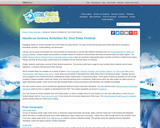
This article provides links to hands-on science activities that could be used in an festival or informal learning event. National standards correlations are provided.
This part of the Student Observation Network allows you to make observations …
This part of the Student Observation Network allows you to make observations to answer the question, "Have auroras been seen within the last 24 hours due to a solar storm?"
The Student Observation Network provides guided inquiry. While participating in the Auroral Friends program your students may think of other questions that they wish to investigate. For instance, they may wish to know; "What causes the aurora?", "What affect does a solar storm have on aurora?", and "What conditions enhance auroras?". These open inquiries may reveal to them that coronal holes may energize auroras even when solar storms have not occurred.
This issue of the free online magazine, Beyond Penguins and Polar Bears, …
This issue of the free online magazine, Beyond Penguins and Polar Bears, highlights ways to teach about the extremes in day and night and seasons in the Arctic and Antarctica. The targeted literacy skill is cause/effect relationships. Art and poetry are integrated through a study of the aurora.
This article describes early studies of the auroras, including techniques used from …
This article describes early studies of the auroras, including techniques used from 1960 when Henry Brecher first spent the winter at Byrd Station in Antarctica.
The Sunspotters program of the Student Observation Network (SON) is excellent for …
The Sunspotters program of the Student Observation Network (SON) is excellent for grades K +12. There are activities for all grades available. You or your students may think of other questions to investigate that can lead to open inquiry by using live and archived data. By collecting and analyzing real-time data from student telescopes, professional observatories, and NASA satellites, they can carry out the same duties as NASA researchers!
In Sunspotters you will learn:
How to instruct students in the construction and use of simple solar telescopes to observe sunspots and to predict which sunspots are most likely to produce solar flares or coronal mass ejections,
How to enable students to obtain and interpret data from ground-based professional observatories,
How to enable students to obtain and interpret data from NASA satellites.
Dancing Lights: Exploring the Aurora through Art and Writing is a science-in-literacy …
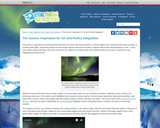
Dancing Lights: Exploring the Aurora through Art and Writing is a science-in-literacy program about the aurora. Students in grades 3-5 write and illustrate their perceptions, ideas, and facts pertaining to auroral science. This short educator background primer was based upon interactions with teachers during Dancing Lights workshops and is meant as a quick guide to the science of the aurora.
Visitors to this site can learn about conditions necessary to view auroras …
Visitors to this site can learn about conditions necessary to view auroras from their geographical location. Materials provided include an explanation of geomagnetic activity and maps showing its distribution, and an explanation of how geographic latitude differs from magnetic latitude, with tables showing magnetic latitudes for major cities around the world. Links are provided to auroral activity and space weather forecasts.
No restrictions on your remixing, redistributing, or making derivative works. Give credit to the author, as required.
Your remixing, redistributing, or making derivatives works comes with some restrictions, including how it is shared.
Your redistributing comes with some restrictions. Do not remix or make derivative works.
Most restrictive license type. Prohibits most uses, sharing, and any changes.
Copyrighted materials, available under Fair Use and the TEACH Act for US-based educators, or other custom arrangements. Go to the resource provider to see their individual restrictions.