The National Center on Accessible Instructional Materials and PACER Center are pleased …
The National Center on Accessible Instructional Materials and PACER Center are pleased to announce the release of our new video explaining Accessible Instruc...
Students play and record the “Mary Had a Little Lamb” song using …
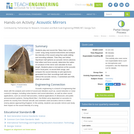
Students play and record the “Mary Had a Little Lamb” song using musical instruments and analyze the intensity of the sound using free audio editing and recording software. Then they use hollow Styrofoam half-spheres as acoustic mirrors (devices that reflect and focus sound), determine the radius of curvature of the mirror and calculate its focal length. Students place a microphone at the acoustic mirror focal point, re-record their songs, and compare the sound intensity on plot spectrums generated from their recordings both with and without the acoustic mirrors. A worksheet and KWL chart are provided.
This class examines the ways humans experience the realm of sound and …
This class examines the ways humans experience the realm of sound and how perceptions and technologies of sound emerge from cultural, economic, and historical worlds. In addition to learning about how environmental, linguistic, and musical sounds are construed cross-culturally, students learn about the rise of telephony, architectural acoustics, and sound recording, as well as about the globalized travel of these technologies. Questions of ownership, property, authorship, and copyright in the age of digital file sharing are also addressed. A major concern will be with how the sound/noise boundary has been imagined, created, and modeled across diverse sociocultural and scientific contexts. Auditory examples — sound art, environmental recordings, music — will be provided and invited throughout the term.
This is Podcast number 1 for Open Educational Recourses at BHCC (Bunker Hill …
This is Podcast number 1 for Open Educational Recourses at BHCC (Bunker Hill Community College). In this podcast Ceit De Vitto, Senior Special Programs Coordinator for Academic Innovation and Distance Education, and Dr. John Brittingham Associate Director Teaching, Learning, & Instructional Design talk with Dr. Melissa Colón, who is an Assistant Professor, Sociology. They talk about OER how Dr. Colón uses it in her own courses, why it is important, and its challenges. For all three it is not just about the cost savings, it is about the students.
This class explores sound and what can be done with it. Sources …
This class explores sound and what can be done with it. Sources are recorded from students' surroundings - sampled and electronically generated (both analog and digital). Assignments include composing with the sampled sounds, feedback, and noise, using digital signal processing (DSP), convolution, algorithms, and simple mixing. The class focuses on sonic and compositional aspects rather than technology, math, or acoustics, though these are examined in varying detail. Students complete weekly composition and listening assignments; material for the latter is drawn from sound art, experimental electronica, conventional and non-conventional classical electronic works, popular music, and previous students' compositions.
This class explores interaction with mobile computing systems and telephones by voice, …
This class explores interaction with mobile computing systems and telephones by voice, including speech synthesis, recognition, digital recording, and browsing recorded speech. Emphasis on human interface design issues and interaction techniques appropriate for cognitive requirements of speech. Topics include human speech production and perception, speech recognition and text-to-speech algorithms, telephone networks, and spatial and time-compressed listening. Extensive reading from current research literature.
This course examines cultural performances of Asia, including both traditional and contemporary …
This course examines cultural performances of Asia, including both traditional and contemporary forms, in a variety of genres. Students will explore the communicative power of performances with attention to the ways performers, media, cultural settings, and audiences interact. The representation of cultural difference is considered and how it is altered through processes of globalization. Performances are viewed live when possible, but the course also relies on video, audio, and online materials as necessary. There are no prerequisites for this course and it is taught in English.
In this lesson, students learn that sound is energy and has the …
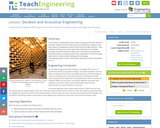
In this lesson, students learn that sound is energy and has the ability to do work. Students discover that sound is produced by a vibration and they observe soundwaves and how they travel through mediums. They understand that sound can be absorbed, reflected or transmitted. Through associated activities, videos and a PowerPoint presentation led by the teacher, students further their exploration of sound through discussions in order to build background knowledge.
This unit depicts the medical model of healthcare in the US, with …
This unit depicts the medical model of healthcare in the US, with an overview of the organization of healthcare and the physical structure of healthcare delivery in the outpatient, inpatient and long-term care settings, including an overview of the organization of the Veterans Affairs (VA) system. This unit is intended primarily for the student who does not have a background in healthcare, though the topics of this unit will be described at a relatively advanced level.
Students learn about the mathematical characteristics and reflective property of ellipses by …
Students learn about the mathematical characteristics and reflective property of ellipses by building their own elliptical-shaped pool tables. After a slide presentation introduction to ellipses, student “engineering teams” follow the steps of the engineering design process to develop prototypes, which they research, plan, sketch, build, test, refine, and then demonstrate, compare and share with the class. Using these tables as models to explore the geometric shape of ellipses, they experience how particles rebound off the curved ellipse sides and what happens if particles travel through the foci. They learn that if a particle travels through one focal point, then it will travel through the second focal point regardless of what direction the particle travels.
This set of course materials includes lecture slides, activity files, images, quizzes, …
This set of course materials includes lecture slides, activity files, images, quizzes, tests, review questions, and project assignments for Digital Media at Georgia Gwinnett College. The course uses open-source applications such as GIMP and InkScape.
Individual chapters are available for download due to the large file sizes. Web-based assignments to supplement these materials are located on the GGC Wiki: All Digital Media Assignments
Topics covered include:
Digital Images Image Processing Audio Processing Video Processing Creating Animation
An introductory textbook of the modern standard Uyghur language with exercises and …
An introductory textbook of the modern standard Uyghur language with exercises and extensive grammatical analysis. With the accompanying audio, the textbook is designed for self-study or a one-year classroom course.
This website contains educational resources that are based on the UNESCO-recognised HIV …
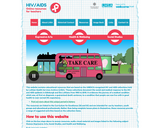
This website contains educational resources that are based on the UNESCO-recognised HIV and AIDS collections held by Lothian Health Services Archive (LHSA).
Rather than being complete lesson plans in themselves, these resources provide a range of suggested activities based on the collection items.
The resources are linked to the Curriculum for Excellence (S2 and S3) and are intended for use by teachers, youth groups and educational professionals.
The site contains resources, audio-visual material and images linked to the following subject themes: Expressive Arts, Social Studies, and Health and Wellbeing.
Esta actividad está pensada para niveles 1 y/o 2. A partir del …
Esta actividad está pensada para niveles 1 y/o 2. A partir del audio se desarrolla la función auditiva. Se trata de identificar las palabras que faltan en los huecos. Para acceder el audio, haz click aquí: (Ecuatoriano 2: Academic Schedule)
This tool is designed to help you locate openly licensed materials to …
This tool is designed to help you locate openly licensed materials to add to your OER. We'll also review how to incorporate content that is not openly licensed (copyrighted) through the principles of fair use.
This introductory unit covers definitions of terms used in the component, with …
This introductory unit covers definitions of terms used in the component, with an emphasis on paradigm shifts in healthcare, including the transition from physician-centric to patient-centric care, the transition from individual care to interdisciplinary team-based care, and the central role of technology in healthcare delivery. This unit also emphasizes the core values in US healthcare.
This course explores the ways in which humans experience the realm of …
This course explores the ways in which humans experience the realm of sound and how perceptions and technologies of sound emerge from cultural, economic, and historical worlds. It examines how environmental, linguistic, and musical sounds are construed cross-culturally. It describes the rise of telephony, architectural acoustics, sound recording, and the globalized travel of these technologies. Students address questions of ownership, property, authorship, and copyright in the age of digital file sharing. There is a particular focus on how the sound/noise boundary is imagined, created and modeled across diverse sociocultural and scientific contexts. Auditory examples will be provided. Instruction and practice in written and oral communication provided. At MIT, this course is limited to 20 students.
This course is an investigation into the history and aesthetics of music …
This course is an investigation into the history and aesthetics of music and technology as deployed in experimental and popular musics from the 19th century to the present. Through original research, creative hands-on projects, readings, and lectures, the following topics will be explored. The history of radio, audio recording, and the recording studio, as well as the development of musique concrète and early electronic instruments. The creation and extension of musical interfaces by composers such as Harry Partch, John Cage, Conlon Nancarrow, and others. The exploration of electromagnetic technologies in pickups, and the development of dub, hip-hop, and turntablism. The history and application of the analog synthesizer, from the Moog modular to the Roland TR-808. The history of computer music, including music synthesis and representation languages. Contemporary practices in circuit bending, live electronics, and electro-acoustic music, as well as issues in copyright and intellectual property, will also be examined. No prerequisites.
No restrictions on your remixing, redistributing, or making derivative works. Give credit to the author, as required.
Your remixing, redistributing, or making derivatives works comes with some restrictions, including how it is shared.
Your redistributing comes with some restrictions. Do not remix or make derivative works.
Most restrictive license type. Prohibits most uses, sharing, and any changes.
Copyrighted materials, available under Fair Use and the TEACH Act for US-based educators, or other custom arrangements. Go to the resource provider to see their individual restrictions.