This group activity engages students in the calculation of absorption spectra. It …
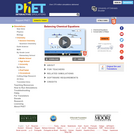
This group activity engages students in the calculation of absorption spectra. It is appropriate for any course covering the baseline mathematical concepts of atomic spectra, including chemistry, physics, astronomy, and related courses.
This site is a searchable encyclopedia of thousands of photos, descriptions, sound …
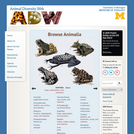
This site is a searchable encyclopedia of thousands of photos, descriptions, sound recordings, and other information about individual animal species. Find out about amphibians, arthropods, birds, fishes, insects, mammals, mollusks, reptiles, and sharks. Explore special features on mammals, skulls, and frog calls. Students are invited to contribute.
This is the first of a two-semester subject sequence that provides the …
This is the first of a two-semester subject sequence that provides the foundations for contemporary research in selected areas of atomic and optical physics. Topics covered include the interaction of radiation with atoms: resonance; absorption, stimulated and spontaneous emission; methods of resonance, dressed atom formalism, masers and lasers, cavity quantum electrodynamics; structure of simple atoms, behavior in very strong fields; fundamental tests: time reversal, parity violations, Bell's inequalities; and experimental methods.
This video segment adapted from A Science Odyssey takes a look at …
This video segment adapted from A Science Odyssey takes a look at the scale of the atom and the tremendous amount of space between the electrons and the nucleus. If all this empty space exists in matter, how can any substance be solid?
Biology is designed for multi-semester biology courses for science majors. It is …
Biology is designed for multi-semester biology courses for science majors. It is grounded on an evolutionary basis and includes exciting features that highlight careers in the biological sciences and everyday applications of the concepts at hand. To meet the needs of today’s instructors and students, some content has been strategically condensed while maintaining the overall scope and coverage of traditional texts for this course. Instructors can customize the book, adapting it to the approach that works best in their classroom. Biology also includes an innovative art program that incorporates critical thinking and clicker questions to help students understand—and apply—key concepts.
Biology is designed for multi-semester biology courses for science majors. This version …
Biology is designed for multi-semester biology courses for science majors. This version has been adapted by faculty at Austin Community College. It is grounded on an evolutionary basis and includes exciting features that highlight careers in the biological sciences and everyday applications of the concepts at hand. To meet the needs of today’s instructors and students, some content has been strategically condensed while maintaining the overall scope and coverage of traditional texts for this course. Instructors can customize the book, adapting it to the approach that works best in their classroom. Biology also includes an innovative art program that incorporates critical thinking and clicker questions to help students understand—and apply—key concepts.
Life is all around us, both as multicellular organisms such as the …
Life is all around us, both as multicellular organisms such as the iguana and bamboo above, as well as the unicellular microorganisms such as bacteria. Life is present on every continent, in the air and in the waters of the world. There is life even in the Mariana Trench, seven miles below the surface of the ocean. As of 2010 biologists have described and classified 1.7 million plants and animals, and estimate that there are till over five million species still undiscovered.This chapter will introduce the ways we study the science of Biology in the twenty-first century, the characteristics of living organisms and their classification.
Living things are highly organized and structured, following a hierarchy that can …
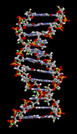
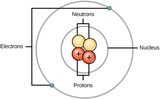
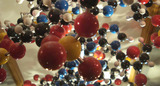
Living things are highly organized and structured, following a hierarchy that can be examined on a scale from small to large. The atom is the smallest and most fundamental unit of matter. It consists of a nucleus surrounded by electrons. Atoms form molecules. A molecule is a chemical structure consisting of at least two atoms held together by one or more chemical bonds. Many molecules that are biologically important are macromolecules, large molecules that are typically formed by polymerization (a polymer is a large molecule that is made by combining smaller units called monomers, which are simpler than macromolecules). An example of a macromolecule is deoxyribonucleic acid (DNA) (Figure 1.15), which contains the instructions for the structure and functioning of all living organisms.
By the end of this section, you will be able to:Define matter …
By the end of this section, you will be able to:Define matter and elementsDescribe the interrelationship between protons, neutrons, and electronsCompare the ways in which electrons can be donated or shared between atomsExplain the ways in which naturally occurring elements combine to create molecules, cells, tissues, organ systems, and organisms
By the end of this section, you will be able to:Define matter …
By the end of this section, you will be able to:Define matter and elementsDescribe the interrelationship between protons, neutrons, and electronsCompare the ways in which electrons can be donated or shared between atomsExplain the ways in which naturally occurring elements combine to create molecules, cells, tissues, organ systems, and organisms
By the end of this section, you will be able to:Identify and …
By the end of this section, you will be able to:Identify and describe the properties of lifeDescribe the levels of organization among living thingsRecognize and interpret a phylogenetic treeList examples of different sub disciplines in biology
By the end of this section, you will be able to:Identify and …
By the end of this section, you will be able to:Identify and describe the properties of lifeDescribe the levels of organization among living thingsRecognize and interpret a phylogenetic treeList examples of different sub disciplines in biology
In this hands-on activity, students explore the electrical force that takes place …
In this hands-on activity, students explore the electrical force that takes place between two objects. Each student builds an electroscope and uses the device to draw conclusions about objects' charge intensity. Students also determine what factors influence electric force.
Students learn about atoms and their structure (protons, electrons, neutrons) — the …
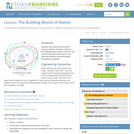
Students learn about atoms and their structure (protons, electrons, neutrons) — the building blocks of matter. They see how scientific discoveries about atoms and molecules influence new technologies developed by engineers.
No restrictions on your remixing, redistributing, or making derivative works. Give credit to the author, as required.
Your remixing, redistributing, or making derivatives works comes with some restrictions, including how it is shared.
Your redistributing comes with some restrictions. Do not remix or make derivative works.
Most restrictive license type. Prohibits most uses, sharing, and any changes.
Copyrighted materials, available under Fair Use and the TEACH Act for US-based educators, or other custom arrangements. Go to the resource provider to see their individual restrictions.