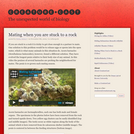
If you are stuck to a rock it is tricky to get close enough to a partner to mate. One solution to this problem would be to release eggs or sperm into the open water, which is what many animals in this situation do. Acorn barnacles (Semibalanus balanoides), however, found a different solution. They have evolved the longest penis relative to their body size of any animal. In this video the penises of several barnacles are probing the neighborhood for mates. The penis is re-grown each mating season.
This resource is a video abstract of a research paper created by …
This resource is a video abstract of a research paper created by Research Square on behalf of its authors. It provides a synopsis that's easy to understand, and can be used to introduce the topics it covers to students, researchers, and the general public. The video's transcript is also provided in full, with a portion provided below for preview:
"Natural microbial systems are all around us, from nutrient-rich soil to churning seawater to our own bodies. These complex systems include bacteria, archaea, viruses, and microbial eukaryotes. One of the best methods available for analyzing these systems is shotgun sequencing, which generates vast quantities of DNA sequence data. However, current data annotation methods don't include a dedicated way to find eukaryotic sequences. Now, researchers have introduced a bioinformatics method called EukDetect. EukDetect uses a database of over 500,000 universal marker genes from 241 conserved gene families across thousands of eukaryotes. Broad taxonomic coverage and accurate identification of low-abundance and high-similarity sequences were possible with EukDetect, and bacterial contamination was no obstacle to identifying eukaryotic species. EukDetect highlights information that could be missed or obscured in standard shotgun sequence analysis..."
The rest of the transcript, along with a link to the research itself, is available on the resource itself.
Students work in teams to design a tabletop supply organizer inspired by …
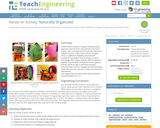
Students work in teams to design a tabletop supply organizer inspired by the natural home of an insect species. Their prototype stores the group’s classroom supplies (scissors, crayon boxes, pencils, and glue sticks). In addition to following measurement constraints that apply to their prototype, students must design their supply organizer with the idea that supplies must be easily retrievable and the organizer must be sturdy enough to withstand everyday classroom wear and tear. Students test their prototype in the classroom for a period of 5 days and evaluate its effectiveness.
No restrictions on your remixing, redistributing, or making derivative works. Give credit to the author, as required.
Your remixing, redistributing, or making derivatives works comes with some restrictions, including how it is shared.
Your redistributing comes with some restrictions. Do not remix or make derivative works.
Most restrictive license type. Prohibits most uses, sharing, and any changes.
Copyrighted materials, available under Fair Use and the TEACH Act for US-based educators, or other custom arrangements. Go to the resource provider to see their individual restrictions.