In this unit students gain an understanding of the elements of gothic …
In this unit students gain an understanding of the elements of gothic literature as evidenced in four short stories: The Raven (Poe), The Masque of the Red Death (Poe), The Yellow Wallpaper (Gilman), and the Lottery (Jackson). Vocabulary is included for each story. Lessons focus on using text evidence to support analysis for tone, diction, inferencing, character analysis, author's purpose, and irony. Lessons include both independent and small group work, shorter writing tasks, small and large group discussion, and other opportunities for instructors to differentiate the lesson to suit classroom needs.
This site presents 2,900 life histories from 300 writers from 24 states. …
This site presents 2,900 life histories from 300 writers from 24 states. These histories describe individuals' families, incomes, occupations, political views, religions, diets, and observations.
Abstract American Literature I combines a textbook covering literary analysis and literary …
Abstract American Literature I combines a textbook covering literary analysis and literary critical theory, basic research methods in the humanities, and a chronological reader of diverse selections in American Literature. The book begins with a focus on creation myths and Native American literature. Following this is a significant section on Romanticism. Also included are sections on literary nonfiction, writing about literature, early American and Puritan literature, and Herman Melville.
Description Prior to my adaptation, this course was created from materials originally developed by the State Board of Community Technical Colleges (SBCTC) of Washington State. American Literature 1 is a modified version of the Lumen American Literature I text. The original version of this book was released under a CC-BY license and is copyright by Lumen Learning. The text is designed to accompany a separate novel such as Moby-Dick and contains supplemental resources for the teaching of American novels of this era. The changes to this book listed are released under a CC-BY-SA license and are copyright by Joshua Dickinson of Jefferson Community College in Watertown, NY.
In this class we will practice skills in reading, analyzing, and writing …
In this class we will practice skills in reading, analyzing, and writing about fiction, poetry and drama from a select sampling of 20th Century American Literature. Through class discussion, close reading, and extensive writing practice, this course seeks to develop critical and analytical skills, preparing students for more advanced academic work.
This module on Colonial Literature explore the essential questions: 1) How does …
This module on Colonial Literature explore the essential questions: 1) How does the literature in early Colonial America reflect the customs and beliefs of the Native Americans and Puritans? 2)What kind of literary styles did the earliest writers contribute to American Literature? and 3) How did history have an effect on the types of literature being written? There are audio and visual activities as well as readings.
This work was created as part of the University Libraries’ Open Educational …
This work was created as part of the University Libraries’ Open Educational Resources Initiative at the University of Missouri–St. Louis.
A web version of this text can be found at https://umsystem.pressbooks.pub/ala1865/.
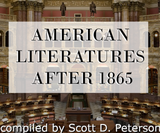
This book is an anthology of American Literatures After 1865, a new revision of the open educational resource entitled Writing the Nation: A Concise Introduction to American Literature 1865 to Present. It contains works that have been newly introduced to the public domain and provides direct links to reading materials that can be borrowed for free from Archive.org.
This work was created as part of the University Libraries’ Open Educational …
This work was created as part of the University Libraries’ Open Educational Resources Initiative at the University of Missouri–St. Louis.
A web version of this text can be found at https://umsystem.pressbooks.pub/alpt1865/.
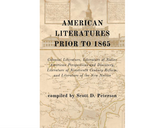
This anthology of American Literatures Prior to 1865, is organized chronologically into four units, focusing on Colonial Literature, Literature of Native American Perspectives and Discovery, Literature of Nineteenth Century Reform, and Literature of the New Nation. It includes introductions to the many authors included to enhance the reader's contextual understanding of the chosen texts. This anthology is essential reading for any student or scholar of Early American literature.
This site provides 253 narratives describing travels in the colonies and U.S. …
This site provides 253 narratives describing travels in the colonies and U.S. The collection includes works by authors not widely known as well as by Matthew Arnold, James Fenimore Cooper, Dickens, Washington Irving, Sir Charles Lyell, Robert Louis Stevenson, and other major figures. The collection is searchable and can be browsed by not only by author and title, but also by subject.
The ĺÎĺ_ĺĚĄ_American Renaissance,ĺÎĺ_ĺĚĺÎĺ a period of tremendous literary activity that took place …
The ĺÎĺ_ĺĚĄ_American Renaissance,ĺÎĺ_ĺĚĺÎĺ a period of tremendous literary activity that took place in America between the 1830s and 1860s represents the cultivation of a distinctively American literature. The student will begin this course by looking at what it was in American culture and society that led to the dramatic outburst of literary creativity in this era. The student will then explore some of the periodĺÎĺ_ĺĚĺ_s most famous works, attempting to define the emerging American identity represented in this literature. Upon successful completion of this course, the student will be able to: discriminate among the key economic, technological, social, and cultural transformations underpinning the American Renaissance; define the transformations in American Protestantism exemplified by the second Great Awakening and transcendentalism; list the key tenets of transcendentalism and relate them to romanticism more broadly and to social and cultural developments in the antebellum United States; analyze EmersonĺÎĺ_ĺĚĺ_s place in defining transcendentalism and his key differences from other transcendentalists; analyze competing conceptualizations of poetry and its construction and purpose, with particular attention to Poe, Emerson, and Whitman; define the formal innovations of Dickinson and their relationship to her central themes; describe the emergence of the short story as a form, with reference to specific stories by Hawthorne and Poe; distinguish among forms of the novel, with reference to specific works by Hawthorne, Thompson, and Fern; analyze the ways that writers such as Melville, Brownson, Davis, and Thoreau saw industrialization and capitalism as a threat to U. S. society; develop the relationship between ThoreauĺÎĺ_ĺĚĺ_s interest in nature and his political commitments and compare and contrast his thinking with Emerson and other transcendentalists; analyze the different ways that sentimentalism constrained and empowered women writers to critique gender conventions, with reference to specific works by writers such as Fern, Alcott, and Stowe; define the ways that the slavery question influenced major texts and major controversies over literature during this period. This free course may be completed online at any time. (English Literature 405)
Dr Sally Bayley presents an illuminating reading of Emily Dickinson's 'I started …
Dr Sally Bayley presents an illuminating reading of Emily Dickinson's 'I started early, took my dog'. In her reading, she seeks out allusions to Shakespearean plays including Hamlet and The Merchant of Venice. She then answers questions about the poem. This audio recording is part the Interviews on Great Writers series presented by Oxford University Podcasts.
This course covers selected works in American literature from its beginnings to …
This course covers selected works in American literature from its beginnings to 1865. Emphasis is placed on historical background, cultural context, and literary analysis of selected prose, poetry, and drama. Upon completion, students should be able to analyze and interpret literary works in their historical and cultural contexts.
Course Description Introduces the literature of the land which is now the …
Course Description Introduces the literature of the land which is now the United States from before European contact through the mid-nineteenth century. Revolves around written manifestations of the various interests, preoccupations, and experiences of the peoples creating and recreating American culture. Considers various literary forms, canonized (such as novel, narrative poem), popular (such as the serialized tale, verse) and unpublished (the jeremiad, Native American oratory, the slave narrative, diary). Prerequisite/concurrent: WR 121. Audit available.
Intended Outcomes Upon successful completion of this course, students will be able to:
Identify and discuss strengths, limitations and cultural assumptions of the various literary forms practiced in America from its earliest days through the mid 1800s. Identify and discuss the roles of gender, class, race, ethnicity, and geography played in creating early American literature. Identify and address the issues, conflicts, preoccupations, and themes of early American literature. Identify and discuss aesthetic aspects of American literature, including plot, setting, character, dialect, oral storytelling, diction, metaphor and allegory. Use literary texts to examine the historical, rhetorical, and cultural contexts in which they were composed. Use literary theory to analyze early American texts.
This course is a survey of Early American Literature (beginnings to 1890). …
This course is a survey of Early American Literature (beginnings to 1890). The course includes suggested assignments, a course outline, and a MS Word text of Public Domain readings. This course is designed for a 16 week semester.
In this unit, students will explore great works of American literature and …
In this unit, students will explore great works of American literature and consider how writers reflect the time period in which they write. They will write two literary analysis papers and also work in groups to research and develop anthologies of excellent American stories.
ACCOMPLISHMENTS
Students read and analyze stories from several 19th-, 20th-, and 21st-century American authors. After researching a time period, they select stories from that period to create an anthology. The readings enhance their understanding of the short story, increase their exposure to well-known American authors, and allow them to examine the influence of social, cultural, and political context. Students examine elements of short stories and have an opportunity for close reading of several American short stories. During these close readings, they examine the ways that short story writers attempt to explore the greater truths of the American experience through their literature.
GUIDING QUESTIONS
These questions are a guide to stimulate thinking, discussion, and writing on the themes and ideas in the unit. For complete and thoughtful answers and for meaningful discussions, students must use evidence based on careful reading of the texts.
If you were to write a short story about this decade, what issues might you focus on? What defines a short story? Just length? To what extent do these stories reflect the era or decade in which they were written? To what extent are the themes they address universal?
CLASSROOM FILMS
History.com has short videos on the Vietnam War (“Vietnam” and “A Soldier's Story”).
"I never knew a whole family to live together, till all were …
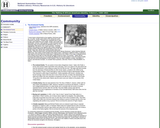
"I never knew a whole family to live together, till all were grown up, in my life," recalls Lewis Clarke of his twenty-five years enslaved in Kentucky.1 Families were separated due to sale, escape, early death from poor health, suicide, and murder by a slaveholder, overseer, slave patroller, or other dominant person. Separation also occurred within the plantation itself, e.g., by segregating "field slaves" from "house servants," removing children from parents to live together with a slave caretaker, or bringing children fathered by the slaveholder to live in the "Big House." How, then, did the slave family provide solace and identity? "What the family does, and what the family did for African Americans," writes historian Deborah White Gray, "was create a world outside of the world of work. It allowed for significant others. It allowed a male slave to be more than just a brute beast. It allowed him to be a father, to be a son. It allowed women to be mothers and to take on roles that were outside of that of a slave, of a servant."2 When did the enslaved child realize how his or her family life differed from the slave-holder's? How did enslaved adults cope with the forced disintegration of their families? Here we read a collection of texts—two letters, a memoir, and interview excerpts—to consider these questions. (See also Theme II: ENSLAVEMENT, #2, Sale.)
Some argue that genre fiction is only a marketing category, but other …
Some argue that genre fiction is only a marketing category, but other critics say that different genres meet specific expectations of readers. This course examines these different agreements of what the reader wants and what the writer provides under the aegis of different genres. We will look at how genres are divided into subgenres, and how they are combined into cross-genre work, always keeping in mind the Reader-Writer Contact that is at the heart of genre writing. We shall also think about the ways in which crossing genres has led to the establishment of new genres (steampunk, preternatural romance) and strongly established subgenres (historical mystery, urban fantasy).
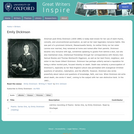
Great Writers Inspire presents an illuminating collection of Emily Dickinson resources curated …
Great Writers Inspire presents an illuminating collection of Emily Dickinson resources curated by specialists at the University of Oxford. It includes audio and video lectures and short talks, downloadable electronic texts and eBooks, and background contextual resources.
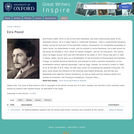
Great Writers Inspire presents an illuminating collection of Ezra Pound resources curated …
Great Writers Inspire presents an illuminating collection of Ezra Pound resources curated by specialists at the University of Oxford. It includes audio and video lectures and short talks, downloadable electronic texts and eBooks, and background contextual resources.
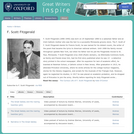
Great Writers Inspire presents an illuminating collection of F. Scott Fitzgerald resources …
Great Writers Inspire presents an illuminating collection of F. Scott Fitzgerald resources curated by specialists at the University of Oxford. It includesdownloadable electronic texts and eBooks, and background contextual resources.
Great Writers Inspire presents an illuminating collection of Walt Whitman resources curated …
Great Writers Inspire presents an illuminating collection of Walt Whitman resources curated by specialists at the University of Oxford. It includes downloadable electronic texts and eBooks, and background contextual resources.
No restrictions on your remixing, redistributing, or making derivative works. Give credit to the author, as required.
Your remixing, redistributing, or making derivatives works comes with some restrictions, including how it is shared.
Your redistributing comes with some restrictions. Do not remix or make derivative works.
Most restrictive license type. Prohibits most uses, sharing, and any changes.
Copyrighted materials, available under Fair Use and the TEACH Act for US-based educators, or other custom arrangements. Go to the resource provider to see their individual restrictions.