This course provides a basic history of American social, economic, and political …
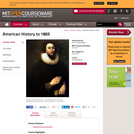
This course provides a basic history of American social, economic, and political development from the colonial period through the Civil War. It examines the colonial heritages of Spanish and British America; the American Revolution and its impact; the establishment and growth of the new nation; and the Civil War, its background, character, and impact. Readings include writings of the period by J. Winthrop, T. Paine, T. Jefferson, J. Madison, W. H. Garrison, G. Fitzhugh, H. B. Stowe, and A. Lincoln.
This course provides a basic history of American social, economic, and political …
This course provides a basic history of American social, economic, and political development from the colonial period through the Civil War. It examines the colonial heritages of Spanish and British America; the American Revolution and its impact; the establishment and growth of the new nation; and the Civil War, its background, character, and impact. Readings include writings of the period by J. Winthrop, T. Paine, T. Jefferson, J. Madison, W. H. Garrison, G. Fitzhugh, H. B. Stowe, and A. Lincoln.
This site provides 253 narratives describing travels in the colonies and U.S. …
This site provides 253 narratives describing travels in the colonies and U.S. The collection includes works by authors not widely known as well as by Matthew Arnold, James Fenimore Cooper, Dickens, Washington Irving, Sir Charles Lyell, Robert Louis Stevenson, and other major figures. The collection is searchable and can be browsed by not only by author and title, but also by subject.
No restrictions on your remixing, redistributing, or making derivative works. Give credit to the author, as required.
Your remixing, redistributing, or making derivatives works comes with some restrictions, including how it is shared.
Your redistributing comes with some restrictions. Do not remix or make derivative works.
Most restrictive license type. Prohibits most uses, sharing, and any changes.
Copyrighted materials, available under Fair Use and the TEACH Act for US-based educators, or other custom arrangements. Go to the resource provider to see their individual restrictions.