Aqua, Latin for water, is a NASA Earth Science satellite mission named for the large amount of information that the mission is collecting about the Earth's water cycle, including evaporation from the oceans, water vapor in the atmosphere, clouds, precipitation, soil moisture, sea ice, land ice, and snow cover on the land and ice. Additional variables also measured by Aqua include radiative energy fluxes, aerosols, vegetation cover on the land, phytoplankton and dissolved organic matter in the oceans, and air, land, and water temperatures. This brochure provides a comprehensive overview of the Aqua spacecraft, instruments, science, and data products.
The Earth Climate Course: What Determines a Planets Climate? is a set of student activities and teachers guides designed to connect NASA Earth science research with the teaching and learning of core science and mathematics concepts and skills while addressing national education standards. The four modules cover: 1) Temperature Variations and Habitability, 2) Modeling Hot and Cold Planets, 3) Using Mathematical Models to Investigate Planetary Habitability, and 4) How Do Atmospheres Affect Planetary Atmospheres. Scientific inquiry and the research tools used to do research play a major role in the lessons. Presented with a science problem, students seek answers and consensus by experimenting with physical and computer models, collecting and analyzing their own measurements, and conducting comparisons with real world data from satellites and ground-based observations.- NASA missions and related Earth and space science topics provide the real world problem context for student investigations.- It aims to help students to develop an understanding of our environment as a system of human and natural processes that result in changes that occur over various space and time scales.
The study of clouds (where they occur, their characteristics, etc) plays a key role in the understanding of climate change. This site discusses how the relative thickness and altitude of various cloud types result in their either reflecting solar radiation or transmitting and trapping it, thereby warming Earth's surface. It features text, a scientific illustration, and links to other relevant topics and datasets.
In this interactive activity adapted from NASA and the U.S. Geological Survey, learn about Earth's albedo (the ratio of reflected vs. incident solar radiation), how pollution alters albedo, and how ice-albedo feedback may accelerate global warming.
The Adventure of Echo the Bat is an interactive Web site allowing students to follow Echo as he migrates through Arizona. The adventure offers a directed and investigative approach to how land features look from space, what the colors mean in a Landsat image, and an introduction to identifying habitats in a false color Landsat image. The site is supported with a teacher's guide that includes the following units: Understanding Light, Remote Sensing, and Biodiversity.
This classroom activity explains how clouds and pollution in the atmosphere are important to climate, and the need to study whether pollution may be changing Earth's climate in undesirable ways. It introduces NASA's Multi-angle Imaging SpectroRadiometer (MISR) mission. The activity includes building a MISR-lite model to demonstrate how looking at the same thing (i.e., Earth's atmosphere) from different angles produces a 3-dimensional effect that gives much more information than just viewing it from one angle, and helps scientists establish a baseline of information about current conditions in the atmosphere. The activity was originally published in Technology Teacher, a magazine published by the International Technology Education Association (ITEA).
Students observe demonstrations, and build and evaluate simple models to understand the greenhouse effect, the role of increased greenhouse gas concentration in global warming, and the implications of global warming theory for engineers, themselves and the Earth. In an associated literacy activity, students learn how a bill becomes law and research global warming legislation.
Subject:
Mathematics and Statistics, Science and Technology
The MODIS instrument, flying aboard NASAs Terra and Aqua satellites, measures how much solar radiation is reflected by the Earths surface almost every day over the entire planet. Zooming in on Africa's Sahara Desert and the Arabian Peninsula, MODIS observed considerable variability in reflectance across the region-from the darkest volcanic terrains to the brightest sand. This matches specific soil groups and rock types to MODIS-derived albedo measurements. This correlation is important because most current weather forecast models treat this region as if the surface is uniform and therefore reflects the same amount of light all across its wide expanse. However, the terrain across the Sahara Desert and Arabian Peninsula is actually quite varied. Darker surface features (like rocks and plant canopies) absorb more light than lighter surfaces (like sand) and therefore get hotter in the afternoon. Over the course of a day, these heating differences can set up atmospheric motions that influence global clouds and rain.
The MODIS instrument, flying aboard NASAs Terra and Aqua satellites, measures albedo. Albedo measures the proportion of incoming solar radiation reaching a surface that is reflected back to the atmosphere and to space. For an unchanging surface, albedo can vary somewhat, depending on the sky and atmospheric conditions. This image maps the white-sky albedo, which is the albedo under conditions of a uniform, dense cloud cover, in which downwelling light energy comes uniformly from all directions. The color bar indicates the albedo value ranging from 0.0 to 0.4 over the Earths land surfaces. Areas colored red show the brightest, most reflective regions; yellows and greens are intermediate values; and blues and violets show relatively dark surfaces. White indicates no data is available. Typically, vegetated surfaces and water have low albedos, while soil and urban surfaces have somewhat higher values. Note that solar energy that is not reflected away from a surface is absorbed by that surface. Thus, albedo also provides information about the amount of energy absorbed by a surface. Since this energy serves to heat the soil and the air just above the surface, albedo is an important factor in weather and climate studies, and especially is important for modeling of weather and climate on scales of days to years This image was produced using data composited over a 16-day period, from April 7-22, 2002.
The MODIS instrument, flying aboard NASAs Terra and Aqua satellites, measures how much solar radiation is reflected by the Earths surface almost every day over the entire planet. The colors in this image emphasize the albedos ranging from 0.0 to 0.4 over the Earths land surfaces. Areas colored red show the brightest, most reflective regions; yellows and greens are intermediate values; and blues and violets show relatively dark surfaces. White indicates no data were available, and no albedo data are provided over the oceans. This image was produced using data composited over a 6-day period, from April 7-22, 2002.
The MODIS instrument, flying aboard NASAs Terra and Aqua satellites, measures how much solar radiation is reflected by the Earths surface almost every day over the entire planet. Zooming in on Africa's Sahara Desert and the Arabian Peninsula, MODIS observed considerable variability in reflectance across the region-from the darkest volcanic terrains to the brightest sand. This matches specific soil groups and rock types to MODIS-derived albedo measurements. This correlation is important because most current weather forecast models treat this region as if the surface is uniform and therefore reflects the same amount of light all across its wide expanse. However, the terrain across the Sahara Desert and Arabian Peninsula is actually quite varied. Darker surface features (like rocks and plant canopies) absorb more light than lighter surfaces (like sand) and therefore get hotter in the afternoon. Over the course of a day, these heating differences can set up atmospheric motions that influence global clouds and rain.
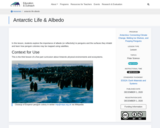
Each two-week module in the Study of Place curriculum is framed by an historical event that makes a connection between the physical environment and human activity. The activities focus primarily on physical and earth science content, geography, and inquiry skills. Assessments and scoring rubrics, including a pre-assessment that can be used for both modules, are embedded in each module, providing opportunities for tracking student learning. The Antarctic Exploration module is framed by Sir Ernest Shackelton's expedition to Antarctica. It explores the relationship between the expanse of sea ice and seasonal change. Students: * examine satellite images of Antarctica, comparing and contrasting the information provided by the various types of technology; * explore seasonal changes in the expanse of sea ice and learn about the Sun's seasonal effect on the concentration of energy on Earth's surface; * explore the differences between fresh and salt water and salinity levels in the Antarctic Ocean; * study the effect of albedo and insulation on sea ice and heat transfer and apply these concepts to a discussion of global climate change.
The MODIS instrument, flying aboard NASAs Terra and Aqua satellites, measures how much solar radiation is reflected by the Earths surface almost every day over the entire planet. Zooming in on Africa's Sahara Desert and the Arabian Peninsula, MODIS observed considerable variability in reflectance across the region-from the darkest volcanic terrains to the brightest sand. This matches specific soil groups and rock types to MODIS-derived albedo measurements. This correlation is important because most current weather forecast models treat this region as if the surface is uniform and therefore reflects the same amount of light all across its wide expanse. However, the terrain across the Sahara Desert and Arabian Peninsula is actually quite varied. Darker surface features (like rocks and plant canopies) absorb more light than lighter surfaces (like sand) and therefore get hotter in the afternoon. Over the course of a day, these heating differences can set up atmospheric motions that influence global clouds and rain.
No restrictions on your remixing, redistributing, or making derivative works.
Give credit to the author, as required.
Your remixing, redistributing, or making derivatives works comes with some
restrictions, including how it is shared.
Your redistributing comes with some restrictions. Do not remix or make
derivative works.
Copyrighted materials, available under Fair Use and the TEACH Act for US-based
educators, or other custom arrangements. Go to the resource provider to see
their individual restrictions.