The AirData Web site gives you access to air pollution data for the entire United States. Want to know the highest ozone level measured in your state last year? Ever wonder where air pollution monitoring sites are located? Are there sources of air pollution in your town? You can find out here! AirData produces reports and maps of air pollution data based on criteria that you specify.
The Aura Ozone Monitoring Lithograph describes where ozone is found, how ozone is formed, and the effects of ozone on biological processes. How and why NASA studies ozone is covered along with how individuals can monitor ground level (tropospheric) ozone by starting their own ozone-monitoring garden.
This lesson is designed to help students gain knowledge in using the MY NASA DATA Live Access Server (LAS) to specify and download a microset of data, then to use the data to investigate the carbon monoxide level at a fixed latitude.
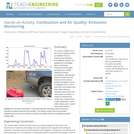
Engineers design methods of removing particulate matter from industrial sources to minimize negative effects of air pollution. In this activity, students will undertake a similar engineering challenge as they design and build a filter to remove pepper from an air stream without blocking more than 50% of the air.
Subject:
Mathematics and Statistics, Science and Technology
This lesson is designed to help students gain knowledge in graphing a microset of data, then using the graphs to investigate trends in cloud coverage over a given locale. Students are provided content-related activities to enhance background knowledge.
Students will use the Live Access Server (LAS) to form maps and a numerical text file of snow cover for each continent on a particular date. They will analyze the data for each map and corresponding text file to determine an estimate of snow cover for each continent.
This lesson is designed to help students gain knowledge in using the MY NASA DATA Live Access Server (LAS) to specify and download a microset of data, then to use the data to compare the ozone levels of selected regions around the world.
In this lesson, students download cloud coverage and surface data from the NASA CERES S-COOL website student observation database, then use the Excel spreadsheet program to develop plots of the data. Students will use S'COOL data to identify factors that affect cloud formation.
This course provides a review of physical, chemical, ecological, and economic principles used to examine interactions between humans and the natural environment. Mass balance concepts are applied to ecology, chemical kinetics, hydrology, and transportation; energy balance concepts are applied to building design, ecology, and climate change; and economic and life cycle concepts are applied to resource evaluation and engineering design. Numerical models are used to integrate concepts and to assess environmental impacts of human activities. Problem sets involve development of MATLAB® models for particular engineering applications. Some experience with computer programming is helpful but not essential.
In this unit, students explore the various roles of environmental engineers, including: environmental cleanup, water quality, groundwater resources, surface water and groundwater flow, water contamination, waste disposal and air pollution. Specifically, students learn about the factors that affect water quality and the conditions that allow for different animals and plants to survive in their environment. Next, students learn about groundwater and how environmental engineers study groundwater to predict the distribution of surface pollution. Students also learn how water flows through the ground, what an aquifer is and what soil properties are used to predict groundwater flow. Additionally, students discover that the water they drink everyday comes from many different sources, including surface water and groundwater. They investigate possible scenarios of drinking water contamination and how contaminants can negatively affect the organisms that come in contact with them. Students learn about the three most common methods of waste disposal and how environmental engineers continue to develop technologies to dispose of trash. Lastly, students learn what causes air pollution and how to investigate the different pollutants that exist, such as toxic gases and particulate matter. Also, they investigate the technologies developed by engineers to reduce air pollution.
Subject:
Mathematics and Statistics, Science and Technology
In this lesson, students download cloud and surface data from the NASA CERES S-COOL website student observation database, then develop and compare graphs to explore the relationships between surface temperature, pressure, and humidity.
In this online activity, students use lichens and tardigrades (water bears) to investigate their use as bioindicators of key air pollutants. When lichens are exposed to some kinds of air pollutants, especially to sulfur dioxide, the lichens are injured and die. The lichen coverage in a specified area should be a good indicator of the level of air quality. The diversity of the tardigrade species on the lichens will be used to develop another level for bioindication of air quality. Sections of this activity include: introduction, sulfur dioxide and lichens, sampling procedure for lichen coverage, tardigrade sampling, sampling procedure for tardigrades, calculating diversity using the Simpson Diversity Index, interpretation of results, and references.
In this activity, students will capture and examine the particles to gain an appreciation of how much dust, pollen and other particulate matter is present in the air around them. Students will place "pollution detectors" at various locations to determine which places have a lot of particles in the air and which places do not have as many. Quantifying and describing these particles is a first step towards engineering methods of removing contaminants from the air.
Subject:
Mathematics and Statistics, Science and Technology
Students identify types and sources of indoor air pollutants in their school and home environments. They evaluate actions that can be taken to reduce and prevent poor indoor air quality. In an associated literacy activity, students develop a persuasive peer-to-peer case against smoking with the goal to understand how language usage can influence perception, attitudes and behavior.
Subject:
Mathematics and Statistics, Science and Technology
This classroom activity explains how clouds and pollution in the atmosphere are important to climate, and the need to study whether pollution may be changing Earth's climate in undesirable ways. It introduces NASA's Multi-angle Imaging SpectroRadiometer (MISR) mission. The activity includes building a MISR-lite model to demonstrate how looking at the same thing (i.e., Earth's atmosphere) from different angles produces a 3-dimensional effect that gives much more information than just viewing it from one angle, and helps scientists establish a baseline of information about current conditions in the atmosphere. The activity was originally published in Technology Teacher, a magazine published by the International Technology Education Association (ITEA).
This lesson is designed to help students gain knowledge in using the MY NASA DATA Live Access Server (LAS) to obtain a microset of data, in using Excel to graph the data. Students will be using data microsets of mean near-surface air temperature and tropospheric ozone residual averages to infer patterns. Analyze changes in tropospheric ozone and then hypothesize about the consequences of these changes.
Ozone (O3) in the lower stratosphere and upper troposphere as measured by the Microwave Limb Sounder (MLS) instrument on NASAs Aura satellite. MLS can simultaneously measure several trace gases and ozone-destroying chemicals in the upper troposphere and photosphere. In this series of animations we present chlorine monoxide (ClO), hydrogen chloride (HCl), nitric acid (HNO3), ozone (O3), water vapor (H2O) and temperature measurements. These are "first light" data taken when the MLS was operated for the first time.
No restrictions on your remixing, redistributing, or making derivative works.
Give credit to the author, as required.
Your remixing, redistributing, or making derivatives works comes with some
restrictions, including how it is shared.
Your redistributing comes with some restrictions. Do not remix or make
derivative works.
Copyrighted materials, available under Fair Use and the TEACH Act for US-based
educators, or other custom arrangements. Go to the resource provider to see
their individual restrictions.