Students create their own anemometers instruments for measuring wind speed. They see …
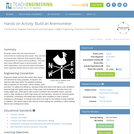
Students create their own anemometers instruments for measuring wind speed. They see how an anemometer measures wind speed by taking measurements at various school locations. They also learn about different types of anemometers, real-world applications, and how wind speed information helps engineers decide where to place wind turbines.
Students use the engineering design process to assemble an electric racer vehicle. …
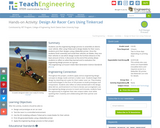
Students use the engineering design process to assemble an electric racer vehicle. After using Tinkercad to design blades for their racers, students print their designs using a MakerBot printer. Once the students finish assembly and install their vehicle’s air blades, they race their vehicles to see which design travels the furthest distance in the least amount of time. A discussion at the end of the activity allows students to reflect on what they learned and to evaluation the engineering design process as a group.
Students create a concept design of their very own net-zero energy classroom …
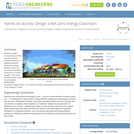
Students create a concept design of their very own net-zero energy classroom by pasting renewable energy and energy-efficiency items into and around a pretend classroom on a sheet of paper. They learn how these items (such as solar panels, efficient lights, computers, energy meters, etc.) interact to create a learning environment that produces as much energy as it uses.
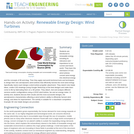
Students gain an understanding of the factors that affect wind turbine operation. …
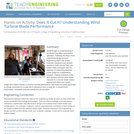
Students gain an understanding of the factors that affect wind turbine operation. Following the steps of the engineering design process, engineering teams use simple materials (cardboard and wooden dowels) to build and test their own turbine blade prototypes with the objective of maximizing electrical power output for a hypothetical situation—helping scientists power their electrical devices while doing research on a remote island. Teams explore how blade size, shape, weight and rotation interact to achieve maximal performance, and relate the power generated to energy consumed on a scale that is relevant to them in daily life. A PowerPoint® presentation, worksheet and post-activity test are provided.
Several activities are included to teach and research the differences between renewable …
Several activities are included to teach and research the differences between renewable and non-renewable resources and various energy resources. The students work with a quantitative, but simple model of energy resources to show how rapidly a finite, non-renewable energy sources can be depleted, whereas renewable resources continue to be available. The students then complete a homework assignment or a longer, in-depth research project to learn about how various technologies that capture energy resources for human uses and their pros and cons. Fact sheets are included to help students get started on their investigation of their assigned energy source.
Fact sheets are provided for several different energy resources as a starting …
Fact sheets are provided for several different energy resources as a starting point for students to conduct literature research on the way these systems work and their various pros and cons. Students complete a worksheet for homework or take in-class time for research and presentation of their findings to the class. This approach requires students to learn for themselves and teach each other, rather than having the teacher lecture about the subject matter.
Posters are provided for several different energy conversion systems. Students are provided …
Posters are provided for several different energy conversion systems. Students are provided with cards that give the name and a description of each of the components in an energy system. They match these with the figures on the diagram. Since the groups look at different systems, they also describe their results to the class to share their knowledge.
Students explore the use of wind power in the design, construction and …
Students explore the use of wind power in the design, construction and testing of "sail cars," which, in this case, are little wheeled carts with masts and sails that are powered by the moving air generated from a box fan. The scientific method is reviewed and reinforced with the use of controls and variables, and the engineering design process is explored. The focus of the activity is on renewable energy, as well as the design, testing and redesign of small cars made from household materials. The activity (and an extension worksheet) includes the use of kinematic equations using distance, time traveled and speed to enforce exponents and decimals.
Students learn and discuss the advantages and disadvantages of renewable and non-renewable …
Students learn and discuss the advantages and disadvantages of renewable and non-renewable energy sources. They also learn about our nation's electric power grid and what it means for a residential home to be "off the grid."
Students learn how engineers harness the energy of the wind to produce …
Students learn how engineers harness the energy of the wind to produce power by following the engineering design process as they prototype two types of wind turbines and test to see which works best. Students also learn how engineers decide where to place wind turbines, and the advantages and disadvantages to using wind power compared to other non-renewable energy sources.
Students are introduced to renewable energy, including its relevance and importance to …
Students are introduced to renewable energy, including its relevance and importance to our current and future world. They learn the mechanics of how wind turbines convert wind energy into electrical energy and the concepts of lift and drag. Then they apply real-world technical tools and techniques to design their own aerodynamic wind turbines that efficiently harvest the most wind energy. Specifically, teams each design a wind turbine propeller attachment. They sketch rotor blade ideas, create CAD drawings (using Google SketchUp) of the best designs and make them come to life by fabricating them on a 3D printer. They attach, test and analyze different versions and/or configurations using a LEGO wind turbine, fan and an energy meter. At activity end, students discuss their results and the most successful designs, the aerodynamics characteristics affecting a wind turbine's ability to efficiently harvest wind energy, and ideas for improvement. The activity is suitable for a class/team competition. Example 3D rotor blade designs are provided.
Students use real-world data to evaluate various renewable energy sources and the …
Students use real-world data to evaluate various renewable energy sources and the feasibility of implementing these sources. Working in small groups, students use data from the Renewable Energy Living Lab to describe and understand the way the world works. The data is obtained through observation and experimentation. Using the living lab gives students and teachers the opportunity to practice analyzing data to solve problems or answer questions, in much the same way that scientists and engineers do every day.
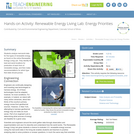
Students analyze real-world data for five types of renewable energy, as found …
Students analyze real-world data for five types of renewable energy, as found on the online Renewable Energy Living Lab. They identify the best and worst locations for production of each form of renewable energy, and then make recommendations for which type that state should pursue.
Students become familiar with the online Renewable Energy Living Lab interface and …
Students become familiar with the online Renewable Energy Living Lab interface and access its real-world solar energy data to evaluate the potential for solar generation in various U.S. locations. They become familiar with where the most common sources of renewable energy are distributed across the U.S. Through this activity, students and teachers gain familiarity with the living lab's GIS graphic interface and query functions, and are exposed to the available data in renewable energy databases, learning how to query to find specific information for specific purposes. The activity is intended as a "training" activity prior to conducting activities such as The Bright Idea activity, which includes a definitive and extensive end product (a feasibility plan) for students to create.
Students use real-world data to calculate the potential for solar and wind …
Students use real-world data to calculate the potential for solar and wind energy generation at their school location. After examining maps and analyzing data from the online Renewable Energy Living Lab, they write recommendations as to the optimal form of renewable energy the school should pursue.
Students use real-world data to evaluate whether solar power is a viable …
Students use real-world data to evaluate whether solar power is a viable energy alternative for several cities in different parts of the U.S. Working in small groups, they examine maps and make calculations using NREL/US DOE data from the online Renewable Energy Living Lab. In this exercise, students analyze cost and availability for solar power, and come to conclusions about whether solar power is a good solution for four different locations.
Students learn about wind as a source of renewable energy and explore …
Students learn about wind as a source of renewable energy and explore the advantages and disadvantages wind turbines and wind farms. They also learn about the effectiveness of wind turbines in varying weather conditions and how engineers work to create wind power that is cheaper, more reliable and safer for wildlife.
Students learn how engineers transform wind energy into electrical energy by building …
Students learn how engineers transform wind energy into electrical energy by building their own miniature wind turbines and measuring the electrical current it produces. They explore how design and position affect the electrical energy production.
Students research the feasibility of installing a wind-turbine distributed energy (DE) system …
Students research the feasibility of installing a wind-turbine distributed energy (DE) system for their school. They write a proposal (actually, the executive summary of a proposal) to the school principal based on their findings and recommendations. While this activity is geared towards fifth-grade and older students, and Internet research capabilities are required, some portions of this activity may be appropriate for younger students.
No restrictions on your remixing, redistributing, or making derivative works. Give credit to the author, as required.
Your remixing, redistributing, or making derivatives works comes with some restrictions, including how it is shared.
Your redistributing comes with some restrictions. Do not remix or make derivative works.
Most restrictive license type. Prohibits most uses, sharing, and any changes.
Copyrighted materials, available under Fair Use and the TEACH Act for US-based educators, or other custom arrangements. Go to the resource provider to see their individual restrictions.