This survey chemistry course is designed to introduce students to the world …
This survey chemistry course is designed to introduce students to the world of chemistry. In this course, we will study chemistry from the ground up, learning the basics of the atom and its behavior. We will apply this knowledge to understand the chemical properties of matter and the changes and reactions that take place in all types of matter. Upon successful completion of this course, students will be able to: Define the general term 'chemistry.' Distinguish between the physical and chemical properties of matter. Distinguish between mixtures and pure substances. Describe the arrangement of the periodic table. Perform mathematical operations involving significant figures. Convert measurements into scientific notation. Explain the law of conservation of mass, the law of definite composition, and the law of multiple proportions. Summarize the essential points of Dalton's atomic theory. Define the term 'atom.' Describe electron configurations. Draw Lewis structures for molecules. Name ionic and covalent compounds using the rules for nomenclature of inorganic compounds. Explain the relationship between enthalpy change and a reaction's tendency to occur. (Chemistry 101; See also: Biology 105. Mechanical Engineering 004)
Students are challenged to use computer-aided design (CAD) software to create “complete” …
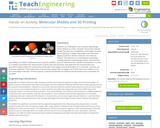
Students are challenged to use computer-aided design (CAD) software to create “complete” 3D-printed molecule models that take into consideration bond angles and lone-pair positioning. To begin, they explore two interactive digital simulations: “build a molecule” and “molecule shapes.” This aids them in comparing and contrasting existing molecular modeling approaches—ball-and-stick, space-filling, and valence shell electron pair repulsion (VSEPR)—so as to understand their benefits and limitations. In order to complete a worksheet that requires them to draw Lewis dot structures, they determine the characteristics and geometries (valence electrons, polar bonds, shape type, bond angles and overall polarity) of 12 molecules. They also use molecular model kits. These explorations and exercises prepare them to design and 3D print their own models to most accurately depict molecules. Pre/Post quizzes, a step-by-step Blender 3D software tutorial handout and a worksheet are provided.
In this interactive activity from ChemThink, learn about covalent molecules and how …
In this interactive activity from ChemThink, learn about covalent molecules and how the VSEPR theory predicts the shapes of covalently-bonded molecules.
5.112 is an introductory chemistry course for students with an unusually strong …
5.112 is an introductory chemistry course for students with an unusually strong background in chemistry. Knowledge of calculus equivalent to MIT course 18.01 is recommended. Emphasis is on basic principles of atomic and molecular electronic structure, thermodynamics, acid-base and redox equilibria, chemical kinetics, and catalysis. The course also covers applications of basic principles to problems in metal coordination chemistry, organic chemistry, and biological chemistry.
This course provides an introduction to the chemistry of biological, inorganic, and …
This course provides an introduction to the chemistry of biological, inorganic, and organic molecules. The emphasis is on basic principles of atomic and molecular electronic structure, thermodynamics, acid-base and redox equilibria, chemical kinetics, and catalysis. In an effort to illuminate connections between chemistry and biology, a list of the biology-, medicine-, and MIT research-related examples used in 5.111 is provided in Biology-Related Examples. Acknowledgements Development and implementation of the biology-related materials in this course were funded through an HHMI Professors grant to Prof. Catherine L. Drennan. Videos and captioning were made possible and supported by the MIT Class of 2009.
No restrictions on your remixing, redistributing, or making derivative works. Give credit to the author, as required.
Your remixing, redistributing, or making derivatives works comes with some restrictions, including how it is shared.
Your redistributing comes with some restrictions. Do not remix or make derivative works.
Most restrictive license type. Prohibits most uses, sharing, and any changes.
Copyrighted materials, available under Fair Use and the TEACH Act for US-based educators, or other custom arrangements. Go to the resource provider to see their individual restrictions.