In this activity, students determine their own eyesight and calculate what a …
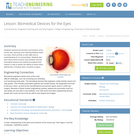
In this activity, students determine their own eyesight and calculate what a good average eyesight value for the class would be. Students learn about technologies to enhance eyesight and how engineers play an important role in the development of these technologies.
In this activity about light and perception, learners discover how a flash …
In this activity about light and perception, learners discover how a flash of light can create a lingering image called an "afterimage" on the retina of the eye. Learners will be surprised when they continue to see an image of a bright object after staring at it and looking away. Use this activity to introduce learners to principles of optics and perception as well as to explain why the full moon often appears larger when it is on the horizon than when it is overhead. This lesson guide also includes a few extensions like how to take "afterimage photographs."
In this demonstration, amaze learners by performing simple tricks using mirrors. These …
In this demonstration, amaze learners by performing simple tricks using mirrors. These tricks take advantage of how a mirror can reflect your right side so it appears to be your left side. To make the effect more dramatic, cover the mirror with a cloth, climb onto the table, straddle the mirror, and then drop the cloth as you appear to "take off." This resource contains information about how this trick was applied during the making of the movie "Star Wars."
In this optics activity, learners discover that when they rotate a special …
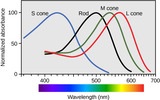
In this optics activity, learners discover that when they rotate a special black and white pattern called a Benham's Disk, it produces the illusion of colored rings. Learners experiment with the speed of rotation and direction of rotation to observe varying patterns. Use this activity to explain to learners how our eyes detect color and how different color receptors in the eye respond at different rates.
Biology is designed for multi-semester biology courses for science majors. It is …
Biology is designed for multi-semester biology courses for science majors. It is grounded on an evolutionary basis and includes exciting features that highlight careers in the biological sciences and everyday applications of the concepts at hand. To meet the needs of today’s instructors and students, some content has been strategically condensed while maintaining the overall scope and coverage of traditional texts for this course. Instructors can customize the book, adapting it to the approach that works best in their classroom. Biology also includes an innovative art program that incorporates critical thinking and clicker questions to help students understand—and apply—key concepts.
By the end of this section, you will be able to:Explain how …
By the end of this section, you will be able to:Explain how electromagnetic waves differs from sound wavesTrace the path of light through the eye to the point of the optic nerveExplain tonic activity as it is manifested in photoreceptors in the retina
Students examine the structure and function of the human eye, learning some …
Students examine the structure and function of the human eye, learning some amazing features about our eyes, which provide us with sight and an understanding of our surroundings. Students also learn about some common eye problems and the biomedical devices and medical procedures that resolve or help to lessen the effects of these vision deficiencies, including vision correction surgery.
The eye’s retina receives and reacts to incoming light and sends signals …
The eye’s retina receives and reacts to incoming light and sends signals to the brain, allowing you to see. One part of the retina, however, doesn't give you visual information—this is your eye’s “blind spot.”
This course explores the problem of intelligence—its nature, how it is produced …
This course explores the problem of intelligence—its nature, how it is produced by the brain and how it could be replicated in machines—using an approach that integrates cognitive science, which studies the mind; neuroscience, which studies the brain; and computer science and artificial intelligence, which study the computations needed to develop intelligent machines. Materials are drawn from the Brains, Minds and Machines Summer Course offered annually at the Marine Biological Laboratory in Woods Hole, MA, taught by faculty affiliated with the Center for Brains, Minds and Machines headquartered at MIT. Elements of the summer course are integrated into the MIT course, 9.523 Aspects of a Computational Theory of Intelligence. Contributors This course includes the contributions of many instructors, guest speakers, and a team of iCub researchers. See the complete list of contributors.
In this fun and interactive online exhibit, the straight lines of a …
In this fun and interactive online exhibit, the straight lines of a tile wall appear to curve. The learner moves the rows of tiles and changes the color of the grout to achieve the intriguing effect. Although the exhibit requires a computer, the concept can be adapted into a longer, hands-on exploration of optical illusions.
This course is designed to provide an understanding of how the human …
This course is designed to provide an understanding of how the human brain works in health and disease, and is intended for both the Brain and Cognitive Sciences major and the non-Brain and Cognitive Sciences major. Knowledge of how the human brain works is important for all citizens, and the lessons to be learned have enormous implications for public policy makers and educators. The course will cover the regional anatomy of the brain and provide an introduction to the cellular function of neurons, synapses and neurotransmitters. Commonly used drugs that alter brain function can be understood through a knowledge of neurotransmitters. Along similar lines, common diseases that illustrate normal brain function will be discussed. Experimental animal studies that reveal how the brain works will be reviewed. Throughout the seminar we will discuss clinical cases from Dr. Byrne's experience that illustrate brain function; in addition, articles from the scientific literature will be discussed in each class.
This course explores the cognitive and neural processes that support attention, vision, …
This course explores the cognitive and neural processes that support attention, vision, language, motor control, navigation, and memory. It introduces basic neuroanatomy, functional imaging techniques, and behavioral measures of cognition, and discusses methods by which inferences about the brain bases of cognition are made. We consider evidence from patients with neurological diseases (Alzheimer's disease, Parkinson's disease, Huntington's disease, Balint's syndrome, amnesia, and focal lesions from stroke) and from normal human participants.
Make a whole rainbow by mixing red, green, and blue light. Change …
Make a whole rainbow by mixing red, green, and blue light. Change the wavelength of a monochromatic beam or filter white light. View the light as a solid beam, or see the individual photons.
This course provides an exciting, eye-opening, and thoroughly useful inquiry into what …
This course provides an exciting, eye-opening, and thoroughly useful inquiry into what it takes to live an extraordinary life, on your own terms. The instructors address what it takes to succeed, to be proud of your life, and to be happy in it. Participants tackle career satisfaction, money, body, vices, and relationship to themselves. They learn how to confront issues in their lives, how to live life, and how to learn from it. A short version of this course meets during the Independent Activities Period (IAP), which is a special 4-week term at MIT that runs from the first week of January until the end of the month. Then this semester-long extension of the IAP course is taught to interested members of the MIT community. This not-for-credit course is sponsored by the Department of Science, Technology, and Society. A similar, semester-long version of this course is taught in the Sloan Fellows Program. Acknowledgment The instructors would like to thank Prof. David Mindell for his sponsorship of this course, his hopes for its continued expansion, and his commitment to the well-being of MIT students.
This course provides an exciting, eye-opening, and thoroughly useful inquiry into what …
This course provides an exciting, eye-opening, and thoroughly useful inquiry into what it takes to live an extraordinary life, on your own terms. The instructors address what it takes to succeed, to be proud of your life, and to be happy in it. Participants tackle career satisfaction, money, body, vices, and relationship to themselves and others. They learn how to address issues in their lives, how to live life, and how to learn from it. This course is offered during the Independent Activities Period (IAP), which is a special 4-week term at MIT that runs from the first week of January until the end of the month. This not-for-credit course is sponsored by the Department of Science, Technology, and Society. A similar, semester-long version of this course is taught in the Sloan Fellows Program. A semester-long extension of the IAP course is also taught to the population at large of MIT (please see PE.550, Spring). Acknowledgment The instructors would like to thank Prof. David Mindell for his sponsorship of this course, his intention for its continued expansion, and his commitment to the well-being of MIT students.
This course considers molecular control of neural specification, formation of neuronal connections, …
This course considers molecular control of neural specification, formation of neuronal connections, construction of neural systems, and the contributions of experience to shaping brain structure and function. Topics include: neural induction and pattern formation, cell lineage and fate determination, neuronal migration, axon guidance, synapse formation and stabilization, activity-dependent development and critical periods, development of behavior.
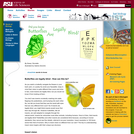
As you watch a butterfly navigate the flowers in your back yard, …
As you watch a butterfly navigate the flowers in your back yard, or a pesky fly avoid your flyswatter, keep in mind their vision is quite different than yours and mine.
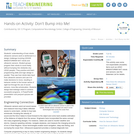
Students' understanding of how robotic ultrasonic sensors work is reinforced in a …
Students' understanding of how robotic ultrasonic sensors work is reinforced in a design challenge involving LEGO MINDSTORMS(TM) NXT robots and ultrasonic sensors. Student groups program their robots to move freely without bumping into obstacles (toy LEGO people). They practice and learn programming skills and logic design in parallel. They see how robots take input from ultrasonic sensors and use it to make decisions to move, resulting in behavior similar to the human sense of sight but through the use of sound sensors, more like echolocation. Students design-test-redesign-retest to achieve successful programs. A PowerPoint® presentation and pre/post quizzes are provided.
No restrictions on your remixing, redistributing, or making derivative works. Give credit to the author, as required.
Your remixing, redistributing, or making derivatives works comes with some restrictions, including how it is shared.
Your redistributing comes with some restrictions. Do not remix or make derivative works.
Most restrictive license type. Prohibits most uses, sharing, and any changes.
Copyrighted materials, available under Fair Use and the TEACH Act for US-based educators, or other custom arrangements. Go to the resource provider to see their individual restrictions.