In this video David quickly reviews the momentum and impulse topics on …
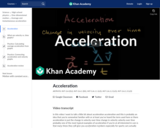
In this video David quickly reviews the momentum and impulse topics on the AP Physics 1 exam and solves an example problem for each concept. Created by David SantoPietro.
A plot of luminosity vs. time is a ‘light curve’. In this …
A plot of luminosity vs. time is a ‘light curve’. In this laboratory, we will use a light curve to determine the diameter of two stars in a binary system. --------------------------------------- Distant Nature: Astronomy Exercises 2016 by Stephen Tuttle under license "Creative Commons Attribution Non-Commercial Share Alike".
Acceleration (a) is the change in velocity (Δv) over the change in …
Acceleration (a) is the change in velocity (Δv) over the change in time (Δt), represented by the equation a = Δv/Δt. This allows you to measure how fast velocity changes in meters per second squared (m/s^2). Acceleration is also a vector quantity, so it includes both magnitude and direction. Created by Sal Khan.
Students work as physicists to understand centripetal acceleration concepts. They also learn …
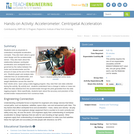
Students work as physicists to understand centripetal acceleration concepts. They also learn about a good robot design and the accelerometer sensor. They also learn about the relationship between centripetal acceleration and centripetal force governed by the radius between the motor and accelerometer and the amount of mass at the end of the robot's arm. Students graph and analyze data collected from an accelerometer, and learn to design robots with proper weight distribution across the robot for their robotic arms. Upon using a data logging program, they view their own data collected during the activity. By activity end , students understand how a change in radius or mass can affect the data obtained from the accelerometer through the plots generated from the data logging program. More specifically, students learn about the accuracy and precision of the accelerometer measurements from numerous trials.
Students prepare for the associated activity in which they investigate acceleration by …
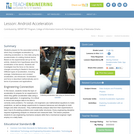
Students prepare for the associated activity in which they investigate acceleration by collecting acceleration vs. time data using the accelerometer of a sliding Android device. Based on the experimental set-up for the activity, students form hypotheses about the acceleration of the device. Students will investigate how the force on the device changes according to Newton's Second Law. Different types of acceleration, including average, instantaneous and constant acceleration, are introduced. Acceleration and force is described mathematically and in terms of processes and applications.
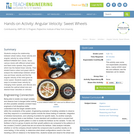
Students analyze the relationship between wheel radius, linear velocity and angular velocity …
Students analyze the relationship between wheel radius, linear velocity and angular velocity by using LEGO(TM) MINDSTORMS(TM) NXT robots. Given various robots with different wheel sizes and fixed motor speeds, they predict which has the fastest linear velocity. Then student teams collect and graph data to analyze the relationships between wheel size and linear velocity and find the angular velocity of the robot given its motor speed. Students explore other ways to increase linear velocity by changing motor speeds, and discuss and evaluate the optimal wheel size and desired linear velocities on vehicles.
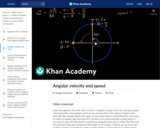
In uniform circular motion, angular velocity (𝒘) is a vector quantity and …
In uniform circular motion, angular velocity (𝒘) is a vector quantity and is equal to the angular displacement (Δ𝚹, a vector quantity) divided by the change in time (Δ𝐭). Speed is equal to the arc length traveled (S) divided by the change in time (Δ𝐭), which is also equal to |𝒘|R. And arc length (S) is equal to the absolute value of the angular displacement (|Δ𝚹|) times the radius (R).
The purpose of this learning video is to show students how to …
The purpose of this learning video is to show students how to think more freely about math and science problems. Sometimes getting an approximate answer in a much shorter period of time is well worth the time saved. This video explores techniques for making quick, back-of-the-envelope approximations that are not only surprisingly accurate, but are also illuminating for building intuition in understanding science. This video touches upon 10th-grade level Algebra I and first-year high school physics, but the concepts covered (velocity, distance, mass, etc) are basic enough that science-oriented younger students would understand. If desired, teachers may bring in pendula of various lengths, weights to hang, and a stopwatch to measure period. Examples of in- class exercises for between the video segments include: asking students to estimate 29 x 31 without a calculator or paper and pencil; and asking students how close they can get to a black hole without getting sucked in.
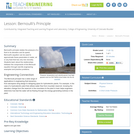
Bernoulli's principle relates the pressure of a fluid to its elevation and …
Bernoulli's principle relates the pressure of a fluid to its elevation and its speed. Bernoulli's equation can be used to approximate these parameters in water, air or any fluid that has very low viscosity. Students learn about the relationships between the components of the Bernoulli equation through real-life engineering examples and practice problems.
Students learn how engineers gather data and model motion using vectors. They …
Students learn how engineers gather data and model motion using vectors. They learn about using motion-tracking tools to observe, record, and analyze vectors associated with the motion of their own bodies. They do this qualitatively and quantitatively by analyzing several examples of their own body motion. As a final presentation, student teams act as engineering consultants and propose the use of (free) ARK Mirror technology to help sports teams evaluate body mechanics. A pre/post quiz is provided.
Students design and build devices to protect and accurately deliver dropped eggs. …
Students design and build devices to protect and accurately deliver dropped eggs. The devices and their contents represent care packages that must be safely delivered to people in a disaster area with no road access. Similar to engineering design teams, students design their devices using a number of requirements and constraints such as limited supplies and time. The activity emphasizes the change from potential energy to kinetic energy of the devices and their contents and the energy transfer that occurs on impact. Students enjoy this competitive challenge as they attain a deeper understanding of mechanical energy concepts.
Students build their own small-scale model roller coasters using pipe insulation and …
Students build their own small-scale model roller coasters using pipe insulation and marbles, and then analyze them using physics principles learned in the associated lesson. They examine conversions between kinetic and potential energy and frictional effects to design roller coasters that are completely driven by gravity. A class competition using different marbles types to represent different passenger loads determines the most innovative and successful roller coasters.
A zip line is a way to glide from one point to another while hanging from a cable. Design and create a zip line that is safe for a hard-boiled egg. After designing a safety egg harness, connect the harness to fishing line or wire connected between two chairs of different heights using a paper clip. Learn to improve your zip line based on data. Attach a motion sensor at the bottom of your zip line and display a graph to show how smooth a ride your egg had!
Students apply their knowledge of linear regression and design to solve a …
Students apply their knowledge of linear regression and design to solve a real-world challenge to create a better packing solution for shipping cell phones. They use different materials, such as cardboard, fabric, plastic, and rubber bands to create new “composite material” packaging containers. Teams each create four prototypes made of the same materials and constructed in the same way, with the only difference being their weights, so each one is fabricated with a different amount of material. They test the three heavier prototype packages by dropping them from different heights to see how well they protect a piece of glass inside (similar in size to iPhone 6). Then students use linear regression to predict from what height they can drop the fourth/final prototype of known mass without the “phone” breaking. Success is not breaking the glass but not underestimating the height by too much either, which means using math to accurately predict the optimum drop height.
No restrictions on your remixing, redistributing, or making derivative works. Give credit to the author, as required.
Your remixing, redistributing, or making derivatives works comes with some restrictions, including how it is shared.
Your redistributing comes with some restrictions. Do not remix or make derivative works.
Most restrictive license type. Prohibits most uses, sharing, and any changes.
Copyrighted materials, available under Fair Use and the TEACH Act for US-based educators, or other custom arrangements. Go to the resource provider to see their individual restrictions.