This course covers the principles of materials science and cell biology underlying …
This course covers the principles of materials science and cell biology underlying the design of medical implants, artificial organs, and matrices for tissue engineering. Methods for biomaterials surface characterization and analysis of protein adsorption on biomaterials. Molecular and cellular interactions with biomaterials are analyzed in terms of unit cell processes, such as matrix synthesis, degradation, and contraction. Mechanisms underlying wound healing and tissue remodeling following implantation in various organs. Tissue and organ regeneration. Design of implants and prostheses based on control of biomaterials-tissue interactions. Comparative analysis of intact, biodegradable, and bioreplaceable implants by reference to case studies. Criteria for restoration of physiological function for tissues and organs.
Students investigate the bone structure of a turkey femur and then create …
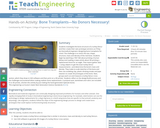
Students investigate the bone structure of a turkey femur and then create their own prototype versions as if they are biomedical engineers designing bone transplants for a bird. The challenge is to mimic the size, shape, structure, mass and density of the real bone. Students begin by watching a TED Talk about printing a human kidney and reading a news article about 3D printing a replacement bone for an eagle. Then teams gather data—using calipers to get the exact turkey femur measurements—and determine the bone’s mass and density. They make to-scale sketches of the bone and then use modeling clay, plastic drinking straws and pipe cleaners to create 3D prototypes of the bone. Next, groups each cut and measure a turkey femur cross-section, which they draw in CAD software and then print on a 3D printer. Students reflect on the design/build process and the challenges encountered when making realistic bone replacements. A pre/post-quiz, worksheet and rubric are included. If no 3D printer, shorten the activity by just making the hand-generated replicate bones.
This course reviews the processing and structure of cellular materials as they …
This course reviews the processing and structure of cellular materials as they are created from polymers, metals, ceramics, glasses, and composites, develops models for the mechanical behavior of cellular solids, and shows how the unique properties of honeycombs and foams are exploited in applications such as lightweight structural panels, energy absorption devices and thermal insulation. The applications of cellular solids in medicine include increased fracture risk due to trabecular bone loss in patients with osteoporosis, the development of metal foam coatings for orthopaedic implants, and designing porous scaffolds for tissue engineering that mimic the extracellular matrix. Modelling of cellular materials applied to natural materials and biomimicking is explored. Students taking the graduate version of the class are required to complete additional assignments.
This resource is a video abstract of a research paper created by …
This resource is a video abstract of a research paper created by Research Square on behalf of its authors. It provides a synopsis that's easy to understand, and can be used to introduce the topics it covers to students, researchers, and the general public. The video's transcript is also provided in full, with a portion provided below for preview:
"Angiogenesis, the formation of new blood vessels, is a popular target of various therapies. Some therapies, like those used in tissue engineering, are designed to promote angiogenesis and new tissue growth, while other therapies, such as those designed to fight cancer, aim to suppress angiogenesis— a lifeline for tumor cells. Unfortunately, these therapies aren’t always effective. Now, a new mathematical model could help researchers understand what molecular levers to pull to effectively modulate angiogenesis. Trained on published experimental data, the model predicted the effects of activating two common targets of angiogenesis-based therapies: vascular endothelial growth factor, or VEGF, and fibroblast growth factor, or FGF. Computational experiments showed that the two factors modify both the ERK signaling pathway, which is linked to cell proliferation, and the Akt signaling pathway, which is associated with cell survival and migration..."
The rest of the transcript, along with a link to the research itself, is available on the resource itself.
This resource is a video abstract of a research paper created by …
This resource is a video abstract of a research paper created by Research Square on behalf of its authors. It provides a synopsis that's easy to understand, and can be used to introduce the topics it covers to students, researchers, and the general public. The video's transcript is also provided in full, with a portion provided below for preview:
"Sound waves. They bring music to our ears, help doctors peer inside our bodies, and even allow us to “see” underwater. Now, scientists are using these versatile packets of vibrating energy for a new application: growing functional, transplantable blood vessels right on the benchtop. These engineered tissues can be used to repair injuries caused by diminished blood flow from blood clots or other blockages. But there’s a lot to consider when fabricating therapeutic blood vessels. There are biological and mechanical attributes that are tricky to get right. The body’s vasculature is complex and multiscale, and a precise geometric arrangement is needed for efficient perfusion. Vessels are also composed of multiple cell types, which need to be well integrated to function. To engineer tissues that meet these requirements, scientists developed a new acoustophoretic cell patterning technique. The method uses sound waves to precisely align cells into user-defined patterns..."
The rest of the transcript, along with a link to the research itself, is available on the resource itself.
The course covers basic concepts of biomedical engineering and their connection with …
The course covers basic concepts of biomedical engineering and their connection with the spectrum of human activity. It serves as an introduction to the fundamental science and engineering on which biomedical engineering is based. Case studies of drugs and medical products illustrate the product development-product testing cycle, patent protection, and FDA approval. It is designed for science and non-science majors.
Students operate mock 3D bioprinters in order to print tissue constructs of …
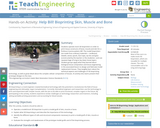
Students operate mock 3D bioprinters in order to print tissue constructs of bone, muscle and skin for a fictitious trauma patient, Bill. The model bioprinters are made from ordinary materials— cardboard, dowels, wood, spools, duct tape, zip ties and glue (constructed by the teacher or the students)—and use squeeze bags of icing to lay down tissue layers. Student groups apply what they learned about biological tissue composition and tissue engineering in the associated lesson to design and fabricate model replacement tissues. They tangibly learn about the technical aspects and challenges of 3D bioprinting technology, as well as great detail about the complex cellular composition of tissues. At activity end, teams present their prototype designs to the class.
Students learn about the current applications and limitations of 3D bioprinting, as …
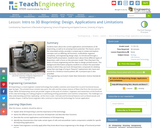
Students learn about the current applications and limitations of 3D bioprinting, as well as its amazing future potential. This lesson, and its fun associated activity, provides a unique way to review and explore concepts such as differing cell functions, multicellular organism complexity, and engineering design steps. As introduced through a PowerPoint® presentation, students learn about three different types of bioprinters, with a focus on the extrusion model. Then they learn the basics of tissue engineering and the steps to design printed tissues. This background information prepares students to conduct the associated activity in which they use mock-3D bioprinters composed of a desktop setup that uses bags of icing to “bioprint” replacement skin, bone and muscle for a fictitious trauma patient, Bill. A pre/post-quiz is also provided.
Students learn the function of the liver and how biomedical engineers can …
Students learn the function of the liver and how biomedical engineers can use liver regeneration to help people. Students test the effects of toxic chemicals on a beef liver by adding hydrogen peroxide to various liver and salt solutions. They observe, record and graph their results.
This course covers the analysis and design at a molecular scale of …
This course covers the analysis and design at a molecular scale of materials used in contact with biological systems, including biotechnology and biomedical engineering. Topics include molecular interactions between bio- and synthetic molecules and surfaces; design, synthesis, and processing approaches for materials that control cell functions; and application of state-of-the-art materials science to problems in tissue engineering, drug delivery, vaccines, and cell-guiding surfaces.
Students are introduced to prosthetics history, purpose and benefits, main components, main …
Students are introduced to prosthetics history, purpose and benefits, main components, main types, materials, control methods, modern examples including modern materials used to make replacement body parts and the engineering design considerations to develop prostheses. They learn how engineers and medical doctors work together to improve the lives of people with amputations and the challenges faced when designing new prostheses with functional and cosmetic criteria and constraints. A PowerPoint(TM) presentation and two worksheets are provided.
The principles and practice of tissue engineering (and regenerative medicine) are taught …
The principles and practice of tissue engineering (and regenerative medicine) are taught by faculty of the Harvard-MIT Division of Health Sciences and Technology (HST) and Tsinghua University, Beijing, China. The principles underlying strategies for employing selected cells, biomaterial scaffolds, soluble regulators or their genes, and mechanical loading and culture conditions, for the regeneration of tissues and organs in vitro and in vivo are addressed. Differentiated cell types and stem cells are compared and contrasted for this application, as are natural and synthetic scaffolds. Methodology for the preparation of cells and scaffolds in practice is described. The rationale for employing selected growth factors is covered and the techniques for incorporating their genes into the scaffolds are examined. Discussion also addresses the influence of environmental factors including mechanical loading and culture conditions (e.g., static versus dynamic). Methods for fabricating tissue-engineered products and devices for implantation are taught. Examples of tissue engineering-based procedures currently employed clinically are analyzed as case studies. Archived webcast lecture videos for the Fall 2008 version of this class can be found at the HST.535 Fall 2008 website.
Students experience the engineering design process as they design and construct lower-leg …
Students experience the engineering design process as they design and construct lower-leg prostheses in response to a hypothetical zombie apocalypse scenario. Like the well-known Apollo 13 story during which engineers were challenged to fix the crippled spacecraft with limited supplies in order to save astronauts' lives, in this activity, students act as engineers during an imaginary disaster in which a group member's leg was amputated in order to survive a zombie attack. Building on what they learned and researched in the associated lesson, they design and fabricate a replacement prosthetic limb using given specific starting material and limited additional supplies, similar to how engineers design for individuals while working within constraints. A more-advanced scenario challenges students to design a prosthesis that is able to provide a more-specific movement function.
No restrictions on your remixing, redistributing, or making derivative works. Give credit to the author, as required.
Your remixing, redistributing, or making derivatives works comes with some restrictions, including how it is shared.
Your redistributing comes with some restrictions. Do not remix or make derivative works.
Most restrictive license type. Prohibits most uses, sharing, and any changes.
Copyrighted materials, available under Fair Use and the TEACH Act for US-based educators, or other custom arrangements. Go to the resource provider to see their individual restrictions.