After completing the various activities in this lesson, students will be able …
After completing the various activities in this lesson, students will be able to understand the importance for a healthy body to be able to do an activity for 1 - 5 minutes.
A plot of luminosity vs. time is a ‘light curve’. In this …
A plot of luminosity vs. time is a ‘light curve’. In this laboratory, we will use a light curve to determine the diameter of two stars in a binary system. --------------------------------------- Distant Nature: Astronomy Exercises 2016 by Stephen Tuttle under license "Creative Commons Attribution Non-Commercial Share Alike".
Acceleration (a) is the change in velocity (Δv) over the change in …
Acceleration (a) is the change in velocity (Δv) over the change in time (Δt), represented by the equation a = Δv/Δt. This allows you to measure how fast velocity changes in meters per second squared (m/s^2). Acceleration is also a vector quantity, so it includes both magnitude and direction. Created by Sal Khan.
This lesson will help children relate the concepts of past, present and …
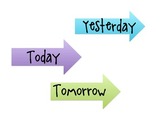
This lesson will help children relate the concepts of past, present and future to their own lives. This lesson will be 45 minutes and include discussions, book reading and coloring. The children will learn the vocabulary words: time, yesterday, today and tomorrow. They will be able to relate this to personal experiences in their own lives. Materials:CalendarWhite board, white board markersHoughton Mifflin Social Studies Teacher Edition Level K My WorldWorksheets for all 15 studentsPencils and crayonsBig Ideas / Essential Questions:What is the difference between last year, this year and next year?Can you describe some of these differences using examples from your own life?
In this activity, students will practice talking about time and movies. They …
In this activity, students will practice talking about time and movies. They will learn how to read the clock in Arabic, recommend a movie based on someone's preferences, and understand schedules.Can-Do Statements:I can understand the time when announced or shown to me.I can identify movies with the times they take place on a schedule.I can recommend a movie for someone according to his/her preference.
In this Activity, students will practice reading daily, weekly, monthly, and yearly …
In this Activity, students will practice reading daily, weekly, monthly, and yearly tasks and schedules. as well as reading time. They will also discuss a task or activity they enjoy completing on time.Can-Do Statements:I can identify the Arabic words for daily, weekly, monthly, and yearly when presented to me.I can describe a character's daily schedule, highlighting the activities and their times.I can discuss a task I enjoy completing on time, along with my preferred timing for doing so.
This site houses a large number of very brief audio files in …
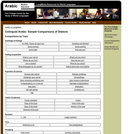
This site houses a large number of very brief audio files in which native speakers say brief, useful, every day phrases in a number of conjugations. Phrases include things like "How much is this?" "How are you?" or simply reciting useful vocabulary and also cover numbers and time. Each phrase is spoken in 8 or 9 dialects from the regions of North Africa, the Levant, and the Persian Gulf. Every phrase is accompanied by a transcript.
No restrictions on your remixing, redistributing, or making derivative works. Give credit to the author, as required.
Your remixing, redistributing, or making derivatives works comes with some restrictions, including how it is shared.
Your redistributing comes with some restrictions. Do not remix or make derivative works.
Most restrictive license type. Prohibits most uses, sharing, and any changes.
Copyrighted materials, available under Fair Use and the TEACH Act for US-based educators, or other custom arrangements. Go to the resource provider to see their individual restrictions.