This course focuses on the archaeology of the Greek and Roman city. …
This course focuses on the archaeology of the Greek and Roman city. It investigates the relationship between urban architecture and the political, social, and economic role of cities in the Greek and Roman world, by analyzing a range of archaeological and literary evidence relevant to the use of space in Greek and Roman cities (e.g. Athens, Paestum, Rome, Pompeii) and a range of theoretical frameworks for the study of ancient urbanism.
This course covers the history of Rome from its humble beginnings to …
This course covers the history of Rome from its humble beginnings to the 5th century A.D. The first half covers Kingship to Republican form; the conquest of Italy; Roman expansion: Pyrrhus, Punic Wars and provinces; classes, courts, and the Roman revolution; Augustus and the formation of empire. The second half covers Virgil to the Vandals; major social, economic, political and religious trends at Rome and in the provinces. There is an emphasis on the use of primary sources in translation.
This 6-week course centers on the origins of human beings and the …
This 6-week course centers on the origins of human beings and the emergence of civilization and includes the study of India, Greece, and Rome as seen thought the development of democratic forms of government.
This art history video discussion looks at Gian Lorenzo Bernini's "Sant'Andrea al …
This art history video discussion looks at Gian Lorenzo Bernini's "Sant'Andrea al Quirinale", 1658-70, Rome; commissioned by Cardinal Camillo Francesco Maria Pamphili for the nearby Jesuit seminary.
In this problem-based learning module, students will use their knowledge of the ancient …
In this problem-based learning module, students will use their knowledge of the ancient Roman Empire and will work to analyze critical theories historians agree contributed to the fall of Rome. Students will then work to compare the problems faced by the Romans with problems citizens of the United States still largely face today. Through this investigation, students should recognize how modern technology, government agencies, laws and resources help to solve societal problems that could have once destroyed an empire. With this new understanding, students should work to present a solution to a major problem that plagued the Roman Empire during the years leading up to its collapse.
In this problem-based learning module, students will use their knowledge of the ancient …
In this problem-based learning module, students will use their knowledge of the ancient Roman Empire and will work to analyze critical theories historians agree contributed to the fall of Rome. Students will then work to compare the problems faced by the Romans with problems citizens of the United States still largely face today. Through this investigation, students should recognize how modern technology, government agencies, laws and resources help to solve societal problems that could have once destroyed an empire. With this new understanding, students should work to present a solution to a major problem that plagued the Roman Empire during the years leading up to its collapse.Remix Resource uses key South Carolina standards for 6th Grade Social Studies and Language ArtsOriginal Resource uses key Ohio standards for 7th Grade Social Studies and Language ArtsAuthor: Blended Learning Teacher Practice Network Date Added: 07/23/2018License: Creative Commons Attribution-NonCommercial 4.0 Language: English Media Format: Audio, Downloadable docs, Graphics/Photos, Text/HTML
Looting, despoiling temples, attempted rape and judicial murder: these are just some …
Looting, despoiling temples, attempted rape and judicial murder: these are just some of the themes of this classic piece of writing by one of the world's greatest orators. This particular passage is from the second book of Cicero's Speeches against Verres, who was a former Roman magistrate on trial for serious misconduct. Cicero presents the lurid details of Verres' alleged crimes in exquisite and sophisticated prose.
This volume provides a portion of the original text of Cicero's speech in Latin, a detailed commentary, study aids, and a translation. As a literary artefact, the speech gives us insight into how the supreme master of Latin eloquence developed what we would now call rhetorical "spin". As an historical document, it provides a window into the dark underbelly of Rome's imperial expansion and exploitation of the Near East.
Ingo Gildenhard's illuminating commentary on this A-Level set text will be of particular interest to students of Latin at both high school and undergraduate level. It will also be a valuable resource to Latin teachers and to anyone interested in Cicero, language and rhetoric, and the legal culture of Ancient Rome.
In republican times, one of Rome's deadliest enemies was King Mithridates of …
In republican times, one of Rome's deadliest enemies was King Mithridates of Pontus. In 66 BCE, after decades of inconclusive struggle, the tribune Manilius proposed a bill that would give supreme command in the war against Mithridates to Pompey the Great, who had just swept the Mediterranean clean of another menace: the pirates. While powerful aristocrats objected to the proposal, which would endow Pompey with unprecedented powers, the bill proved hugely popular among the people, and one of the praetors, Marcus Tullius Cicero, also hastened to lend it his support. In his first ever political speech, variously entitled pro lege Manilia or de imperio Gnaei Pompei, Cicero argues that the war against Mithridates requires the appointment of a perfect general and that the only man to live up to such lofty standards is Pompey. In the section under consideration here, Cicero defines the most important hallmarks of the ideal military commander and tries to demonstrate that Pompey is his living embodiment.
This course book offers a portion of the original Latin text, study aids with vocabulary, and a commentary. Designed to stretch and stimulate readers, the incisive commentary will be of particular interest to students of Latin at both AS and undergraduate level. It extends beyond detailed linguistic analysis and historical background to encourage critical engagement with Cicero's prose and discussion of the most recent scholarly thought.
Trebia. Trasimene. Cannae. With three stunning victories, Hannibal humbled Rome and nearly …
Trebia. Trasimene. Cannae. With three stunning victories, Hannibal humbled Rome and nearly shattered its empire. Even today Hannibal's brilliant, if ultimately unsuccessful, campaign against Rome during the Second Punic War (218-202 BC) make him one of history's most celebrated military leaders. This biography by Cornelius Nepos (c. 100-27 BC) sketches Hannibal's life from the time he began traveling with his father's army as a young boy, through his sixteen-year invasion of Italy and his tumultuous political career in Carthage, to his perilous exile and eventual suicide in the East. As Rome completed its bloody transition from dysfunctional republic to stable monarchy, Nepos labored to complete an innovative and influential collection of concise biographies. Putting aside the detailed, chronological accounts of military campaigns and political machinations that characterized most writing about history, Nepos surveyed Roman and Greek history for distinguished men who excelled in a range of prestigious occupations. In the exploits and achievements of these illustrious men, Nepos hoped that his readers would find models for the honorable conduct of their own lives. Although most of Nepos' works have been lost, we are fortunate to have his biography of Hannibal. Nepos offers a surprisingly balanced portrayal of a man that most Roman authors vilified as the most monstrous foe that Rome had ever faced.
Students work with specified materials to create aqueduct components that can transport …
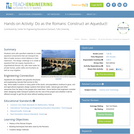
Students work with specified materials to create aqueduct components that can transport two liters of water across a short distance in their classroom. The design challenge is to create an aqueduct that can supply Aqueductis, a (hypothetical) Roman city, with clean water for private homes, public baths and fountains as well as crop irrigation.
This course surveys the social, cultural, and political development of western Europe …
This course surveys the social, cultural, and political development of western Europe between 500 and 1350. A number of topics are incorporated into the broad chronological sweep of the course, including: the Germanic conquest of the ancient Mediterranean world; the rise of a distinct northern culture and the Carolingian Renaissance; the emergence of feudalism and the breakdown of political order; contact with the Byzantine and Islamic East and the Crusading movement; the quality of religious life; the vitality of the high medieval economy and culture; and the catastrophes of the fourteenth century.
This course is an investigation of the Roman empire of Augustus, the …
This course is an investigation of the Roman empire of Augustus, the Frankish empire of Charlemagne, and the English empire in the age of the Hundred Years War. Students examine different types of evidence, read across a variety of disciplines, and develop skills to identify continuities and changes in ancient and medieval societies. Each term this course is different, looking at different materials from a variety of domains to explore ancient and mideveal studies. This version is a capture of the course as it was taught in 2012, and does not reflect how it is taught currently.
This art history video discussion looks at Giacomo Barozzi da Vignola & …
This art history video discussion looks at Giacomo Barozzi da Vignola & Giacomo della Porta's "Church of Il Gesù", consecrated 1584, Rome; and Giovanni Battista Gaulli's (also known as il Baciccio) "The Triumph of the Name of Jesus", Il Gesù ceiling fresco, 1672-1685.
This course is a global-oriented survey of the history of architecture, from …
This course is a global-oriented survey of the history of architecture, from the prehistoric to the sixteenth century. It treats buildings and environments, including cities, in the context of the cultural and civilizational history. It offers an introduction to design principles and analysis. Being global, it aims to give the student perspective on the larger pushes and pulls that influence architecture and its meanings, whether these be economic, political, religious or climatic.
This course explores how our views of Jewish history have been formed …
This course explores how our views of Jewish history have been formed and how this history can explain the survival of the Jews as an ethnic/religious group into the present day. Special attention is given to the partial and fragmentary nature of our information about the past, and the difficulties inherent in decoding statements about the past that were written with a religious agenda in mind. It also considers complex events in Jewish history -- from early history as portrayed in the Bible to recent history, including the Holocaust.
This course explores the political, social, and economic factors commonly offered to …
This course explores the political, social, and economic factors commonly offered to explain the fall of the Roman Republic: growth of the territorial empire, increased intensity of aristocratic competition, transformation of the Italian economy, growth of the city of Rome and dependence of the urban plebs, changes in military recruitment and dependence of soldiers on their generals. There is an emphasis on the reading of ancient sources in translation, including Cicero, Sallust, Caesar, Augustus, Appian, Plutarch, and Suetonius.
Measure and Map Our Galaxy: The Milky Way Project needs your help …
Measure and Map Our Galaxy: The Milky Way Project needs your help looking through tens of thousands of images from the Spitzer Space Telescope. By telling us what you see in this infrared data, we can better understand how stars form. The scale of this project necessitates group participation. We need the help of the public to classify the thousands of images we have on file. If all 900,000 Zooniverse members classified a few images, this project would be done in no time!
This sourcebook offers a carefully-honed selection of Latin authors, predominately from classical …
This sourcebook offers a carefully-honed selection of Latin authors, predominately from classical antiquity, and supplemented by texts from later periods. The sourcebook purposefully includes both prose and poetry, and a range of genres, including epic, epigram, history, oratory, the letter, and the philosophical essay. Most of the core texts include supplemental notes that will elucidate key grammatical and cultural information for intermediate-level Latin students, as well as provide questions to guide their reading and contextualizing essays on the authors, texts, and ideas with which students are engaging. The book will also include a range of pedagogical resources for students at this level that have been developed and tested through over 15 years of educational practice.
Secondary educators across Lebanon County, Pennsylvania developed lesson plans to integrate the …
Secondary educators across Lebanon County, Pennsylvania developed lesson plans to integrate the Pennsylvania Career Education and Work Standards with the content they teach. This work was made possible through a partnership between the South Central PA Workforce Investment Board (SCPa Works) and Lancaster-Lebanon Intermediate Unit 13 (IU13) and was funded by a Teacher in the Workplace Grant Award from the Pennsylvania Department of Labor and Industry. This lesson plan was developed by one of the talented educators who participated in this project during the 2018-2019 school year.
This is an interactive resource that describes the objects and artists of …
This is an interactive resource that describes the objects and artists of Rome. It includes a historical timeline, an interactive map, lists of artists, patrons, and a short bibliography. The only drawback is that the biographies of the artists are linked to Boston College library and not available to others. The list itself is useful for students as it includes names not usually part of lower level art history courses. This would be a resource that could be made available to students as part of a larger course on Early Renaissance art and culture.
No restrictions on your remixing, redistributing, or making derivative works. Give credit to the author, as required.
Your remixing, redistributing, or making derivatives works comes with some restrictions, including how it is shared.
Your redistributing comes with some restrictions. Do not remix or make derivative works.
Most restrictive license type. Prohibits most uses, sharing, and any changes.
Copyrighted materials, available under Fair Use and the TEACH Act for US-based educators, or other custom arrangements. Go to the resource provider to see their individual restrictions.