This worksheet prompts students to consider their digital identity in terms of academic …
This worksheet prompts students to consider their digital identity in terms of academic development and to prepare for a portfolio project. Created by Steven Harris-Scott, Ph.D., and Amy Lewis, Ed.D., for INTO George Mason University with support from Mason 4-VA. Attribution-NonCommercial 4.0 International (CC BY-NC 4.0)
The purpose of activity reflections is to encourage graduate students to become …
The purpose of activity reflections is to encourage graduate students to become involved in academic and professional communities. By engaging in their field of study outside of the classroom environment, they are able to: introduce themselves in different situations, build academic and professional relationships, connect issues that they learn in the classroom to current discourse, and use reflection techniques to refine their academic and professional goals. Created by Steven Harris-Scott, Ph.D., and Amy Lewis, Ed.D., for INTO George Mason University with support from Mason 4-VA.
In this demonstration, amaze learners by performing simple tricks using mirrors. These …
In this demonstration, amaze learners by performing simple tricks using mirrors. These tricks take advantage of how a mirror can reflect your right side so it appears to be your left side. To make the effect more dramatic, cover the mirror with a cloth, climb onto the table, straddle the mirror, and then drop the cloth as you appear to "take off." This resource contains information about how this trick was applied during the making of the movie "Star Wars."
The Authenticity and Agency rubrics are based on elements from two frameworks: …
The Authenticity and Agency rubrics are based on elements from two frameworks: Student as Producer and Social Pedagogies. The rubrics were created for instructors and instructional designers to use as they develop authentic learning experiences in the course design process.
Lighting is responsible for nearly one-third of the electricity use in buildings. …
Lighting is responsible for nearly one-third of the electricity use in buildings. One of the best ways to conserve energy is to make sure the lights are turned off when no one is in a room. This process can be automated using motion sensors. In this activity, students explore material properties as they relate to motion detection, and use that knowledge to make design judgments about what types of motion detectors to use in specific applications.
Explore bending of light between two media with different indices of refraction. …
Explore bending of light between two media with different indices of refraction. See how changing from air to water to glass changes the bending angle. Play with prisms of different shapes and make rainbows.
Better Arguments can help students learn to engage productively across differences and …
Better Arguments can help students learn to engage productively across differences and grapple with differing viewpoints. Linked are resources that are applicable to school-based learning activities and after school programs. These include a curriculum, exit ticket exercise and current events exercise.
Students, particularly international graduate students, often do not know all the details …
Students, particularly international graduate students, often do not know all the details of the field they have chosen to study and the resources available therein. In addition, they when they begin graduate school, they must adjust to the nature of the Western model where knowledge is created and shared within the field of study in a critical-thinking based model. The best way for them to truly enter the conversation of knowledge is to jump in and experience the information as fully as they can. Journals, associations and trade publications all provide a wealth of information - much of it free to students - for them to explore and think through how they want to make a contribution.
This article lists common misconceptions about light, heat, and the sun. It …
This article lists common misconceptions about light, heat, and the sun. It provides formative assessment probes and information about teaching for conceptual change.
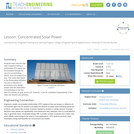
Students learn how the total solar irradiance hitting a photovoltaic (PV) panel …
Students learn how the total solar irradiance hitting a photovoltaic (PV) panel can be increased through the use of a concentrating device, such as a reflector or lens. This is the final lesson in the Photovoltaic Efficiency unit and is intended to accompany a fun design project (see the associated Concentrating on the Sun with PVs activity) to wrap up the unit. However, it can be completed independently of the other unit lessons and activities.
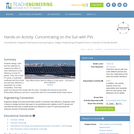
Students design, build and test reflectors to measure the effect of solar …
Students design, build and test reflectors to measure the effect of solar reflectance on the efficiency of solar PV panels. They use a small PV panel, a multimeter, cardboard and foil to build and test their reflectors in preparation for a class competition. Then they graph and discuss their results with the class. Complete this activity as part of the Photovoltaic Efficiency unit and in conjunction with the Concentrated Solar Power lesson.
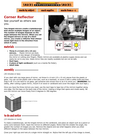
In this optics/mathematics activity, learners use two hinged mirrors to create a …
In this optics/mathematics activity, learners use two hinged mirrors to create a kaleidoscope that shows multiple images of an object. Learners discover that the number of images reflected in the mirrors depends on the angle between the mirrors. Learners also observe that when they set the hinged mirrors on top of a third mirror, they create a reflector that always sends light back in the direction from which it came. Use this activity to introduce basic principles of light and optics including angle of reflection and angle of incidence.
Problem solving is often guided by disciplinary frames of reference, which can …
Problem solving is often guided by disciplinary frames of reference, which can restrict our ability to see other possibilities. This exercise uses object-based learning to underscore the idea that there is more than one way of analyzing and knowing the world, and that through multiple ways of knowing, we develop more complex understandings and new solutions. Through the process of critique, an essential part of visual-arts pedagogy, students practice analyzing and reflecting both individually and in groups.
This is a printable version of the activity in the user guide. …
This is a printable version of the activity in the user guide. It gives examples of how each domain in the learning trajectories contributes to the holistic outcomes of the EYLF V2.0.
It invites you to collect examples within the context of your service. You may then revisit and reflect on the examples, individually and with colleagues, to deepen your knowledge and understanding of the learning trajectories and EYLF V2.0 Learning Outcomes.
No restrictions on your remixing, redistributing, or making derivative works. Give credit to the author, as required.
Your remixing, redistributing, or making derivatives works comes with some restrictions, including how it is shared.
Your redistributing comes with some restrictions. Do not remix or make derivative works.
Most restrictive license type. Prohibits most uses, sharing, and any changes.
Copyrighted materials, available under Fair Use and the TEACH Act for US-based educators, or other custom arrangements. Go to the resource provider to see their individual restrictions.