Advanced Igneous Petrology covers the history of and recent developments in the study of igneous rocks. Students review the chemistry and structure of igneous rock-forming minerals and proceed to study how these minerals occur and interact in igneous rocks. The course focuses on igneous processes and how we have learned about them through studying a number of significant sites worldwide.
This site contains 15 time-lapse QuickTime movies that show the experimental deformation behavior of octachloropropane. This compound shows similar microstructures to those found in quartzite, and thus is a nice analog for the deformation of rocks. The movies illustrate cataclastic deformation, grain boundary opening, formation of subgrains, subgrain boundary formation and grain boundary migration, ribbon formation, grain growth at zero strain rate, and grain boundary migration during high temperature deformation.
This 11-slide PowerPoint presentation presents a short succession of schematic diagrams illustrating the structural evolution of anorthosites. The slides discuss the relative abundance of rare earth elements, describe six types of anorthosite occurrence, and contain pictures showing anorthositic texture. This resource is part of the Teaching Petrology collection. http://serc.carleton.edu/NAGTWorkshops/petrology03/index.html
This site is a lecture about crystal structure from Dr. Stephen Nelson at Tulane University. Topics include axial ratios, intercepts of crystal faces (Weiss Parameters), determination of the Miller Index of a crystal, the modified notation of hexagonal systems, which is referred to as Miller-Bravais Indices, and using the Miller Index notation to designate crystal forms. Tables and illustrations accompany the text.
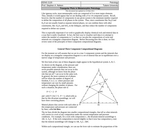
This PowerPoint presentation is part of the Whitman College petrology course. The presentation covers isobaric ternary T-X diagrams (An-Di-Fo), liquidus, intensive variables, cotectic, peritectic, and cooling paths. Solid solution and 4 component diagrams are described as well as the effect of water on melting temperatures. This resource is part of the Teaching Petrology collection. http://serc.carleton.edu/NAGTWorkshops/petrology03/index.html
This PowerPoint presentation is part of the Whitman College petrology course. The presentation covers classification of phaneritic igneous rocks, gabbroic rocks, ultramafic rocks, pyroclastic rocks and volcanic rocks using triangular diagrams, and classification of igneous rocks based on total alkalis vs. silica. This resource is part of the Teaching Petrology collection. http://serc.carleton.edu/NAGTWorkshops/petrology03/index.html
This 24-slide PowerPoint presentation describes the classification of metamorphic rocks using texture and composition. Foliation, lineation, cleavage, schistosity, gneissose structure, hornfels, and granofels are discussed. Specific metamorphic rock types and modifying terms (porphyroblastic, spotted, augen, para-, ortho-) are defined and photographs of some are provided. This resource is part of the Teaching Petrology collection. http://serc.carleton.edu/NAGTWorkshops/petrology03/index.html
This set of lecture notes about contact metamorphism contains information on contact aureoles, isograds, thermal conductivity, and latent heat of crystallization. Albite-epidote hornfels, hornblende hornfels, pyroxene hornfels, and sanidinite facies are presented. Skarns are also discussed. A number of ternary diagrams and illustrations are included. This resource is part of the Teaching Petrology collection. http://serc.carleton.edu/NAGTWorkshops/petrology03/index.html
This 32 slide PowerPoint presentation presents a list of alkaline rocks followed by an in depth look at continental alkaline magmatism of the East African Rift system. A chemical, geographic, and structural look at carbonatites follows. The presentation progresses through discussions of lamproites, lamprophyres, and kimberlites. This resource is part of the Teaching Petrology collection. http://serc.carleton.edu/NAGTWorkshops/petrology03/index.html
This 27-slide PowerPoint presentation contains a number of schematic diagrams showing continental arc settings. Chemical comparisons of various continental arc magmas are discussed using isotopic variation and the occurrence of rare earth elements. The presentation also covers isotopes, rare earth element characteristics, and the geographic occurrence of plutonic arcs. This resource is part of the Teaching Petrology collection. http://serc.carleton.edu/NAGTWorkshops/petrology03/index.html
This PowerPoint presentation is part of the Whitman College petrology course. This 17-slide presentation addresses the major flood basalts. The Columbia River flood basalts are discussed in detail. Other flood basalts that are covered include the Keeweenawan, Deccan, Parana and Karroo. This resource is part of the Teaching Petrology collection. http://serc.carleton.edu/NAGTWorkshops/petrology03/index.html
This site is a lecture by Dr. Stephen Nelson from Tulane University that explores the use of the Miller Index notation to designate crystal forms. Topics include crystal forms, general and special forms, and open and closed forms. Also discussed is the relationship between form and crystal faces, along with zones and zone symbols, the vectorial properties of crystals, and crystal habit. Tables and illustrations accompany the text.
This site is a lecture by Dr. Stephen Nelson from Tulane University that discusses crystallographic calculations. Topics include a review of Miller indices, axial ratios, angles corresponding to a Miller Index, and angles between crystallographic axes in monoclinic or triclinic systems. Step by step examples of the calculations are provided, including associated illustrations and diagrams.
This site is a lecture by Dr. Stephen Nelson from Tulane University that explores the 32 possible combinations of symmetry operations that define the external symmetry of crystals. The lecture defines the six crystal systems (triclinic, monoclinic, orthorhombic, tetragonal, hexagonal, and isometric) and explains the derivation of the Hermann-Mauguin symbols (also called the international symbols) used to describe the crystal classes from the symmetry content. Tables and illustrations accompany the text.
This is a collection of 18 geology exercises that are designed for teachers with little or no geology background. Each exercise includes relevant background information, complete instructions, student handouts and answer keys. Topics include rock and mineral identification, Bowen's reaction series, crystal models, topographic maps, earthquakes, groundwater, oil exploration, plate tectonics and more.
This lesson provides an introduction to the use of natural gas as an energy source. Topics include its advantages (cleanliness, fewer carbon emissions), disadvantages (difficulty in transport and storage), sources, and usage.
This website contains an abundance of data on the geochemistry of igneous rocks. The site provides very brief descriptions of many types of terrestrial and lunar igneous rocks, their regional distribution and classification, and examples of their geochemical trends and fingerprints. Graphs that plot the geochemical composition of both terrestrial and extraterrestrial igneous rocks are also featured. This site could be useful for upper level geology students doing independent research, as well as for geology faculty to create classroom exercises using the data sets. This resource is part of the Using Data collection. http://serc.carleton.edu/usingdata/
This site features rock and mineral photographs that can be used for teaching or research. There are pictures of minerals, fossils, and sedimentary, metamorphic, and igneous rocks. There are also images of thin sections of igneous and metamorphic rocks. Sets of images are presented as collections for geology courses. The site also provides information on igneous and metamorphic petrology topics such as metacarbonates, contact metamorphism, regional metamorphism, and blueschists, granulites, and eclogites. There is also a mineral web quiz. This resource is part of the Teaching Petrology collection. http://serc.carleton.edu/NAGTWorkshops/petrology03/index.html
This 16-slide PowerPoint presentation discusses the characteristics of granitoid rocks including geographic occurrence, rare earth elements, enclave characteristics, pressure-temperature conditions, the influence of water, and tectonic setting. This resource is part of the Teaching Petrology collection. http://serc.carleton.edu/NAGTWorkshops/petrology03/index.html
This PowerPoint presentation is part of the Whitman College petrology course. The presentation provides an introduction to the structure of the earth in the context of the generation of igneous rocks. Slides in the presentation cover the composition of layers of the earth, P-wave and S-wave velocities through layers of the earth, pressure and heat characteristics of the earth, and regions of igneous generation within the earth. This resource is part of the Teaching Petrology collection. http://serc.carleton.edu/NAGTWorkshops/petrology03/index.html
No restrictions on your remixing, redistributing, or making derivative works.
Give credit to the author, as required.
Your remixing, redistributing, or making derivatives works comes with some
restrictions, including how it is shared.
Your redistributing comes with some restrictions. Do not remix or make
derivative works.
Copyrighted materials, available under Fair Use and the TEACH Act for US-based
educators, or other custom arrangements. Go to the resource provider to see
their individual restrictions.