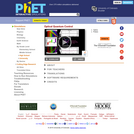
Discover what controls how fast tiny molecular motors in our body pull …
Discover what controls how fast tiny molecular motors in our body pull through a single strand of DNA. How hard can the motor pull in a tug of war with the optical tweezers? Discover what helps it pull harder. Do all molecular motors behave the same?
Discover what controls how fast tiny molecular motors in our body pull …
Discover what controls how fast tiny molecular motors in our body pull through a single strand of DNA. How hard can the motor pull in a tug of war with the optical tweezers? Discover what helps it pull harder. Do all molecular motors behave the same?
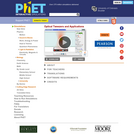
Explore an active area of research in optical physics: producing designer pulse …
Explore an active area of research in optical physics: producing designer pulse shapes to achieve specific purposes, such as breaking apart a molecule. Carefully create the perfect shaped pulse to break apart a molecule by individually manipulating the colors of light that make up a pulse.
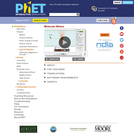
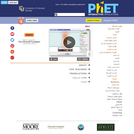
Did you ever imagine that you can use light to move a …
Did you ever imagine that you can use light to move a microscopic plastic bead? Explore the forces on the bead or slow time to see the interaction with the laser's electric field. Use the optical tweezers to manipulate a single strand of DNA and explore the physics of tiny molecular motors. Can you get the DNA completely straight or stop the molecular motor?
Did you ever imagine that you can use light to move a …
Did you ever imagine that you can use light to move a microscopic plastic bead? Explore the forces on the bead or slow time to see the interaction with the laser's electric field. Use the optical tweezers to manipulate a single strand of DNA and explore the physics of tiny molecular motors. Can you get the DNA completely straight or stop the molecular motor?
This course provides an introduction to optical science with elementary engineering applications. …
This course provides an introduction to optical science with elementary engineering applications. Topics covered in geometrical optics include: ray-tracing, aberrations, lens design, apertures and stops, radiometry and photometry. Topics covered in wave optics include: basic electrodynamics, polarization, interference, wave-guiding, Fresnel and Fraunhofer diffraction, image formation, resolution, space-bandwidth product. Analytical and numerical tools used in optical design are emphasized. Graduate students are required to complete assignments with stronger analytical content, and an advanced design project.
In this activity, students will calculate the index of refraction of water …
In this activity, students will calculate the index of refraction of water by measuring the angles of incidence and refraction of light as it passes from air to water. They will follow directions to set up the experiment with cheaply available materials, make several measurements, then answer follow-up questions regarding the mathematical relationship between angles of incidence and refraction, experimental error and uncertainty.
In this lesson, students learn that light travels in a straight line …
In this lesson, students learn that light travels in a straight line from a light source and that ray diagrams help us understand how an image will be created by a lens. In the accompanying activity, students explore the concepts behind the workings of a pinhole camera.
In this activity, learners explore their eye pupils and how they change. …
In this activity, learners explore their eye pupils and how they change. Learners use a magnifying glass, mirror, and flashlight to observe how their pupil changes size in response to changes in lighting. Learners also experiment to determine how light shining in one eye affects the size of the pupil in their other eye. This resource guide includes background information about pupils and why they change as well as information related to emotional stimuli, involuntary reflexes, and photography.
No restrictions on your remixing, redistributing, or making derivative works. Give credit to the author, as required.
Your remixing, redistributing, or making derivatives works comes with some restrictions, including how it is shared.
Your redistributing comes with some restrictions. Do not remix or make derivative works.
Most restrictive license type. Prohibits most uses, sharing, and any changes.
Copyrighted materials, available under Fair Use and the TEACH Act for US-based educators, or other custom arrangements. Go to the resource provider to see their individual restrictions.