Anatomy and Physiology is a dynamic textbook for the two-semester human anatomy and …
Anatomy and Physiology is a dynamic textbook for the two-semester human anatomy and physiology course for life science and allied health majors. The book is organized by body system and covers standard scope and sequence requirements. Its lucid text, strategically constructed art, career features, and links to external learning tools address the critical teaching and learning challenges in the course. The web-based version of Anatomy and Physiology also features links to surgical videos, histology, and interactive diagrams.
This 16-minute video lesson looks at how one neuron can stimulate (or …
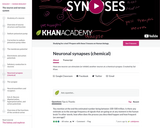
This 16-minute video lesson looks at how one neuron can stimulate (or inhibit) another neuron at a chemical synapse. [Biology playlist: Lesson 46 of 71].
This 15-minute video lesson looks at the role of the sarcoplasmic reticulum …
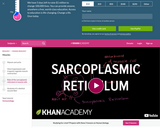
This 15-minute video lesson looks at the role of the sarcoplasmic reticulum in controlling calcium ion concentrations within the muscle cell. [Biology playlist: Lesson 49 of 71].
Survey of principles underlying the structure and function of the nervous system, …
Survey of principles underlying the structure and function of the nervous system, integrating molecular, cellular, and systems approaches. Topics: development of the nervous system and its connections, cell biology or neurons, neurotransmitters and synaptic transmission, sensory systems of the brain, the neuro-endocrine system, the motor system, higher cortical functions, behavioral and cellular analyses of learning and memory. First half of an intensive two-term survey of brain and behavioral studies for first-year graduate students.
This course serves as an introduction to the structure and function of …
This course serves as an introduction to the structure and function of the nervous system. Emphasis is placed on the cellular properties of neurons and other excitable cells. Topics covered include the structure and biophysical properties of excitable cells, synaptic transmission, neurochemistry, neurodevelopment, and the integration of information in simple systems and the visual system.
This course is designed to provide an understanding of how the human …
This course is designed to provide an understanding of how the human brain works in health and disease, and is intended for both the Brain and Cognitive Sciences major and the non-Brain and Cognitive Sciences major. Knowledge of how the human brain works is important for all citizens, and the lessons to be learned have enormous implications for public policy makers and educators. The course will cover the regional anatomy of the brain and provide an introduction to the cellular function of neurons, synapses and neurotransmitters. Commonly used drugs that alter brain function can be understood through a knowledge of neurotransmitters. Along similar lines, common diseases that illustrate normal brain function will be discussed. Experimental animal studies that reveal how the brain works will be reviewed. Throughout the seminar we will discuss clinical cases from Dr. Byrne's experience that illustrate brain function; in addition, articles from the scientific literature will be discussed in each class.
This resource is a video abstract of a research paper created by …
This resource is a video abstract of a research paper created by Research Square on behalf of its authors. It provides a synopsis that's easy to understand, and can be used to introduce the topics it covers to students, researchers, and the general public. The video's transcript is also provided in full, with a portion provided below for preview:
"Small extracellular vesicles (sEVs) mediate intercellular communication by carrying RNA, proteins, and lipids between cells. These cargo molecules mirror the physiological state of their donor cells, but they are selectively loaded into sEVs. sEVs can cross the blood-brain barrier, and their contents may be influenced by neurological disorders, making them potential biomarkers. Identifying cell-specific signatures could be an important first step in the biomarker discovery process. Recently researchers examined sEVs isolated from cultures of primary mouse cortical neurons and astrocytes. They identified distinct total RNA and miRNA profiles between the two cell types. While astrocytes had a greater number of detected miRNAs than neurons, neurons expressed more sEV-associated miRNAs than astrocytes. They also identified short miRNA sequence motifs that were differentially loaded to or excluded from sEVs..."
The rest of the transcript, along with a link to the research itself, is available on the resource itself.
Designed for students without previous experience in techniques of cellular and molecular …
Designed for students without previous experience in techniques of cellular and molecular biology, this class teaches basic experimental techniques in cellular and molecular neurobiology. Experimental approaches covered include tissue culture of neuronal cell lines, dissection and culture of brain cells, DNA manipulation, synaptic protein analysis, immunocytochemistry, and fluorescent microscopy.
We make thousands of decisions every day: where to go, what to …
We make thousands of decisions every day: where to go, what to do, when to do it. Join UCSD's William Kristan and discover how neurons, synapses, and chemical input play out in decision making. (57 minutes)
The Nervous System Student Edition book is one of ten volumes making …
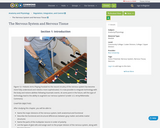
The Nervous System Student Edition book is one of ten volumes making up the Human Biology curriculum, an interdisciplinary and inquiry-based approach to the study of life science.
Early Childhood Development (ECD) spans from the moment of conception until the …
Early Childhood Development (ECD) spans from the moment of conception until the beginning of primary school, and includes physical well-being, and cognitive, linguistic, and socio-emotional development. Investing in ECD leads to happier children, more equal societies, and prevents higher costs further down the road.
This course introduces quantitative approaches to understanding brain and cognitive functions. Topics …
This course introduces quantitative approaches to understanding brain and cognitive functions. Topics include mathematical description of neurons, the response of neurons to sensory stimuli, simple neuronal networks, statistical inference and decision making. It also covers foundational quantitative tools of data analysis in neuroscience: correlation, convolution, spectral analysis, principal components analysis, and mathematical concepts including simple differential equations and linear algebra.
The course will span modern neuroscience from molecular neurobiology to perception and …
The course will span modern neuroscience from molecular neurobiology to perception and cognition, including the following major topics: anatomy and development of the brain; cell biology of neurons and glia; ion channels and electrical signaling; synaptic transmission, integration, and chemical systems of the brain; sensory systems, from transduction to perception; motor systems; and higher brain functions dealing with memory, language, and affective disorders.
This video segment, adapted from NOVA scienceNOW, introduces the latest research on …
This video segment, adapted from NOVA scienceNOW, introduces the latest research on a system of neurons that plays a part in how people relate to each other.
This learning strategy provides discussion and visualizations of the neuron and its …
This learning strategy provides discussion and visualizations of the neuron and its function, as well as components and functions of different parts of the nervous system, including the human brain.
We look at anatomical classification and functional classification. -Classification of neurons -Anatomical …
We look at anatomical classification and functional classification. -Classification of neurons -Anatomical classification of neurons -unipolar neurons -bipolar neurons -multipolar neurons -Functional classification of neurons -sensory neurons -motor neurons -interneurons
Lesson 3 in our Nervous System series. This is part of our Anatomy and Physiology lecture series.
If this video helps you please be sure to LST -like subscribe and tell your friends. Your support help us make more videos. For the complete series please visit http://mrfordsclass.net/
Videos in the skeletal system series: - Introduction (10:01): http://youtu.be/HX1bsdHLC58 - Neurons (10:02): http://youtu.be/-AcQI5MQhLU - Classification of Neurons (10:03): http://youtu.be/PoqzDE_OLsQ - Neuroglia Cells (10:04): http://youtu.be/stqdNMc6-Jk - Before We Start (10:08): http://youtu.be/E8K_W8c_c-M - Divisions of the Nervous System (10:09): http://youtu.be/kEJkYkF6nMc - Components of the Central Nervous System (10:10): http://youtu.be/IwofyN198YU - The Cerebrum (10:11): http://youtu.be/VLt3jigsMAU - Lobes of the Cerebrum (10:12): http://youtu.be/Zc__B_sOA-Q - Functional Areas of the Brain (10:13): http://youtu.be/sjbZ9QGyBi8
We take a look at the nerve cells, the components of a …
We take a look at the nerve cells, the components of a neuron: dendrites, cell bodies, and axons.
The concepts covered in this video include: •Neurons •Parts of the neuron •Axonal transport
Lesson 2 in our Nervous System series. This is part of our Anatomy and Physiology lecture series.
If this video helps you please be sure to LST -like subscribe and tell your friends. Your support help us make more videos. For the complete series please visit http://mrfordsclass.net/
Videos in the skeletal system series: - Introduction (10:01): http://youtu.be/HX1bsdHLC58 - Neurons (10:02): http://youtu.be/-AcQI5MQhLU - Classification of Neurons (10:03): http://youtu.be/PoqzDE_OLsQ - Neuroglia Cells (10:04): http://youtu.be/stqdNMc6-Jk - Before We Start (10:08): http://youtu.be/E8K_W8c_c-M - Divisions of the Nervous System (10:09): http://youtu.be/kEJkYkF6nMc - Components of the Central Nervous System (10:10): http://youtu.be/IwofyN198YU - The Cerebrum (10:11): http://youtu.be/VLt3jigsMAU - Lobes of the Cerebrum (10:12): http://youtu.be/Zc__B_sOA-Q - Functional Areas of the Brain (10:13): http://youtu.be/sjbZ9QGyBi8
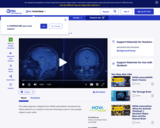
Stimulate a neuron and monitor what happens. Pause, rewind, and move forward …
Stimulate a neuron and monitor what happens. Pause, rewind, and move forward in time in order to observe the ions as they move across the neuron membrane.
No restrictions on your remixing, redistributing, or making derivative works. Give credit to the author, as required.
Your remixing, redistributing, or making derivatives works comes with some restrictions, including how it is shared.
Your redistributing comes with some restrictions. Do not remix or make derivative works.
Most restrictive license type. Prohibits most uses, sharing, and any changes.
Copyrighted materials, available under Fair Use and the TEACH Act for US-based educators, or other custom arrangements. Go to the resource provider to see their individual restrictions.